A special legislative session looms in Iowa, where House Republican leaders are calling for lawmakers to convene in Des Moines to overturn Gov. Kim Reynolds’s veto of a bill adopted in May that would restrict the use of eminent domain in pipeline siting.
Grassley, grandson of eight-term U.S. Sen. Chuck Grassley (R-Iowa), faces at least one obstacle in garnering the two-thirds supermajority needed for a special session: Iowa Senate Republicans.
“I expect that the majority of our caucus would not be interested in any attempt to override her veto,” state Senate Majority Leader Sen. Jack Whitver said in a widely published statement supporting the governor’s veto.
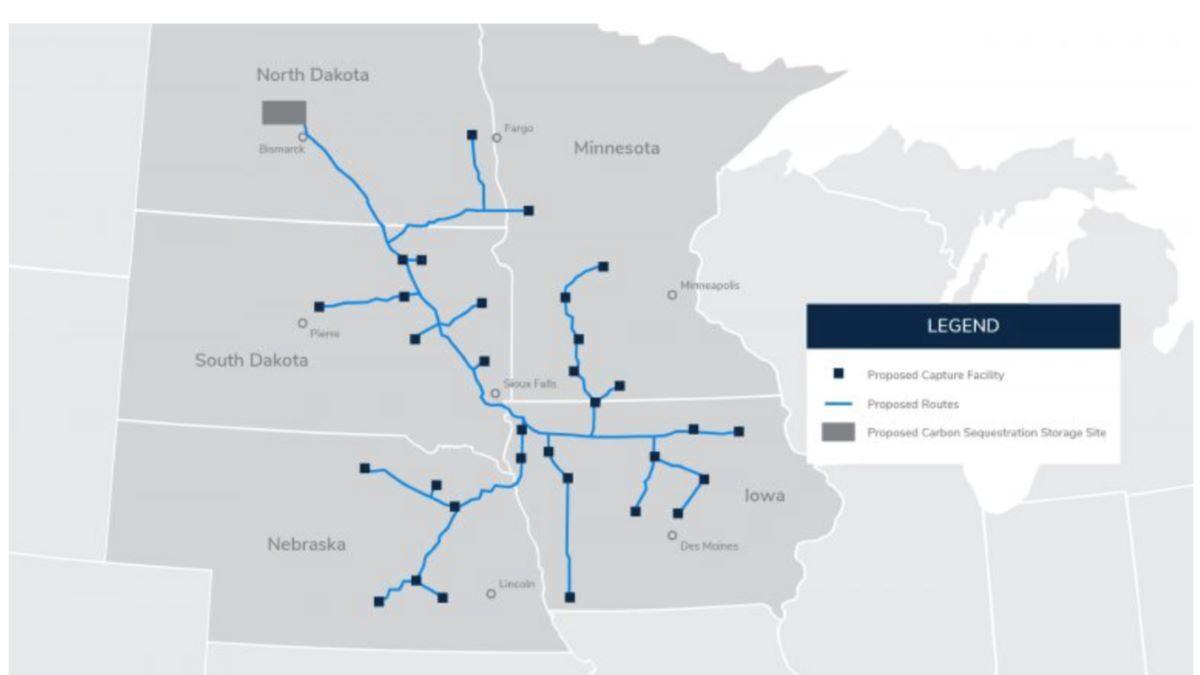
HF 639 was adopted after exhaustive debate spanning legislative sessions since 2021, when Summit Carbon Solutions proposed building its $9 billion, 2,500-mile carbon dioxide Midwest Carbon Express Pipeline to funnel carbon emissions from 57 ethanol plants across Iowa, Minnesota, Nebraska, South Dakota, and North Dakota.
The CO2 would be “sequestered,” or stored, underground in North Dakota’s Oliver and Mercer counties, not far from Dakota Gasification Company’s 25-year-old, 205-mile Souris Valley Pipeline, which funnels the “captured” CO2 into Saskatchewan, Canada.
Summit planned to break ground in 2023 and be operational by 2026. But the project—touted as the world’s largest CO2 pipeline—has been beset by lawsuits and restrictions imposed by states and counties.
Neither state granted the company a right to use eminent domain in securing easements from reluctant landowners.
Summit is also embroiled in lawsuits in Nebraska, which does not have statewide pipeline permitting, meaning that it must secure conditional use permits from each of the nine counties along its 320-mile route. One county has denied its application, and several others have postponed votes.
Strange Bedfellows
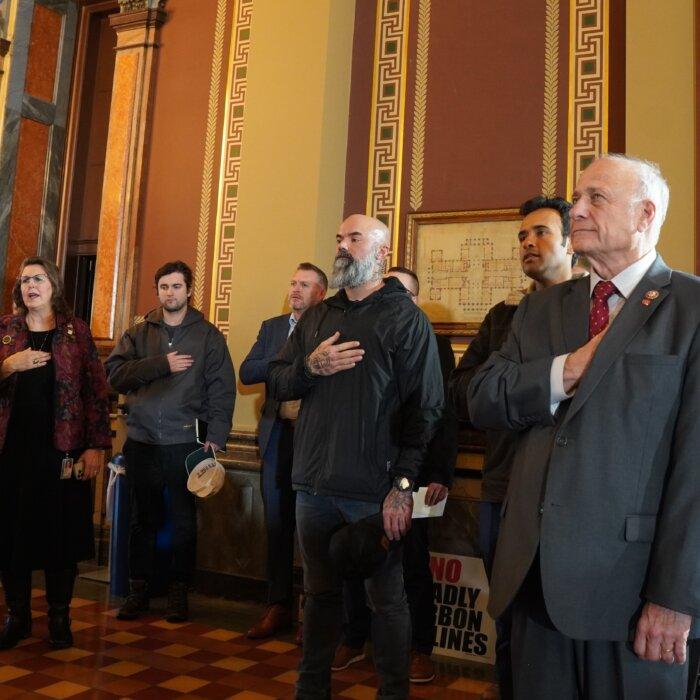
The proposed pipeline has roiled Iowa politics and evolved into an alliance of strange bedfellows.Climate and environmental groups, such as the Sierra Club, Bold Iowa, and Food & Water Watch, have found common ground in opposition to the pipeline with landowners who have formed an ad hoc “Iowa Easement Team.” Their position is supported by more than 40 Republican lawmakers, eight of 29 county commissions on the pipeline route, the Iowa Farmers Union, and conservative groups such as the Freesoil Foundation, which has former Rep. Steve King (R-Iowa) as a prominent spokesman.
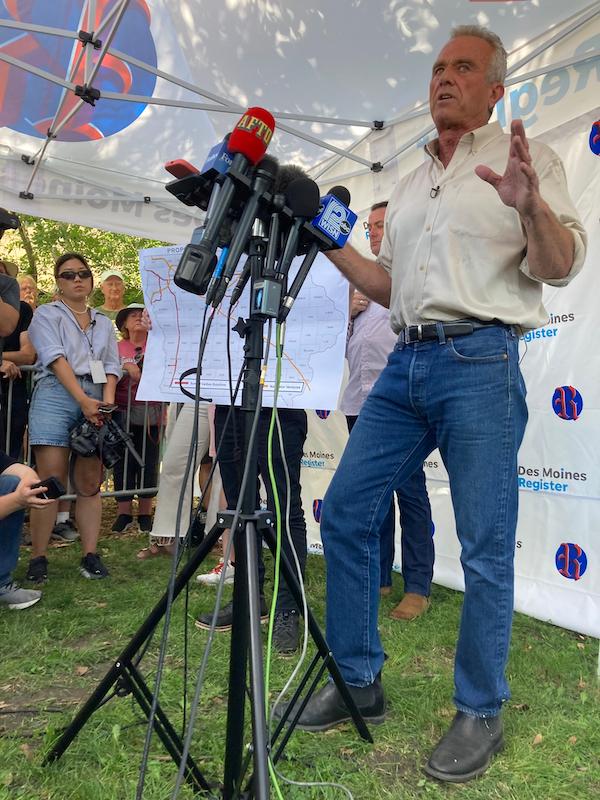
During the January 2024 Iowa presidential caucus, GOP candidate Vivek Ramaswamy, escorted by King, touted opposition to the pipeline, and now-Health Secretary Robert F. Kennedy Jr. based his entire election pitch on his opposition to the pipeline when he spoke at the 2023 Iowa State Fair as an independent presidential candidate.
Alongside the governor, Summit’s pipeline is supported by the Iowa Renewable Fuels Association, Iowa Corn Growers Association, ethanol refiners, manufacturers such as John Deere, a dozen county commissions, and an array of ad hoc organizations of landowners and businesses.
Several bills—including a 2023 measure to allow eminent domain only if 90 percent of landowners along the route sign voluntary easements—were adopted in the House, but none advanced in the Senate until this year.
HF 639, which includes parts of six bills, passed the House as an omnibus in an 85–10 vote on March 26, but was stagnated in the Senate until the session’s last week, when 12 GOP senators pledged to withdraw votes on budget cuts unless it was heard.
HF 639 was adopted on May 13—two days before adjournment—in a 27–22 tally, with 13 Republicans joining all 14 Democrats in moving the measure to Reynolds’s desk.
To Be Continued
One reason why the bill stalled in the Senate was that a provision in President Donald Trump’s proposed 2026 budget would have allowed the Federal Energy Regulatory Commission to issue licenses for pipelines, preempting local and state regulators.However, the federal pipeline preemption provision was removed two days before the House adopted the budget on May 22 and sent it to the Senate.
HF 639 defines what constitutes “public good” in the use of eminent domain; requires hazardous liquid pipeline companies carry a greater amount of insurance and restore damaged farmland; prohibits renewal of a CO2 pipeline project after 25 years; places constraints on pipeline companies filing lawsuits against landowners; and requires that Iowa Utilities commissioners attend hearings on pipeline projects.
In her veto, Reynolds said the bill lacked “clear, careful lines” in defining the insurance and reparations guidelines, and feared that it could lead to Iowa losing “leadership” as the nation’s top biofuel production state.
In calling for a special session to override Reynolds’s veto, Grassley said the governor’s rejection “is a setback not only for landowners who have been fighting across Iowa, but for the work the House of Representatives has put in for four years to get legislation such as HF 639 passed.
“We will not stop fighting and stand firm on our commitment until landowners in Iowa are protected against Eminent Domain for private gain,” he vowed.
But they may need to wait until Iowa’s 2026 session. Whitver, state Sen. Mike Bousselot, and Iowa Senate President Amy Sinclair are among chamber leaders who say it’s unlikely that the 21 Republican senators who voted against HF 639 in May will support returning for a special session to vote against it again.
In supporting Reynolds’s veto, Monte Shaw, executive director of the Iowa Renewable Fuels Association, said carbon capture projects are “an entry to ultra-low carbon fuel industry” that Iowa must develop or face “very real, very severe economic consequences.”