This copy is for your personal, non-commercial use only. Distribution and use of this material are governed by our Subscriber Agreement and by copyright law. For non-personal use or to order multiple copies, please contact The Epoch Times Reprints.

The Epoch Times
The Epoch Times
AD
Executive Branch

What to Know About Trump’s Plan to Prevent States From Regulating AI

Although the president hasn’t yet offered many concrete details on the upcoming executive order, the plan has key similarities to one that failed in Congress.

FacebookXTruthGettrLinkedInTelegramEmail
Add to My List
Save
What to Know About Trump’s Plan to Prevent States From Regulating AI
The Chat GPT app icon on a smartphone screen in Chicago on Aug. 4, 2025. AP Photo/Kiichiro Sato, File
Jacob Burg
Jacob Burg
12/10/2025|Updated: 12/10/2025
0:00

President Donald Trump will sign an executive order this week that aims to preempt states from establishing their own regulations on artificial intelligence (AI) companies in favor of a single federal “rulebook” on the rapidly growing technology, even as major figures in his own party have called for leaving that power to the states.

Trump said last month that allowing states to enact their own regulations on AI would undermine growth in the booming industry.

“We MUST have one Federal Standard instead of a patchwork of 50 State Regulatory Regimes. We can do this in a way that protects children AND prevents censorship!” the president wrote on social media at the time.

Both the tech industry and the Trump administration have argued that allowing a patchwork of legislation across all 50 states will hamper innovation and allow communist China to outpace the United States.

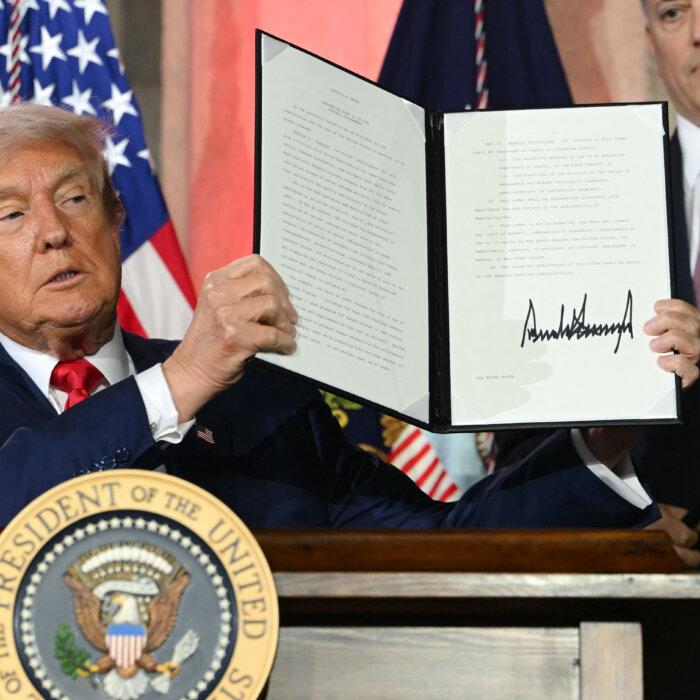
On Dec. 8, Trump said he would sign an executive order to create “One Rulebook” at the federal level for AI regulations, claiming that the technology will be “destroyed in its infancy” if states are allowed to create their own laws.
The executive order would be the Trump administration’s largest move thus far toward exerting federal control on AI governing authority after months of advocacy by companies and investors such as OpenAI, Meta, and venture capital firm Andreessen Horowitz against allowing states to clamp down on the industry in the United States at this stage in its development.
Related Stories
The Epoch Times
House Democrats Form AI Commission on Innovation, AI Guardrails
The Epoch Times
Trump Plans Executive Order to Curb State Power Over AI Regulation
Here’s everything you need to know about the president’s plan to curb state power over the meteoric rise of the AI sector.

Similar Plan Stripped From OBBB, NDAA

Trump’s original version of his signature spending bill the One Big Beautiful Bill Act (OBBB) from earlier this year called for a 10-year moratorium on any statewide regulations on AI.

The Senate ended up voting nearly unanimously, 99–1, to strip that provision from the final version of the president’s spending bill.

Then, when AI regulation advocates pointed out that House Republicans had put the provision into an early draft version of the now-released National Defense Authorization Act (NDAA), many top Republicans criticized the move, including Sen. Josh Hawley (R-Mo.), who voted to remove it from the OBBB.
Florida Gov. Ron DeSantis, a Republican ally of the president, called it “an insult to voters” to sneak the provision into the defense bill.
The official version of the defense bill lacks the 10-year moratorium on state AI regulation, House Majority Leader Steve Scalise (R-La.) said last week.

Draft Order Leaked?

Multiple media outlets, including CNBC, The Financial Times, and The Information, reported on Nov. 20 that Trump was considering signing an executive order that would withhold federal funding from any states that decided to create their own laws regarding AI. The reports cited a leaked draft of the executive order, which appeared on CNBC shortly after Trump’s social media post calling for a “Federal Standard” on AI.

At the time, a White House official told The Epoch Times that until an official announcement came from the White House, any talk regarding potential executive orders was speculation.

The draft order cited by other outlets accuses President Joe Biden of trying to “paralyze” the AI industry and states that instead, the Trump administration would “remove barriers to American AI leadership” by allowing tech companies to “be free to innovate without cumbersome regulation.”

The document lists several Democrat-led states, such as California and Colorado, as case examples of why state AI regulation is a threat to the industry.

Meanwhile, state-level AI regulations have largely gained bipartisan support since Trump took office in January, as a growing number of Republican-led states such as Alabama, Arkansas, and Florida have joined their blue counterparts in drafting legislation regarding the technology.

Arkansas created a law that clarifies who owns AI-generated content, including the person who provides the data or input used to train a generative AI model or an employer in situations in which content is generated for employment duties. The regulation holds that generated content cannot infringe on existing intellectual property rights or copyright.

North Dakota enacted a law that prohibits people from using an AI-powered robot to stalk and harass others, expanding on its current harassment and stalking laws.

Few Details on Official Order

Not much is known about what the president is planning to put in his official executive order on creating a single federal standard for AI regulation.
When he announced the order on Dec. 8, which he plans to release sometime this week, Trump suggested that forcing tech companies to “get 50 approvals every time they want to do something” is too burdensome to the industry’s development, describing it as an international race between nations.
“There must be only One Rulebook if we are going to continue to lead in AI,” Trump said. “We are beating ALL COUNTRIES at this point in the race, but that won’t last long if we are going to have 50 States, many of them bad actors, involved in RULES and the APPROVAL PROCESS.”

Republican Resistance

DeSantis, whose state has introduced a wide array of AI-targeted legislation so far this year, said the president’s executive order “doesn’t/can’t” preempt states from enacting legislation but that Congress could do so “theoretically.”
“The problem is that Congress hasn’t proposed any coherent regulatory scheme but instead just wanted to block states from doing anything for 10 years, which would be an AI amnesty,” the Republican governor wrote on social media on Dec. 8.

“I doubt Congress has the votes to pass this because it is so unpopular with the public.”

Meanwhile, Hawley recently introduced a bill—among other pieces of legislation intended to clamp down on AI—that would allow parents to sue tech companies in cases in which children have been targeted online. The bill was unanimously passed out of committee soon after the senator introduced it.

“Meta is TARGETING minors with sexual content. AI chatbots are advising children on how to commit suicide. Big Tech harms kids because a child’s pain lines their pockets,” Hawley wrote on social media on Dec. 9. “We need to protect our kids from Big Tech NOW.”

After Scalise confirmed that the House was no longer going to pursue a 10-year ban on state-level AI regulation in the defense bill, Hawley applauded the move.

“Good. This is a terrible provision and should remain OUT,” he said.

Other Opposition

When asked in June about the plan in Congress to prevent states from regulating AI companies for 10 years, 55 percent of Americans said they were against the provision, according to a YouGov survey conducted for the Institute of Family Studies.

Although that sentiment varied somewhat by party affiliation—44 percent of 2024 Trump voters opposed the provision, compared with 65 percent of people who voted for Vice President Kamala Harris—more voters for both candidates said they were against the plan than said they supported it.

The now-tossed plan had many similarities to the president’s, although congressional limits on state AI regulations would have more authority than those from an executive order.

Digital advocacy groups have also opposed the federal government’s plans to curb states’ power on AI.

The nonprofit Electronic Frontier Foundation, which defends “civil liberties in the digital world,” called Trump’s plan to prevent states from regulating AI “deeply misguided.”

“While state AI laws have not been perfect, they are genuine attempts to address harms that people across the country face from certain uses of AI systems right now,” the group wrote in a statement.

Tom Ozimek contributed to this report.
Jacob Burg
Jacob Burg
Author
Jacob Burg reports on national politics, aerospace, and aviation for The Epoch Times. He previously covered sports, regional politics, and breaking news for the Sarasota Herald Tribune.
Author’s Selected Articles
OpenAI Releases New Flagship Model to Limited Users Following Government Concerns
Jun 26, 2026
OpenAI Releases New Flagship Model to Limited Users Following Government Concerns
AI-Powered Cyberattacks on Advanced Systems May Be Months Away, Intel Agencies Warn
Jun 22, 2026
AI-Powered Cyberattacks on Advanced Systems May Be Months Away, Intel Agencies Warn
Trump Unveils New Air Force One Plane
Jun 19, 2026
Trump Unveils New Air Force One Plane
Trump Says He No Longer Views Anthropic as National Security Threat
Jun 19, 2026
Trump Says He No Longer Views Anthropic as National Security Threat
AD
Add to My List
Save
The Epoch Times
Copyright © 2000 - 2026 The Epoch Times Association Inc. All Rights Reserved.