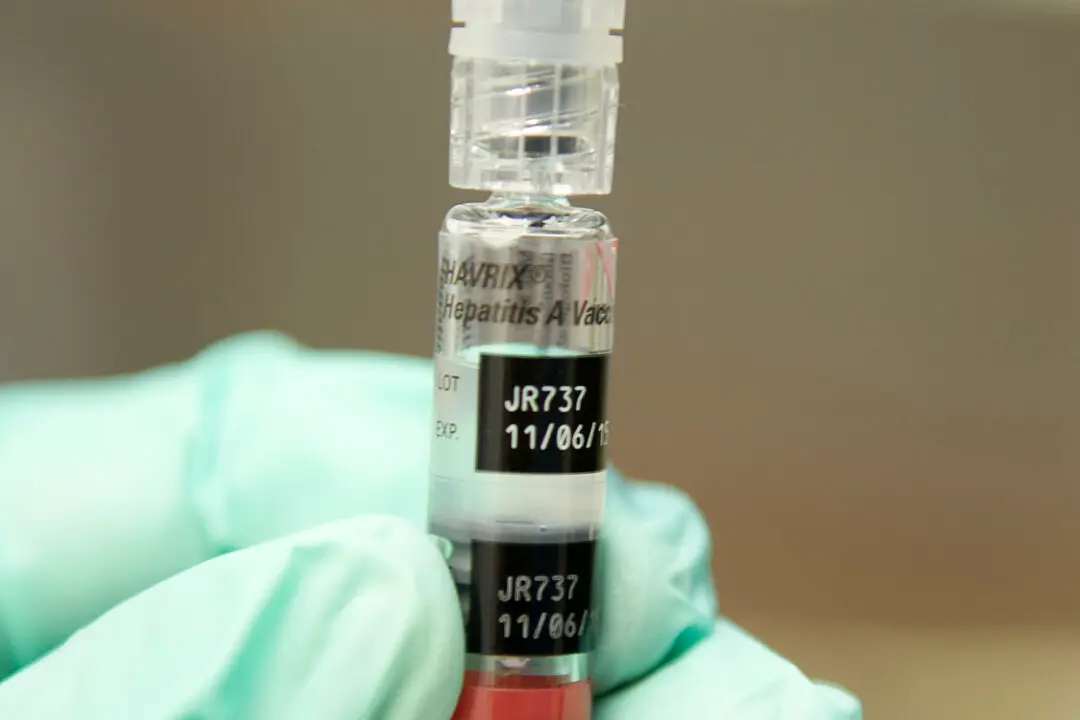
Vaccination coverage among kindergartners remains about the same as before, according to new estimates released by the Centers for Disease Control and Prevention on Aug. 17.
The percentage of kindergartners who have received a vaccine against hepatitis B stayed at 94 percent, according to data collected by states and the District of Columbia in late 2025 and early 2026 and passed on to the CDC before being reported on Aug. 17.
Coverage of three other vaccines declined slightly, by 0.1 percentage points. Some 92.4 percent of kindergartners had received a measles, mumps, rubella shot; 92 percent had received a vaccine against diphtheria and tetanus; and 92.4 percent had received a vaccine against polio.
For vaccination against chickenpox, or varicella, the percentage of kids who had a history of two doses was about the same, at 92.2 percent. The percentage who had received one dose declined by 0.6 percentage points, to 93.4 percent.
At the same time, exemptions from vaccines, which can be obtained on a medical or religious basis depending on state law, increased to 4.2 percent from 3.6 percent. That amounted to 155,000 kindergartners with an exemption from one or more vaccines.


The new data show that vaccination rates among kindergartners “remained high,” the CDC said in an Aug. 17 statement.
“CDC continues to encourage parents to discuss vaccination options with their doctors,” the public health agency said.
The CDC releases the kindergarten vaccine estimates annually. The agency’s database has coverage estimates dating back to late 2011. Hepatitis B vaccination coverage peaked at 96.4 percent in 2011 and 2012. Measles vaccination peaked at 95.2 percent in 2019 and 2020. Diphtheria and tetanus vaccination was the highest in 2016, 2017, and 2018, at 95.2 percent. Polio vaccination was 95.3 percent in 2011 and 2012, a high not seen since.
The highest coverage for one-dose chickenpox vaccination was in 2018 and 2019 (94.3 percent) and the highest coverage for two-dose chickenpox vaccination was in 2016 and 2017 (97.5 percent).
Rates for vaccines against, among other diseases, influenza and pneumococcal disease are not included in the estimates.
The CDC issues a recommended vaccine schedule, which has traditionally been adopted with little or no change by states. The CDC began changing some vaccine recommendations in 2025 under President Donald Trump and Health Secretary Robert F. Kennedy Jr., prompting some states to diverge from its schedule.
Some outside groups, such as the American Academy of Pediatrics, which receives money from vaccine companies, criticized the changes, saying that they would result in lower vaccination coverage and higher rates of disease.
The academy did not respond to The Epoch Times’ request for comment by publication time.
“The latest figures continue a broader decline that took hold under the Biden administration during the COVID-19 pandemic, as mandates, shifting guidance, and the administration’s mishandling of pandemic-era vaccination policy eroded public trust in health institutions,” a spokesperson for the Department of Health and Human Services, the CDC’s parent agency, told The Epoch Times in an email.
“[The department] continues to encourage parents to make informed decisions about protecting their children from infectious, vaccine-preventable diseases.”