U.S. retail sales were unexpectedly flat in October, as consumers appeared reluctant to open their wallets ahead of the holiday season.
The market consensus pointed to a reading of 0.1 percent.
A 1.6 percent decline in receipts at motor vehicle and parts dealers was a significant factor in the lackluster reading. Transactions at building material and garden equipment dealers and gasoline stations also fell by 0.9 percent and 0.8 percent, respectively.
Conversely, there were higher sales at furniture and home furnishings vendors (2.3 percent); sporting goods, musical instruments, and bookstores (1.9 percent); and digital retailers (1.8 percent).
The year-over-year increase in retail sales eased to 3.5 percent, from a downwardly adjusted 4.2 percent.

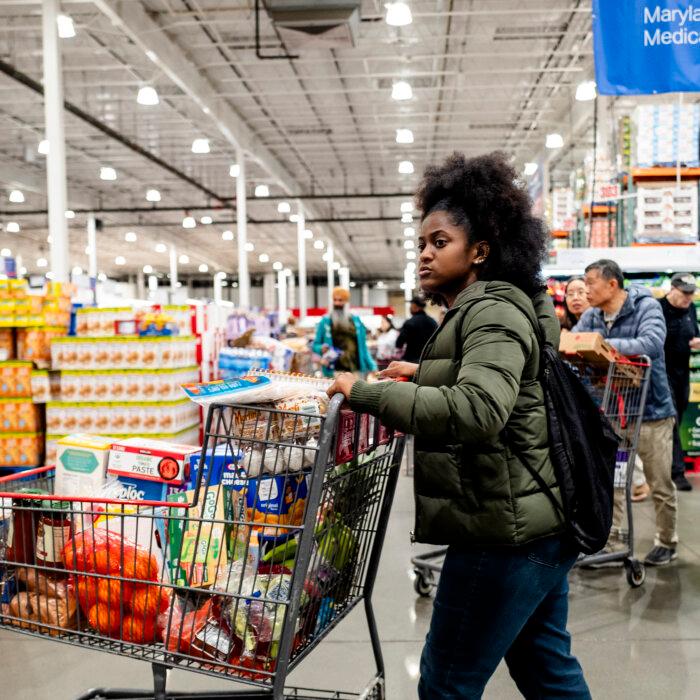
“October was supposed to be the big holiday shopping kickoff, with sales like Prime Big Deal Days and Target Circle Week,” Ted Rossman, senior industry analyst at Bankrate, said in a statement to The Epoch Times.
“This adds up to a consumer that was spending very thoughtfully—reluctantly, even—as we entered the holiday season. Retail sales seem to be losing momentum at a crucial time of year.”
However, the retail sales control group—excluding building materials stores, car dealers, food services, and gasoline stations—increased at a higher-than-expected pace of 0.8 percent, from the 0.1 percent drop in September.
This portion of the monthly retail sales is used in gross domestic product calculations.
The Bureau of Economic Analysis will release the delayed first estimate of third-quarter GDP on Dec. 23.
Still, the lower-than-expected reading, which is not adjusted for inflation, signals that shoppers are being a bit more cautious as they continue to grapple with years-long affordability challenges.
While both readings will bolster internal debates about the economy’s overall strength, the Federal Reserve should keep lowering interest rates to offset downside risks to employment, says Chris Zaccarelli, chief investment officer at Northlight Asset Management.
“The labor market is weakening as evidenced by the higher unemployment rate ... but the retail sales were generally better than expected,” Zaccarelli said in a note emailed to The Epoch Times.
“With the reluctance with which the Fed cut last week (as evidenced by the dot plot and forward-looking projections), it remains to be seen how attentive they are to the labor market versus the fact that inflation has remained stubbornly above their 2% target.”
The next major report will be the November consumer price index report.
K-Shaped Spending
Over the past few months, market watchers have warned about a K-shape forming in the U.S. marketplace, particularly among consumers.A K-shaped economy is one in which different groups recover or grow at starkly different speeds, producing a divergence that resembles the upward and downward arms of the letter K.
In November, higher-income households increased their spending by 2.6 percent from a year earlier, while lower-income groups rose 0.6 percent.
“Spending trends by income continue to show a K-shaped pattern,” the bank economists said in the Dec. 10 report.
“Labor market trends likely remained a key driver, even as wage growth has stabilized a bit. After-tax wage and salary growth among lower-income households continued to lag behind higher-income households.”
Investors have benefited immensely from the U.S. stock market climbing to record highs, while homeowners have also enjoyed surging home prices nationwide.
“If you listen to the earnings reports for consumer-facing companies that tend to deal with low- and moderate-income people, they'll all say that we’re seeing people tightening their belts, changing products that they buy, buying less,” Powell said at the post-meeting Dec. 10 press conference.
“And so it’s clearly a thing.”
Whether this is sustainable is unknown, the central bank chief added.