The U.S. budget deficit narrowed in May from the prior year, but tariff revenues declined that month as federal refunds began being issued.
Washington registered a $293 billion shortfall last month, down more than 7 percent from a year ago, according to new data the Treasury Department released on June 10.
Economists had forecast a $275 billion deficit.
Federal outlays fell almost 9 percent year over year, totaling about $628 billion.
Social Security was the top budgetary item last month, totaling $140 billion. This was followed by net interest payments ($107 billion), Medicare ($87 billion), healthcare ($82 billion), and defense ($73 billion).
Tax receipts also slipped 10 percent year-over-year to $335 billion.

Social insurance and retirement contributions ($157 billion) and individual income taxes ($152 billion) were the chief revenue generators.
Customs duties dropped by $42 billion last month—a rounding error compared to the overall $7 trillion budget—but are still up $189 billion fiscal year to date.
This marked the first full month since the launch of the U.S. Customs and Border Protection’s refund portal, allowing companies and individuals to begin submitting tariff refund applications.
This was in response to the Supreme Court’s ruling that President Donald Trump’s sweeping global tariffs, imposed under the International Economic Emergency Powers Act, were illegal.
Moving forward, the tariff revenue outlook could be uncertain in the coming months as the current administration attempts to limit payouts.
As of June 8, the federal government has collected $1.948 billion in tariffs.
$2 Trillion Deficit
In the first eight months of fiscal year 2026, the federal budget deficit was $1.25 trillion, a 9 percent decrease from the previous period.
The 12-month rolling deficit, according to the Committee for a Responsible Federal Budget, is $1.7 trillion.
“Another month’s budget results means yet another reminder of just how routine our unsustainable borrowing has become,” Maya MacGuineas, president of the independent policy organization, said in a June 10 statement.
“Month after month these numbers are published, and each time it should force us to recognize our unsustainable fiscal trajectory.”
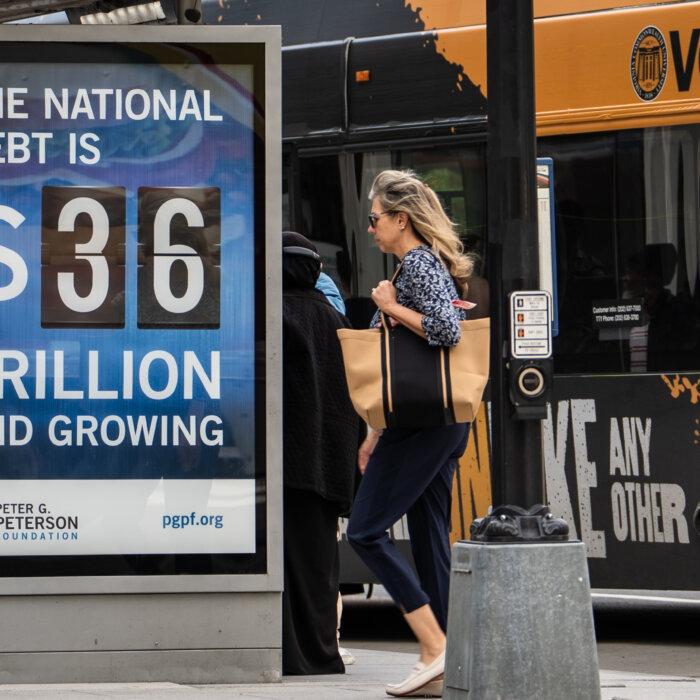
Overall, the United States is on track to post a $2 trillion budget deficit this fiscal year, exacerbating the national debt. Additionally, the national debt will likely top $40 trillion before the year’s end.
Interest charges and spending on Social Security and Medicare are key drivers of the deteriorating fiscal situation in the nation’s capital.
Gross interest payments—interest paid to the public and interest paid on intragovernmental holdings—are projected to top $1.3 trillion this fiscal year.
Mandatory spending already accounts for approximately two-thirds of the budget, with Social Security and Medicare accounting for a sizable share of the annual outlays.
In its long-term budget outlook earlier this year, the Congressional Budget Office estimated that increases in spending on Social Security, Medicare, and interest will push outlays to $11.4 trillion, or more than 24 percent of gross domestic product (GDP), in 2036.
Much of the predicted acceleration in mandatory spending will be fueled “by an aging population and rapid growth in federal healthcare costs,” the nonpartisan budget watchdog said.
“The number of participants in Social Security and Medicare is projected to continue growing faster than the overall population. At the same time, federal health care costs per beneficiary are projected to continue growing faster than GDP per capita,” the report stated.
The Social Security Board of Trustees released its annual report on the financial health of the Social Security Trust Fund this week.
The combined reserves of the Old‑Age and Survivors Insurance (OASI) and Disability Insurance (DI) Trust Funds are projected to cover all scheduled benefits and administrative costs through 2034.
The OASI Trust Fund is expected to be depleted in the fourth quarter of 2032. At that point, incoming payroll taxes will be sufficient to pay about 78 percent of scheduled benefits.
“Under the Trump Administration, we are committed to protecting and strengthening Social Security,” Frank J. Bisignano, Commissioner of Social Security, said in a statement.
“This year, we have made historic improvements in providing best-in-class service for the more than 330 million Americans we serve. We are eliminating waste, fraud, abuse, and ensuring program integrity.”