This copy is for your personal, non-commercial use only. Distribution and use of this material are governed by our Subscriber Agreement and by copyright law. For non-personal use or to order multiple copies, please contact The Epoch Times Reprints.

The Epoch Times
The Epoch Times
AD
The Epoch Times
Constitutional Rights

2 More Governors Block Credit Card Companies From Tracking Gun Sales

Indiana and Utah join seven other states in passing laws banning the use of codes to track firearms and ammunition sales.
Google LogoMark Us Preferred on Google
2 More Governors Block Credit Card Companies From Tracking Gun Sales
The National Armory gun store in Pompano Beach, Fla., on Dec. 23, 2015. Joe Raedle/Getty Images
Patricia Tolson
Patricia Tolson
Reporter
3/22/2024|Updated: 3/23/2024
0:00

Two more governors have approved bills that prohibit credit card companies from tracking gun sales in their respective states, with a firearm industry trade association spokesman suggesting this proves ongoing efforts to restrict Second Amendment rights are “not going to be tolerated any longer.”

On March 13, Indiana Republican Gov. Eric Holcomb approved HB 1084 (pdf) and Utah Republican Gov. Spencer Cox approved HB 406. Both measures prohibit the use of a merchant category code (MCC) to track the purchase of firearms and ammunition.

Indiana and Utah join seven other states in passing laws banning the use of MCCs to track firearms and ammunition sales in their respective jurisdictions.

MCCs are four-digit numbers established by the Switzerland-based International Organization of Standardization (IOS) that identify a type of business and the kind of goods or services it provides. The codes are assigned to businesses by credit card companies and can affect the fees a card user is charged for credit card purchases.

The firearms and ammunition-specific MCC (5723) was created by the IOS on Sept. 9, 2022, in response to a petition from New York-based Amalgamated Bank, which says it supports “hundreds of progressive political organizations, campaigns, and candidates.”

Amalgamated Bank President and CEO Priscilla Sims Brown said, “We all have to do our part to stop gun violence, and it sometimes starts with illegal purchases of guns and ammunition.”

Related Stories
The Epoch Times
National Women’s Range Day Celebrates Second Amendment Rights as Women’s Rights
The Epoch Times
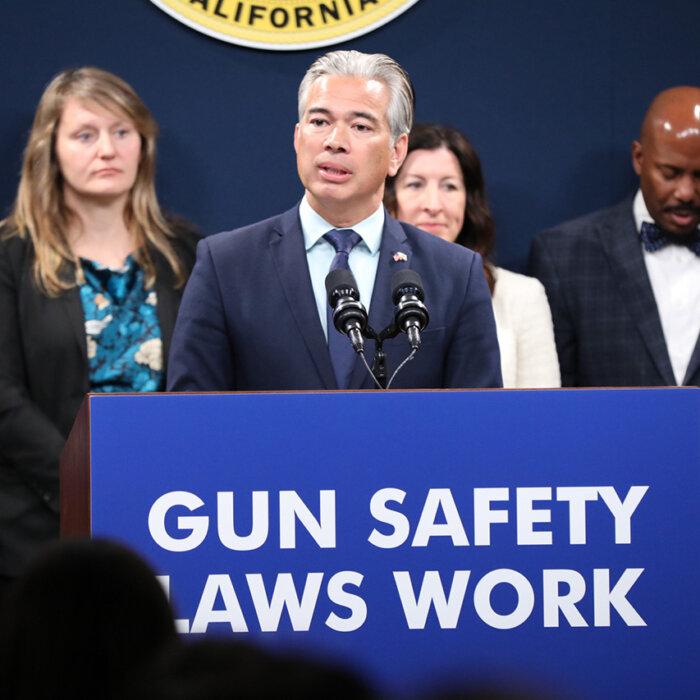
Attorney General Bonta Takes Aim at Gun Rights
“The new code will allow us to fully comply with our duty to report suspicious activity and illegal gun sales to authorities without blocking or impeding legal gun sales,” she said.

Concern Over Tracking

However, the announcement was immediately met with a flurry of bills in West Virginia, Idaho, Mississippi, North Dakota, Florida, Montana, and Texas, drafted specifically to block the new MCC effort in their respective jurisdictions.
Mark Oliva is the managing director for public affairs with the National Shooting Sports Foundation (NSSF). With more states feeling the need to protect their citizens from efforts to track their weapons and ammunition purchases, he believes Americans have cause for concern.
While companies like Amalgamated say they are using this new MCC as a way to prevent potential crimes and potential terror, Mr. Oliva suggests that it’s little more than a surreptitious way of circumventing federal laws (pdf) that prohibit the creation of a federal firearm registry.

“It’s a very scary, Orwellian maneuver that everyone should be concerned about,” Mr. Oliva told The Epoch Times.

Indiana and Utah bring the number of states resisting the effort to track firearms sales to nine. However, Mr. Oliva noted that other states are embracing the move to force their merchants to track firearms and ammunition purchases.

California recently enacted a law that requires credit card companies to use the firearms-specific MCC. Colorado is now considering similar legislation.
He was, however, encouraged by legislation recently introduced by U.S. Rep. Elise Stefanik (R-N.Y.) that would ban the use of MMCs to track firearms and ammunition purchases nationwide.
“We expect there will be others who will pass similar legislation this year,” Mr. Oliva said. “It’s just not going to be tolerated any longer.”

‘A Divergence in Policy’

With the renewed push to use credit card companies to track the purchase of firearms and ammunition among American citizens, Mr. Oliva suggests the U.S. government now “appears to be outsourcing” the effort to create a national firearms registry to credit card companies so it can “create a back-door registry of when people are buying guns and ammunition and keeping that, making it accessible to subpoena by the federal government whenever they choose to do so.”

“You’re seeing a divergence in policy,” Mr. Oliva proposed, a move he suggested is “not good” for credit card companies.

Some major credit card companies have also voiced concern about using private firms being used to track the purchases of guns and ammunition.

Visa said that asking private companies to “serve as moral arbiters” in deciding which products or services can or can’t be purchased from which stores “sets a dangerous precedent.

“Further, it would be an invasion of consumers’ privacy for banks and payment networks to know each of our most personal purchasing habits,” the company added, saying, “Visa is firmly against this.”

Following the volley of laws in 2023 in protest of the effort to track firearms and ammunition sales in their respective states, Visa issued an update to its position on March 19 criticizing the legislative actions as a disruption “to the intent of the global MCC and suggesting such laws caused ”significant confusion and legal uncertainty in the payments ecosystem regarding this code.”

For those reasons, Visa said it would “pause implementation of the MCC.”

Discover Financial, American Express, and Mastercard followed suit.

“I think what you’re seeing is that there is a growing movement among state legislators and governors who are not going to tolerate the overreaches of the federal government working hand-in-hand with private businesses to violate the Second Amendment and privacy rights of their citizens.” Mr. Oliva suggested. “It won’t be tolerated any longer.”

Google LogoMark Us Preferred on Google
Patricia Tolson
Patricia Tolson
Reporter
Patricia Tolson is an award-winning Epoch Times reporter who covers human interest stories, election policies, education, school boards, and parental rights. Ms. Tolson has 20 years of experience in media and has worked for outlets including Yahoo!, U.S. News, and The Tampa Free Press. Send her your story ideas: [email protected]
twitter
Author’s Selected Articles
Weight Loss Drugs Like Ozempic Linked to Lung Infection Risks During Surgery: Study
Aug 08, 2024
Weight Loss Drugs Like Ozempic Linked to Lung Infection Risks During Surgery: Study
American Preteen Suicide Rates Increased More Than 8 Percent Annually Since 2008: Study
Aug 03, 2024
American Preteen Suicide Rates Increased More Than 8 Percent Annually Since 2008: Study
More Than 300 Suspected Heat-Related Deaths in Arizona County as Temperatures Soar
Jul 19, 2024
More Than 300 Suspected Heat-Related Deaths in Arizona County as Temperatures Soar
2 Hospitalized After Shark Attacks Disrupt Fourth of July in Texas
Jul 05, 2024
2 Hospitalized After Shark Attacks Disrupt Fourth of July in Texas
AD
Add to My List
Save
The Epoch Times
Copyright © 2000 - 2026 The Epoch Times Association Inc. All Rights Reserved.