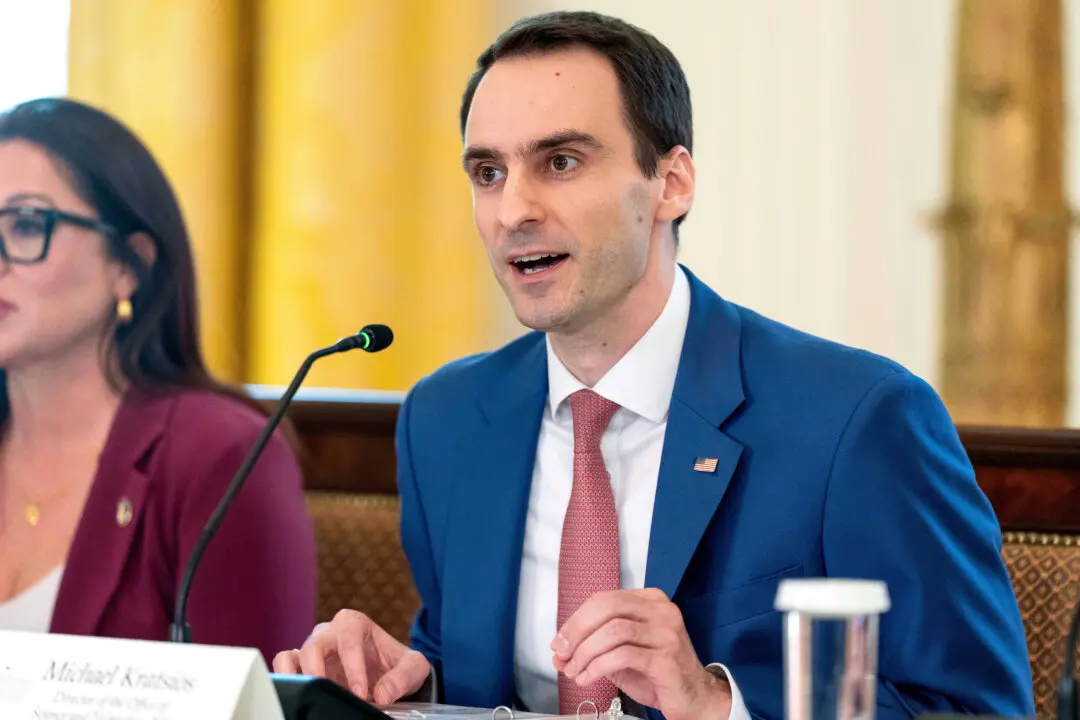
Just days after catastrophic flash floods devastated Central Texas, President Donald Trump’s nominee to lead the National Oceanic and Atmospheric Administration (NOAA) told the Senate on July 9 that he would seek improvements to the agency’s weather forecasting and warning capabilities despite recent budget cuts.
Neil Jacobs, a meteorologist who headed NOAA on an acting basis during the first Trump administration, testified before the Senate Commerce, Science, and Transportation Committee less than a week after floods claimed the lives of at least 119 people in Texas’s Hill Country. At least 173 are still missing.
Jacobs also vowed to maintain the highest level of performance at the National Weather Service (NWS) if confirmed.
“One of my top priorities is to return the United States to the world’s leader in global weather forecast modeling capability as a matter of public safety, national security, and national pride,” he said. “We will restore American technological superiority with this vital service for the country and our military serving around the world.”
Jacobs said this would require embracing new technologies and novel approaches at the NWS.
He said the agency, which is under NOAA’s umbrella, did a “great job” in Texas last week, but suggested ways to improve its forecasting technology and warning systems.
Jacobs cited the agency’s weather radio as one way to advance and modernize the NOAA, including using satellites to send out warning messages as well as moving away from copper wire telecommunication infrastructure.
“We also need more data in doing post-storm assessments,” he said. “We need the data to understand what went right, what went wrong, whether people got the warnings, if they did or didn’t, and if they did, did they not understand them?”
To make U.S. weather forecasting the best in the world will require “closing the gap” between U.S. meteorology and Europe’s, which Jacobs said excels at weather modeling because of Europeans’ employment of new advancements in data collection and analysis.
He suggested that NOAA use the same data assimilation practices to improve U.S. weather modeling and forecasting capabilities.
NOAA could also use cloud computing for weather forecasting, Jacobs said, as the NWS has to download data locally, which slows forecasting.
“It would allow a forecaster from anywhere to do a forecast for anywhere,” he said. “They could literally work from anywhere. And so embedding in the emergency management centers, particularly during major weather events, would be really advantageous.”
The agency could also use post-disaster assessments similar to what the National Transportation Safety Board does for transportation accidents and incidents, Jacobs said.
Democrats have raised concerns that NOAA and the NWS may be underequipped to handle disasters such as the Central Texas floods because of layoffs and steep budget cuts by the Trump administration.
Sen. Maria Cantwell (D-Wash.), the top Democrat on the Senate Commerce, Science, and Transportation Committee, noted that NOAA had laid off 2,000 employees and has more than 3,000 vacancies that cannot be filled because of Trump’s hiring freeze.
“For example, Pendleton, Oregon, the forecast office serving Central Washington, no longer has 24/7 local coverage because of their 44 percent vacancy rate,” Cantwell said. “And in my opinion, that is unacceptable in the height of fire season.”
Jacobs said staffing at NOAA and the NWS would be a top priority, as it’s important to have people on the ground who have relationships with the local community.
“Even if the forecast is perfect, getting the warnings to the people, particularly at late hours of the night, is a challenge,” he said, referring to the flash flood warnings last week in Central Texas, which were issued after midnight, when many of the victims were asleep.