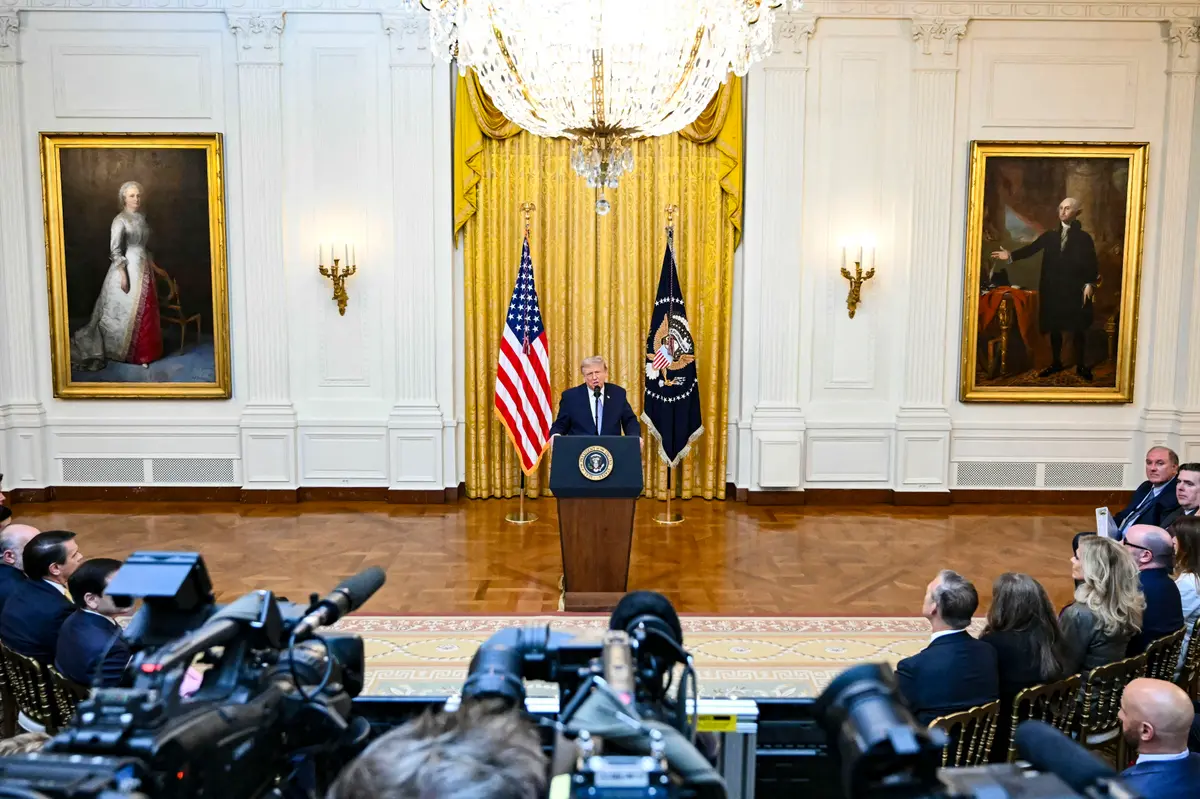
He said the CCP had acquired the personal information of approximately 220 million American voters during the 2020 election cycle and suggested the data could have been used for voter registration-related activities or other unlawful purposes.
Trump also said that Beijing had conducted influence operations targeting his presidency since 2018, including efforts to weaken his electoral support, pressure him to step down, and prevent him from winning another term.
Trump has directed the Office of the Director of National Intelligence and the Department of Justice to investigate the matter. He said officials found to have covered up relevant information would be removed and could face criminal charges.
These disclosures are some of Trump’s most direct accusations against Beijing regarding American election interference and come amid renewed debate in Washington over the long-term direction of U.S.–China relations.

Several experts, including prominent Chinese dissident scholar Yuan Hongbing, said Trump’s remarks could signal a tougher phase in Washington’s approach to Beijing, while also complicating Chinese leader Xi Jinping’s efforts to leverage his relationship with Trump as a source of political capital inside the Chinese regime.

Strategic Competition
Yuan, a Chinese dissident and former law professor at Peking University now living in Australia, told The Epoch Times that Trump’s remarks should be viewed within the broader evolution of U.S. policy toward Beijing.
According to Yuan, Trump helped end decades of U.S. engagement with the Chinese regime during his first term, as policymakers increasingly viewed the CCP as the primary long-term U.S. strategic challenge.
Yuan said Trump’s public tone toward Xi had become more conciliatory after Trump returned to office because the administration initially hoped Beijing might assist in addressing broader geopolitical issues, including the war in Ukraine and instability in the Middle East.
However, Yuan said those expectations have largely failed to materialize as China continued strengthening ties with Russia, Iran, North Korea, and other U.S. adversaries.
“His vision of making America great again is fundamentally incompatible with the CCP’s ambitions for global expansion,” Yuan said. “It is in this context that Trump delivered this speech.”
Shift in US–China Competition
Chen Wen-chia, a professor of international business and vice president of Kainan University in Taiwan, told The Epoch Times that Trump’s remarks elevated the issue from election integrity to national security.
“This is not simply criticism from Trump,” Chen said. “It is laying the groundwork for policy.
“The core message is that U.S.–China competition is being placed directly at the center of American domestic politics and elections, framed as a struggle between democracy and authoritarianism.”

Yuan offered a similar assessment, saying that the speech reflected a growing recognition within the Trump administration that strategic competition with the CCP remains central to American foreign policy despite efforts to maintain channels of cooperation.
Chen said the speech conveyed at least three messages.
First, Trump was shifting political pressure surrounding him toward foreign interference, strengthening support among his political base.
Second, Trump was seeing the CCP not merely as an economic competitor but as a systemic rival, providing greater justification for a more confrontational policy.
Third, the remarks sent a signal to Xi that Trump’s approach toward Beijing would likely become even more hardline.
Chen said the accusations could further reduce trust between Washington and Beijing because allegations of election interference involve issues of national sovereignty.
“If interference in elections is confirmed, the foundation of mutual trust between the two sides would be severely damaged,” he said.
He also said that the issue could create broader bipartisan pressure in Washington, making it more difficult for future administrations to change course on China policy significantly.
“Competition between the two countries could become more institutionalized and long-term,” Chen said.
Chen said Beijing could face increased pressure, including expanded American technology restrictions and stronger coordination among American allies. He said that China’s international image could also be affected if it becomes associated with interfering in democratic elections around the world.
At the same time, he said Beijing could respond by promoting ultranationalist messaging and portraying American actions as an attempt to contain China.
Chen concluded that Trump’s speech was more than political rhetoric, saying it was another step toward a more sustained and structural confrontation between the world’s two largest economies.
Possible Change in Trump’s Strategy
Su Tzu-yun, a researcher at Taiwan’s Institute for National Defense and Security Research, told The Epoch Times that Trump’s remarks were unexpected, particularly given recent signs of engagement between Trump and Xi.
The two leaders had previously described their relationship positively, and Xi was expected to visit the United States in September.
Su said Trump’s latest comments could indicate a shift in the Trump administration’s policy toward Beijing.
However, he said it remained unclear whether the administration would continue pursuing a dual-track strategy of cooperation and confrontation.
Trump has repeatedly described Xi as a friend and emphasized his personal relationship with the Chinese leader. Su said Trump’s approach resembled that of President Theodore Roosevelt, who was known for a policy of speaking softly while maintaining military strength.
“[His] friendly tone may simply be a tactical approach,” Su said.
He pointed to U.S. national security strategy documents that emphasize strengthening collective defense arrangements in the first island chain and preventing Taiwan from being taken by force.
Regarding Beijing’s response, Su said the CCP is likely still assessing the situation before deciding whether to proceed with plans for a potential Trump–Xi meeting in September.
Yuan said the speech could also carry implications for Xi domestically.
According to Yuan, Xi has frequently highlighted his relationship with Trump as evidence of his diplomatic stature and influence.
Trump’s direct allegations against the CCP, however, could make it more difficult for Xi to portray that relationship as a political asset within the Party.
“Trump’s decision to publicly accuse the CCP of serious election interference could weaken Xi’s efforts to portray that relationship as a source of political strength within China,” Yuan said.
Long-Term Focus on Beijing
Shen Ming-shih, another researcher at Taiwan’s Institute for National Defense and Security Research, told The Epoch Times that Trump’s speech reflected what he sees as a broader American strategic focus on the CCP as the United States’ primary long-term competitor.
“Whether it is Cuba or the CCP, these are likely among the major [adversarial] targets Trump sees as part of his goal of becoming a great president and making America great again,” Shen said.
He said Trump’s remarks did not necessarily indicate a complete break in U.S.–China relations, but rather a continuation of a strategy combining competition with selective cooperation.
“Trump has clearly demonstrated his strategic intentions,” Shen said. “This does not mean there will be no cooperation, but if the CCP continues what he views as attempts to undermine him, the United States will respond firmly.”
Shen said Trump had previously been more restrained in his public comments toward Beijing. However, after observing Xi’s approach toward the United States and issues such as Taiwan, Trump and his Cabinet appear to have developed a stronger consensus.
“The United States understands that whether it is the Middle East or the Western Pacific, many major issues are connected to China,” Shen said.