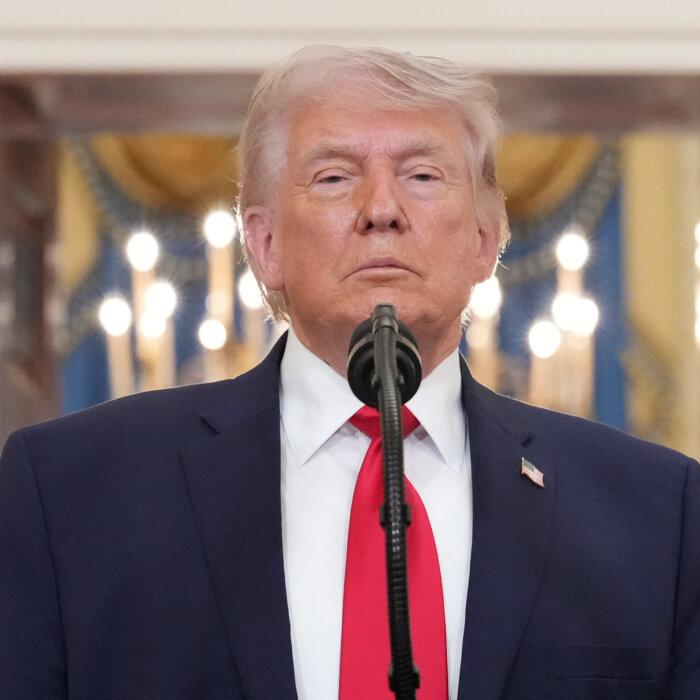
President Donald Trump is going to ask the Supreme Court to consider overturning lower court verdicts against him in a case involving former Secretary of State Hillary Clinton and others who created and promoted a debunked dossier accusing Trump of colluding with Russia, according to a new court filing.
Steele, paid by Clinton’s campaign, compiled a dossier that included claims that the Russian government possessed a salacious video of Trump at a hotel in Moscow, based on what he claimed were sources inside Russia. His main source was later revealed to be Igor Danchenko, who was based in the United States and has been investigated by federal agents for possibly being a Russian spy.
A request for the full appeals court to rehear the case was denied in May.
Both the district and appeals courts committed legal errors, Trump’s lawyers said in the new filing.
That includes the determination that the allegations of conspiracy could not be brought because they were filed after the statute of limitations had expired and the conclusion that Trump being president did not count as an extraordinary factor that would pause the period of time for the statute of limitations.
“These matters are of fundamental importance to multiple constitutional and statutory interpretation issues,” the filing stated. “These questions warrant granting a writ of certiorari, and require substantial legal research and review by counsel, including as to circuit conflicts. The issues are complex.”
The lawyers requested an extension of the deadline they face to lodge a writ of certiorari, or a review of the lower court ruling. That extension is needed due to factors such as the complexity of the record for the case, which spans hundreds of filings, they said.
A lawyer representing Clinton declined to comment.
If the writ is eventually filed, then justices will vote on whether to grant the petition. At least four of the nine justices must vote to accept a writ for the court to consider an appeal.