President Donald Trump on Sept. 22 signed an order declaring Antifa a domestic terror organization.
The president said the loosely organized group “uses illegal means to organize and execute a campaign of violence and terrorism nationwide” including “coordinated efforts to obstruct enforcement of Federal laws through armed standoffs with law enforcement, organized riots, violent assaults on Immigration and Customs Enforcement and other law enforcement officers, and routine doxing of and other threats against political figures and activists.”
The order ties the decision to declare the group a terrorist organization to the “aforementioned pattern of political violence designed to suppress lawful political activity and obstruct the rule of law.”
Trump also directed administration officials to “investigate, disrupt, and dismantle any and all illegal operations—especially those involving terrorist actions—conducted by Antifa or any person claiming to act on behalf of Antifa.”
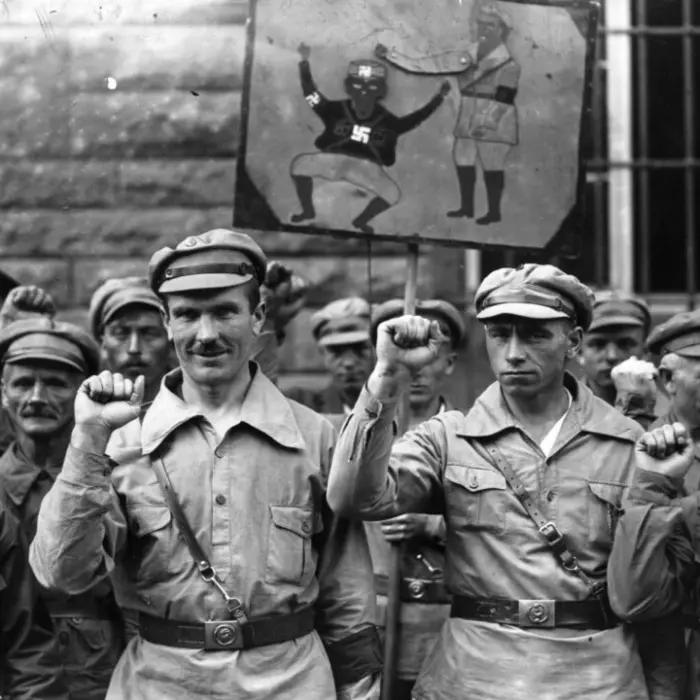
What Is Antifa?
Antifa, short for “anti-fascist,” has been involved in numerous violent incidents during protests and riots over the past decade. Its supporters generally hold extreme political views, including communist or anarchist beliefs.The group’s members and supporters are usually organized through decentralized cells, and often favor “direct action” over political engagement.
Though the group doesn’t have a formal leadership structure, its members are often identifiable by their efforts to hide their identities through masks and other face coverings, as well as dark clothing.
In several cases, its members have engaged in violence during demonstrations, such as during the unrest that occurred throughout the summer of 2020 in the wake of George Floyd’s death.
In the executive order, Trump accused the group of recruiting, training, and radicalizing young Americans “to engage in this violence and suppression of political activity, then employs elaborate means and mechanisms to shield the identities of its operatives, conceal its funding sources and operations in an effort to frustrate law enforcement, and recruit additional members.”
During some riots where the group was present, individuals suspected to be affiliated with the group have been involved in violent clashes with law enforcement, including throwing bricks and molotov cocktails, and other criminal acts.
Lawmakers React
Democrats didn’t immediately respond to the move, while Republicans applauded the decision.During an exchange in the Oval Office with reporters, Trump said he would pursue a domestic terrorism designation for the group if the move had the backing of Attorney General Pam Bondi and other cabinet members.
“It’s something I would do, yeah,” Trump said. “I would do that 100 percent. Antifa is terrible.”
Some Republicans had been calling for Trump to follow through on his comment.
Legal Challenges
While many conservative lawmakers and social media personalities responded favorably to the administration’s move, the order could face pushback in federal courts.As a domestic entity, Antifa isn’t eligible for inclusion in the U.S. State Department list of foreign terror organizations, which hosts organizations like the ISIS terrorist group and al-Qaeda, which masterminded the Sept. 11, 2001, terror attacks.
However, despite some calls over the years for the federal government to create an equivalent domestic terror designation system—particularly after mass shootings by political extremists—these efforts have faltered due to First Amendment concerns.
First Amendment protections have broadly limited the federal government’s ability to circumscribe activity by even extremist organizations. That’s why groups like the American Nazi Party, Ku Klux Klan, and American Communist Party are allowed to operate in the United States despite these groups being condemned by most Americans.
Federal law has often targeted specific criminal acts in response to a domestic extremist group. For instance, the federal government in 1870 and 1871 passed laws targeting the most common race-based offenses committed by the Ku Klux Klan, but membership in the group remained legal.
It’s the second time Trump has taken steps toward designating the group a terror threat.
After Black Lives Matter protests and riots broke out nationwide in 2020—many attended by members who affiliated themselves with Antifa—Trump said that the federal government “will be designating ANTIFA as a Terrorist Organization.”