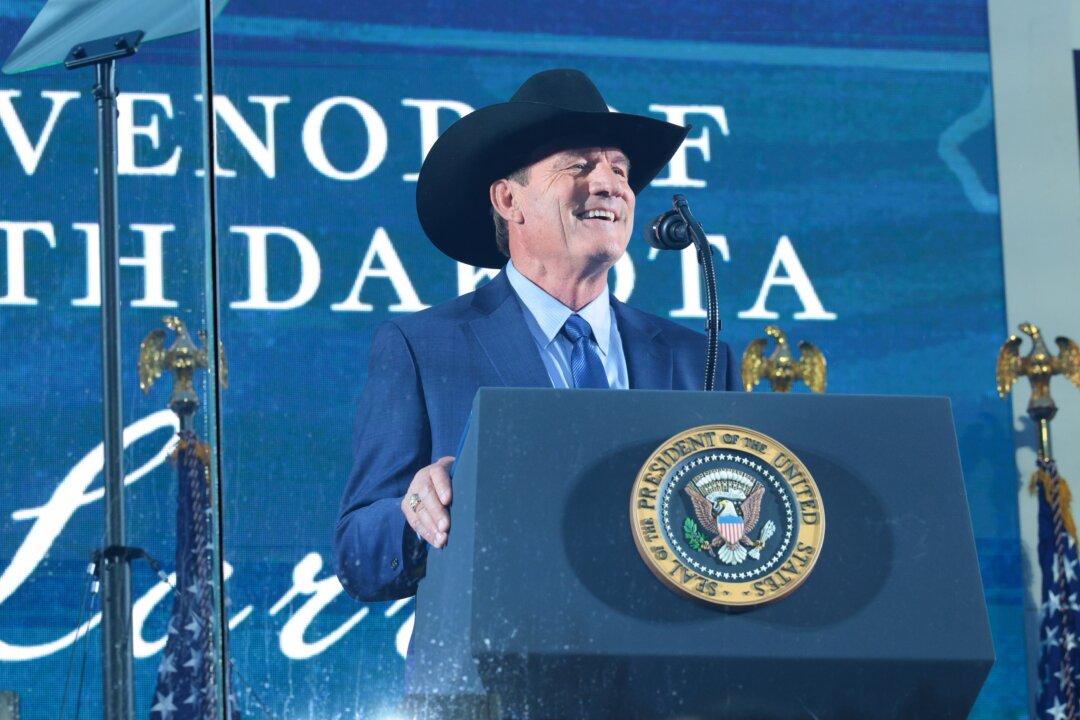
President Donald Trump on the evening of Dec. 1 signed into law a bill that would nearly quadruple pensions for Medal of Honor recipients.
The Medal of Honor, first introduced during the Civil War, is the single-highest military honor and is awarded exclusively for acts of extreme bravery that rise beyond what would be reasonably expected of an individual.
In 1963, Congress standardized the requirements to receive a Medal of Honor via legislation that outlined the core requirement that a service member display “conspicuous gallantry and intrepidity at the risk of his life above and beyond the call of duty.”
Today, 61 Americans who have been awarded the Medal of Honor are alive. Most are veterans of the Vietnam War, but others are veterans of the major U.S. military actions in the Middle East since the turn of the century. Often, the medal is awarded posthumously for actions that cost a service member his or her life.


“Medal of Honor recipients truly embody the best of our nation,” Nehls said. “They never ask for special recognition or demand special treatment. Many of the living Medal of Honor recipients spend most of their time traveling our country, telling their stories inspiring the next generation of America’s heroes.
“My bill, the Medal of Honor Act, eases their financial burden by increasing their special pension—ensuring they know that America is grateful for all they’ve done to serve our country and defend our freedoms.
“I am beyond grateful to President Trump, our Commander in Chief, for signing my bill into law. The least we can do is lift the financial burden off of these selfless warriors who continue to serve our great nation.”
In a video posted to X after Trump signed the bill, Cruz said that the legislation would give the 61 living Medal of Honor recipients “support and a small but meaningful recognition of the incredible sacrifice they’ve given.”
“These individuals are heroes,” Cruz said. “We see you, we remember you, we’re grateful for you.”
Congress first authorized a pension for Medal of Honor recipients in 1916, with a starting rate of $10 a month, equivalent to about $300 today.
In 1961, that amount was raised to $100, or about $1,059 today.
Congress most recently increased that amount in 2002, raising the monthly payment to $1,000 per month. With cost-of-living and other adjustments, recipients were receiving $1,406.73 per month prior to the passage of the Medal of Honor Act.
Under the change signed into law by Trump on Dec. 1, recipients will receive about $5,625 a month specifically for the Medal of Honor pension.