This copy is for your personal, non-commercial use only. Distribution and use of this material are governed by our Subscriber Agreement and by copyright law. For non-personal use or to order multiple copies, please contact The Epoch Times Reprints.
Blank Social Security checks are run through a printer at the U.S. Treasury printing facility in Philadelphia, Pa., on July 18, 2011. William Thomas Cain/Getty Images
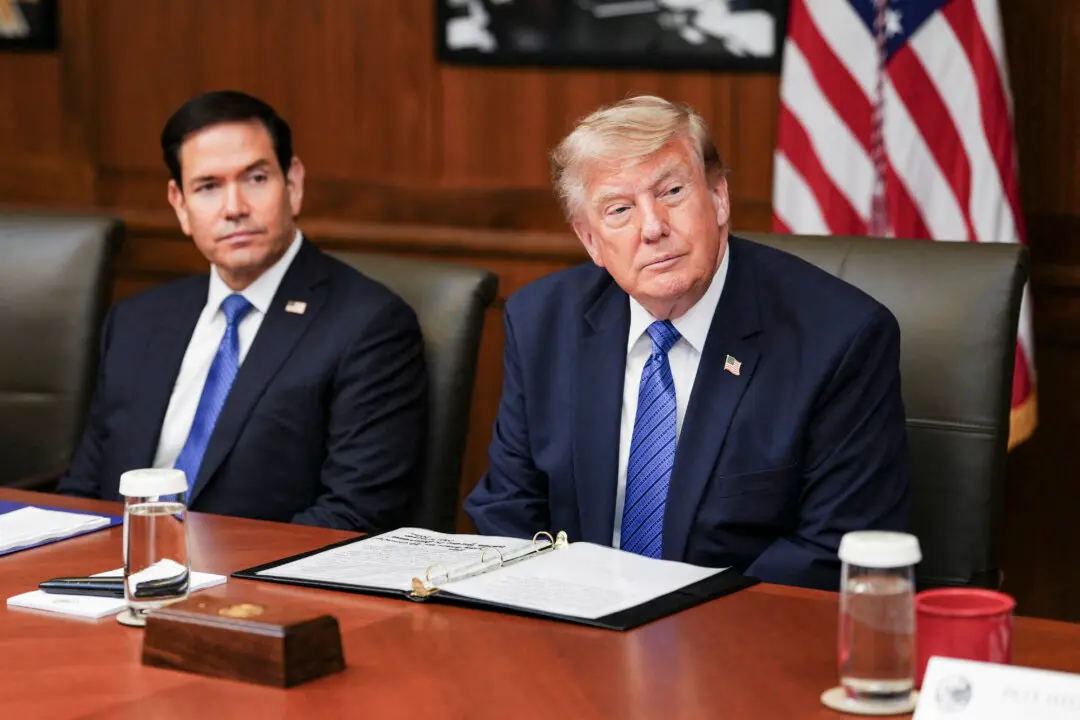
President Donald Trump said that his administration will protect Social Security and Medicaid, when asked about which programs he would want to see cut in a congressional reconciliation bill.
During remarks to reporters at the Oval Office on Aug. 25, Trump was asked what he would prioritize if Republicans, who control Congress, tried to cut costs.
“One thing I said and I gave my word—we’re not going to hurt anybody on Medicaid, Medicare, or Social Security,” Trump said, adding that “we’re doing great on Social Security,” and that “we’re going to protect it.”
Trump had promised to protect Social Security and Medicare on the campaign trail last year, often echoing those statements after he took office in January. His administration has sought cuts to other federal programs and various government agencies in a bid to root out what it says is fraud, waste, and abuse.
A report from the trust that operates Social Security stated that the combined trust funds used to make payments to retired Americans and people with disabilities are projected to run out by 2034. Following its depletion, it would only be able to pay 81 percent of scheduled benefits to its recipients, it said.
“The Trustees recommend that lawmakers address the projected trust fund shortfalls in a timely way in order to phase in necessary changes gradually and give workers and beneficiaries time to adjust,” the report said.
“Implementing changes sooner rather than later would allow more generations to share in the needed revenue increases or reductions in scheduled benefits.”
Meanwhile, the Medicare trustees’ report, released earlier in the summer, said that the program’s Hospital Insurance trust fund is projected to be depleted by 2033, or three years earlier than the previous projection.
Separately, the Committee for a Responsible Federal Budget (CRFB) released an analysis in July saying that Social Security recipients face a 24 percent cut to their monthly payments in less than a decade due to the trust fund drying up.
“We estimate that this would be equal to an $18,100 annual benefit cut for a dual-earning couple retiring at the start of 2033,” the CRFB said, adding it would occur “shortly after” the Social Security trust fund goes insolvent.
Amid reports of the fund becoming insolvent in the next decade, Treasury Secretary Scott Bessent in June called on Congress “to take action to support the long-term viability of these programs.”
A July survey released by AARP, formerly called the American Association of Retired Persons, found that around 65 percent of retired Americans say “they rely substantially on Social Security,” compared with 21 percent who say “they rely on it somewhat.”
Meanwhile, 62 percent of respondents to the AARP survey believe that the average Social Security payment of roughly $2,000 per month is too low. That percentage is down from 2020, when 65 percent of respondents said the same, but is up from 61 percent in 2015, and 54 percent in 2010.
Earlier this month, Trump issued a proclamation marking the 90th anniversary of the establishment of Social Security, also pledging to strengthen the program and saying that customer service has improved since he took over.
There are about 70 million Social Security beneficiaries in the United States, according to the Social Security Administration.
Jack Phillips is a breaking news reporter who covers a range of topics, including politics, U.S., and health news. A father of two, Jack grew up in California's Central Valley. Follow him on X: https://twitter.com/jackphillips5