President Donald Trump’s January executive orders “Declaring a National Energy Emergency” and “Unleashing American Energy” and April executive action “Reinvigorating America’s Beautiful Clean Coal Industry” have loosened regulations, streamlined permitting, and classified coal, a sedimentary rock, as a critical mineral.
Those orders and policy actions are being implemented under the fiscal year 2026 budget as key components in increasing energy production to meet spiking electricity demand largely spurred by artificial intelligence and data center development.
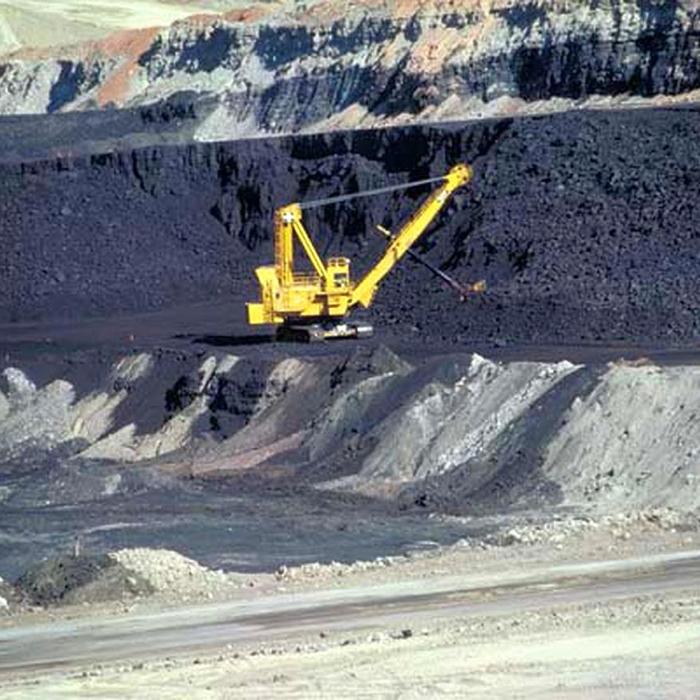

In 1923, before modern advancements, there were more than 880,000 coal miners in the United States.
The downward production trend appears to be reversing, especially with the Trump administration’s policy of slashing royalty rates, split 50-50 between the federal government and states, from 12.5 percent to 7 percent for coal extracted and sold from federal mineral estate—the 700 million acres of sub-surface minerals owned by the U.S. government nationwide—with a series of lease sales and new mine permits.
The Department of Interior’s Bureau of Land Management (BLM), which orchestrates lease sales for federal mineral estate beginning at $3 an acre, has awarded bids by existing coal mines in North Dakota and Wyoming to expand onto adjacent lands and extend operational timelines.
Earlier in 2025, the BLM endorsed Ramaco Resources’ proposed Brook Mine near Sheridan in north-central Wyoming, the first new coal mine in Wyoming in 50 years, and the first rare-earth minerals mine in the United States in more than 70 years.
Tripling Access
Under the One Big Beautiful Bill Act, the Interior Department was required to open 4 million acres of mineral estate to coal mining within 90 days.Unlike most leases awarded since spring 2025, nearly 85 percent of this land—11 million of the 13.1 million acres—is “split estate,” meaning the federal government owns subsurface minerals rights, but the surface is either privately owned or state land.
Of the 13.1 million acres, 1.96 million acres are managed by the BLM and 65,000 acres are managed by the U.S. Army Corps of Engineers. These lands, many near existing mines, are likely to draw the most immediate interest.
The seven expanses open for coal mining including four in BLM resource management plan (RMP) areas.
The first is Miles City RMP, which encompasses 6.7 million acres in Montana that include 1.1 million acres of federal land and 5.6 million acres of split-estate.
The North Dakota RMP consists of 3.79 million acres, including 30,000 acres of BLM land, 65,000 acres managed by the Army Corps of Engineers, and 3.7 million acres of split estate.
The Buffalo RMP is a 2.1-million acre area in the Powder River Basin—where more than 40 percent of the nation’s coal is produced—that includes 400,000 acres of federal land and 1.7 million acres of split estate.
The Rock Springs RMP consists of 100,000 acres of federal land in western Wyoming adjacent to Black Butte Mine, which on Sept. 9 received BLM approval to access an additional 9.2 million tons of coal through 2039 on an existing lease that was set to expire in 2028. Black Butte Mine has operated since 1977, supplying coal to Jim Bridger Power Plant. The expansion could nearly double the mine’s workforce of 56 full-time employees.
The three expanses not in RMP areas include 200,000 acres of federal land in New Mexico without any split estate; a 160,000-acre span near Dinosaur National Monument near Colorado’s western state line with Utah that includes 100,000 acres of federal land and 60,000 acres of split-estate; and 48,000 acres in Utah that includes 19,000 acres of split estate near the Zion, Bryce Canyon, and Capitol Reef national parks.