In a rare move aimed at bypassing a lengthy court battle, Texas Gov. Greg Abbott petitioned the state Supreme Court to remove a state Democratic leader trying to derail Republican plans to redraw the state’s congressional map.
More than 50 Democrats left the Lone Star State for several blue states and have been absent from the 150-member Texas House, which requires 100 legislators to meet quorum and conduct business.
While Democratic Texas House members left the state over their opposition to the redistricting plan, it was only one of 18 agenda items to be considered during a 30-day special session called by the Republican governor, which ends Aug. 19.
The petition pointed out that the state cannot conduct any business without a quorum, which interferes with the very function of government.
“This court should make clear that a legislator who does not wish to perform his duties will be stripped of them,” the petition stated.
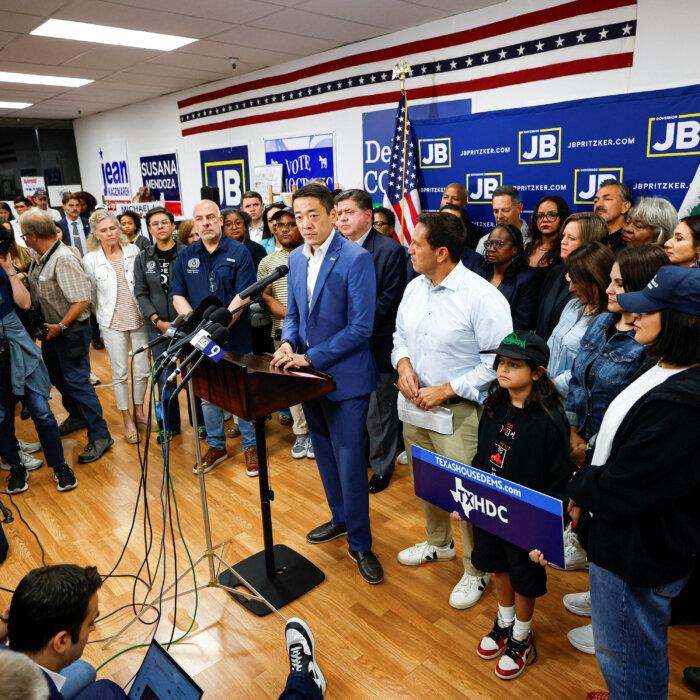

Legal experts said Abbott’s argument, based on Article Three, Section 10 of the state Constitution, could prevail since the case has statewide implications, but it faces headwinds.
If successful, the petition could serve as a test case allowing the Republican governor to remove other lawmakers who left the state.
The state justices gave Wu until Friday to respond.
The fight started when the Department of Justice (DOJ) sent Abbott a July 7 letter raising concerns that four congressional districts in the Houston and Dallas areas were unconstitutional because of “racial gerrymandering.”
Current boundaries run afoul of the Voting Rights Act by relying on racial demographics to group minority voters into “coalition districts,” where no single racial group forms a majority, according to the DOJ.
The DOJ pointed to a recent Supreme Court decision requiring states to show a compelling interest to justify such configurations.
“It’s simply insanity,” he said. “I took an oath to defend against that.”
Warranto petitions are typically used to challenge a person’s right to hold a public or corporate office or to revoke a corporation’s charter.
“They’re very uncommon,” David Coale, a Dallas appellate attorney, told The Epoch Times.
Coale said it’s unclear if the state Supreme Court has jurisdiction in the case.
“[The case] being in the state Supreme Court in the first place is a little odd, although the point is well taken that this is a very important question,” he said.
Texas attorney Jonathan Hullihan, president and general counsel of Remnant Law, a group focused on constitutional issues, said Abbott’s “innovative” approach is likely to face an uphill battle.
The warranto petition could be successful because it addresses a case of statewide constitutional significance, Hullihan told The Epoch Times.
However, it also presents concerns over the separation of powers, he said.
Judicial action runs the risk of weaponizing warranto actions in future partisan battles.
“The judiciary must be extremely careful not to become a tool for one branch to pressure another during policy disagreements,” Hullihan said. “That said, we cannot normalize the idea that government officials can simply skip town whenever an agenda item displeases them.”
Wu and his colleagues took an oath to faithfully execute the duties of their office, and the constitution mandates that legislators “shall meet,” he added.
Coale suspects the state Supreme Court may end up moving forward with the case, but at a much slower pace than what the governor has in mind.
Democrats may argue they have no intention of giving up their seats, and not showing up is similar to abstaining from voting, Coale said.
“Where I really think it’s headed is that some court somewhere is going to say, this is a matter for the voters,” he said.
The last time Democrats fled the state to break quorum was in 2021 over Republican efforts to restrict election practices such as 24-hour drive-thru voting and the distribution of unsolicited mail-in ballots. The state Supreme Court ruled that state police could arrest lawmakers who are intentionally breaking quorum and bring them to Austin.
Abbott cited Paxton’s 2021 nonbinding opinion stating that although Texas courts recognize that a vacancy may occur by abandonment of office, it would need to be decided by the courts.
“The people of Texas elected lawmakers, not jet-setting runaways looking for headlines. If you don’t show up to work, you get fired,” Paxton stated.
Also, the fleeing Democrats face civil arrest warrants, fines of $500 per day that must be paid from their personal funds, and potential felony charges.