This copy is for your personal, non-commercial use only. Distribution and use of this material are governed by our Subscriber Agreement and by copyright law. For non-personal use or to order multiple copies, please contact The Epoch Times Reprints.

The Epoch Times
The Epoch Times
AD
The Epoch Times
Constitutional Rights

Supreme Court to Look Into Whether Public Officials Can Block Citizens on Social Media

A key issue is whether the First Amendment rights of citizens are violated when public officials block their criticism online.
Google LogoMark Us Preferred on Google
Supreme Court to Look Into Whether Public Officials Can Block Citizens on Social Media
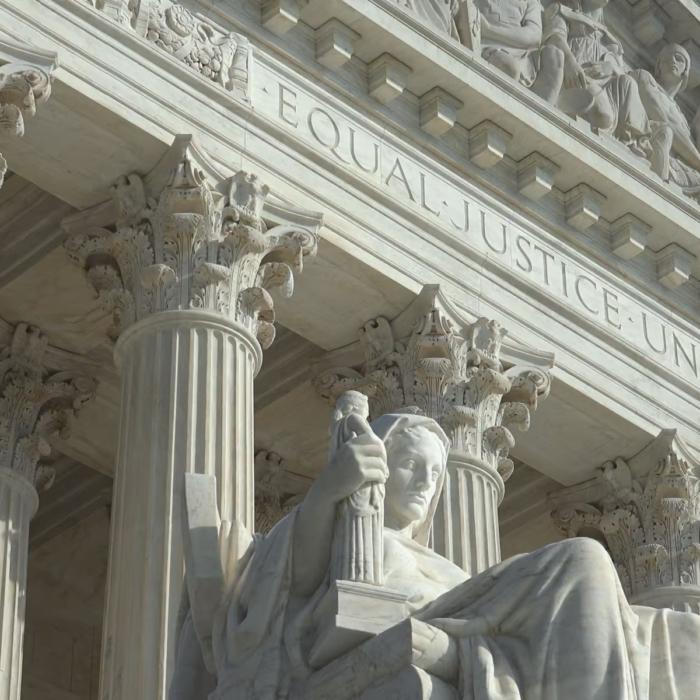
“The Guardian” or “Authority of Law" statue by James Earle Frasier in front of the U.S. Supreme Court in Washington on Sept. 28, 2020. Al Drago/Getty Images
Naveen Athrappully
Naveen Athrappully
Reporter
10/31/2023|Updated: 10/31/2023
0:00

The U.S. Supreme Court will hear two lawsuits on Tuesday that will look into the issue of whether public officials can block citizens from the officials’ social media accounts and if such actions constitute a violation of First Amendment rights.

The two cases, from California and Michigan, revolve around the issue of public officials blocking citizens who made critical comments on social media pages owned by the officials. Both cases have resulted in opposing decisions from the lower courts. In California, an appeals court ruled that public officials violated the First Amendment rights of the citizens by blocking them. But an appeals court in Michigan ruled that the official in the case was not at fault.

The Biden administration has taken the side of the public officials. The Department of Justice (DOJ) asked the court to respect the distinction between the personal and public lives of officials. Regarding the two cases, the department pointed out that the government neither owns nor controls official accounts involved in the lawsuits.

In an interview with CBS News, Katie Fallow, senior counsel at the Knight First Amendment Institute, pointed out that a key issue underlying the cases is whether public officials “may discriminate against people based on viewpoint by blocking them or deleting their comments” while using their social media accounts.

“The impact of these cases is very real because it will affect both free speech and the public sphere and the ability to engage in participatory democracy,” she said.

The Knight Institute had earlier brought a similar case against former President Donald Trump for blocking users on Twitter, which is now called X.

Related Stories
The Epoch Times
Supreme Court to Scrutinize Biden Administration’s Alleged Big Tech Censorship Machine
The Epoch Times
Supreme Court Won’t Rehear Police Brutality Case
Even though a federal appeals court had deemed President Trump’s action as unconstitutional, the Supreme Court found no wrong in the former president’s decision and dismissed the case after he left the White House.

The California Case

The first case involves two California public officials from the Poway Unified School District Board of Education—current vice president Michelle O'Connor-Ratcliff and former board member T.J. Zane.

While running for election in late 2014, both of them created public Facebook pages. Sometime before 2017, Ms. Ratcliff also created a public Twitter page. After being elected, both of them used these social media accounts to provide details regarding the activities of the board.
The logo for social media platform X, following the rebranding of Twitter, is seen covering the old logo in an illustration taken on July 24, 2023. (Dado Ruvic/Illustration/Reuters)
The logo for social media platform X, following the rebranding of Twitter, is seen covering the old logo in an illustration taken on July 24, 2023. Dado Ruvic/Illustration/Reuters
Two parents, Christopher and Kimberly Garnier, who had children enrolled in the school district, made multiple replies to the social media posts of the officials. Ms. Ratcliff and Mr. Zane eventually blocked the Garniers from their Facebook pages. Ms. Ratcliff also blocked Mr. Christopher from her Twitter page.

The Garniers filed a lawsuit, alleging that the officials violated their First Amendment speech rights by blocking them, which they characterized as public forums.

The matter went to a federal district court, where the officials argued that the school district was not involved in the creation or maintenance of their social media pages and that these accounts were created by them in their personal capacity to support and promote their political activities. However, the district court did not favor these arguments.

It pointed out that public officials “swathed” their pages in “the trappings” of their offices and frequently communicated with the public about “events which arose out of their official status,” including matters they had the ability to discuss only “due to their positions.”

As such, the district court held that the action of blocking the Garniers from social media pages amounted to a violation of their First Amendment rights.

The matter went to the U.S. Court of Appeals for the Ninth Circuit, which upheld the district court ruling. The Supreme Court will now weigh on the matter.

The officials and Garniers have both filed their arguments related to the case. The officials argued that “a public official’s operation of a social media page is not state action when it neither carried out any state duty nor relies on any state authority.”

“Treating an official’s personal social-media page as a public forum is particularly nonsensical because that official’s tenure will eventually end. At that time, people who have been blocked from the page have no viable claim,” they said in a filing.

They warned that if the court were to allow the Ninth Circuit’s ruling to stand, “the result will not be that public officials across the land all feel compelled to expose their personal social-media pages to the degradations of political opponents and abusive trolls. Rather than more speech, the result will be worse speech, less speech, or even no speech.”

In their filing, the Garniers pointed out that the question in this case is whether the officials were doing their job as PUSD members when they operated the social media pages and communicated matters related to the board.
“They were,” the filing said. “And their decision to block the Garniers from that mechanism was therefore state action.”

The Michigan Case

The second case was triggered after James Freed, the city manager of Port Huron, Michigan, deleted comments from a citizen Kevin Lindke from his Facebook page. Mr. Lindke’s comments criticized Mr. Freed’s handling of the COVID-19 pandemic. Mr. Freed also blocked Mr. Lindke from the page.

The Facebook page was Mr. Freed’s personal profile that he converted to a public page. After becoming the city manager in 2014, Mr. Freed updated the page to reflect his title.

Dismayed by the deletion of his comments, Mr. Lindke sued Mr. Freed in a federal court, arguing a violation of his First Amendment rights. A federal district court ruled in favor of Mr. Freed and the issue went to the appeals court.

In its opinion, the U.S. Court of Appeals for the Sixth Circuit took Mr. Freed’s side, claiming that his Facebook activity “was not state action.”

“The page neither derives from the duties of his office nor depends on his state authority. In short, Freed operated his Facebook page in his personal capacity, not his official capacity,” the court opinion said.

“James Freed didn’t transform his personal Facebook page into official action by posting about his job. Instead, his page remains personal.”


Following the decision, Mr. Lindke approached the Supreme Court. He argues that Mr. Freed designed his Facebook page to appear like a government outlet and used the account to carry out public responsibilities.
The Supreme Court will review both cases on Tuesday, and will clarify where U.S. law stands in terms of the relationship between the government and online platforms.
Google LogoMark Us Preferred on Google
Naveen Athrappully
Naveen Athrappully
Reporter
Naveen Athrappully is a news reporter covering business and world events at The Epoch Times.
Author’s Selected Articles
Nearly 18.7 Million Air Travelers Expected to Be Screened on Fourth of July: TSA
Jun 26, 2026
Nearly 18.7 Million Air Travelers Expected to Be Screened on Fourth of July: TSA
7,200 Trafficked Children Have Been Rescued in Trump’s Second Term, FBI Says
Jun 26, 2026
7,200 Trafficked Children Have Been Rescued in Trump’s Second Term, FBI Says
Europe Warned of Energy Supply Disruptions Following Its Methane Regulations
Jun 26, 2026
Europe Warned of Energy Supply Disruptions Following Its Methane Regulations
ICE Arrests More Than 10,000 Gang Members Under Trump
Jun 25, 2026
ICE Arrests More Than 10,000 Gang Members Under Trump
Related Topics
US Supreme Court
social media blocking
AD
Add to My List
Save
The Epoch Times
Copyright © 2000 - 2026 The Epoch Times Association Inc. All Rights Reserved.