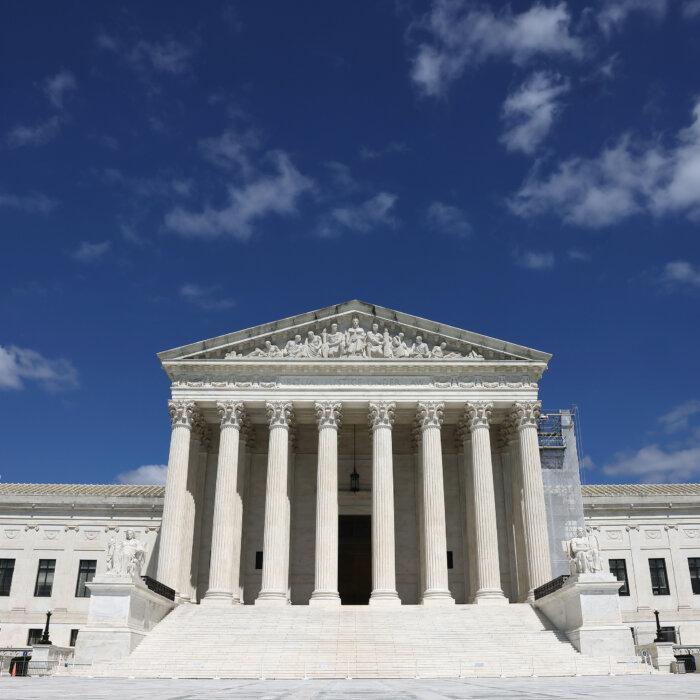
The Supreme Court has agreed to consider whether prisoners who claim their religious rights have been violated may sue state officials personally for monetary damages.
The justices will look at whether damages are allowed under the federal Religious Land Use and Institutionalized Persons Act (RLUIP), which forbids state officials from restricting or infringing religious rights.
Tanzin v. Tanvir held that “appropriate relief ” under RFRA may include monetary damages against government officials in their individual capacities. “No sound basis exists to reach a different conclusion with respect to RLUIPA,” the brief said.

The petitioner is Damon Landor, a Rastafarian, who, for religious reasons, opposes cutting his hair. Prison officials in Louisiana forcibly shaved Landor’s head, despite him previously receiving religious accommodations while incarcerated elsewhere. Court papers do not indicate why he was incarcerated.
He was housed for four months in a facility that “respected Landor’s vow and allowed him to either wear his hair long or to keep it under a ‘rastacap.’”
With weeks remaining in his sentence, he was transferred to the Raymond Laborde Correctional Center at which the warden “demanded Landor hand over documentation from his sentencing judge that corroborated his religious beliefs.” Landor then offered to have his attorney supply those materials but the warden allegedly said it was “too late for that.” Landor was physically restrained while guards shaved him, the petition said.
Landor sued the warden, guards, and James LeBlanc, the state secretary of the Department of Corrections and Public Safety, not in their capacities as officials, but as individuals, for damages under the RLUIP. The federal district court approved a motion to dismiss the lawsuit because the U.S. Court of Appeals for the Fifth Circuit precedent does not allow claims for damages against individual state officials, the petition said.
The Fifth Circuit affirmed, holding that prior circuit court precedent meant that “under RLUIPA, [Landor] cannot seek money damages from officials in their individual capacities.” The court held that Tanzin v. Tanvir had not overruled circuit precedent and that the texts of RFRA and RLUIPA were “almost the same.”
Landor “faces a wall of precedent from coast to coast foreclosing his view that RLUIPA permits money damages against state officials sued in their individual capacities,” the brief said.
The case is expected to be heard in the Supreme Court’s new term, which begins in October.