As May, Mental Health Awareness Month, draws to a close, spending a few minutes with the “Be the Sun, Not the Salt” podcast is what psychologist Harry Cohen hopes everyone will do.
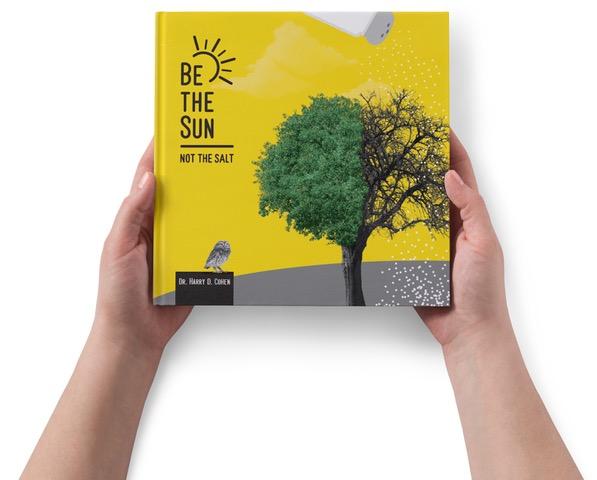
“The choice exists in each moment for us to be uplifting, like the sun on the leaves of the plant, or we can be depleting like the salt on the roots of that plant,” Dr. Cohen said in a recent interview with The Epoch Times.
An Ann Arbor, Michigan-based psychologist, coach, husband, father, restaurateur, and self-described “seeker of wisdom,” Cohen said his a-ha moment—this simple way to be, rooted in the heliotropic phenomenon where plants turn toward the sun for their energy—didn’t happen all at once, but came after decades of listening and learning.
In fact, Cohen, 70, himself didn’t realize that spreading this one idea would become his lifelong mission—until it did.
“The light bulb was the simplicity of the metaphor,” he said.
Finishing up his TEDx Talk in March, it crystallized for him: He realized, “I don’t need to do anything other than hone the articulation of the point.”


Focus on Your Own Behavior
“I read a chapter a day, every single day, and then write a note, ‘Here’s how I intend to practice today’s lesson’, so that it’s more real, and it’s never ending in terms of information and wisdom that I collect and go,” Cohen said, explaining how people, including himself, can use the book as a blueprint to living a healthier life.Unlike many other self-help manifestations, it doesn’t matter what your background or family history is, or how you’ve been living your life up to this point. Growing up in Buffalo, New York, Cohen said his own family was not a force of positivity.
“My father was glass half empty. My mother was more glass half full,” he said. “They weren’t abusive but angry. They were not aware of the power of emotional regulation, the power of leaning into being a better human being.“
All it takes to start your path of positivity is “the tiniest of things,” Cohen said. “What I keep learning about is, the little-er the better.”
What does that “smallest thing” look like for someone wanting to put positivity at the forefront?
“Showing up on time; taking a breath; asking someone how they’re doing,” Cohen said.
“I didn’t say to you this morning for example, ‘How are you? How can I help you?’ I mean that’s little. I could go on and on about the little stuff—conversations you get into, words we use, how the words I use can be more effective, more heliotropic. They’re endless.”
For Cohen, this has now become his life’s work. He doesn’t see the need to do anything else but keep spreading it.
“This is a lifelong noble effort,” he said. “The lifelong piece is, ‘We'll never be done with this.’ I know my motive. I know why we’re doing this. And I know it’s good. And that’s why I’m doing this until I die.”
Don’t ‘Eat’ Everything
In today’s social media-obsessed world, the challenge is greater, Cohen said. He regards choosing the social media we follow as a metaphor for choosing the food we put into our bodies.“Monitor your media intake, watch what you ingest, be mindful of the stuff that is put on the buffet before us,” he said.
“We won’t get to eat anything we want. There’s a million things on a buffet and I look at it and go, No. No, No, No. That’s decent. No, no, no, no. Oh, I guess I can eat this, this, and this because I know enough to know that this, this, and this is good.”
Research consistently links optimism to better well-being, something Cohen taps into with his “sunny over salty” philosophy.
“It’s every single thing that I do, and more importantly, don’t do,” Cohen said about walking the walk.
“It took decades for the establishment and for the mass media to go: ‘Yeah, I guess smoking is not good for you.’ And they’re just starting now with sugar and processed food and alcohol. And maybe decades from now ... but that’s what we are up against.
“It’s OK for me. It’s a noble fight. I’m not going to get dissuaded by the avalanche of negativity.”