Unless states follow through with reciprocal urgency, little of this federal momentum will matter beyond the Beltway, nuclear energy experts and industry leaders warn.
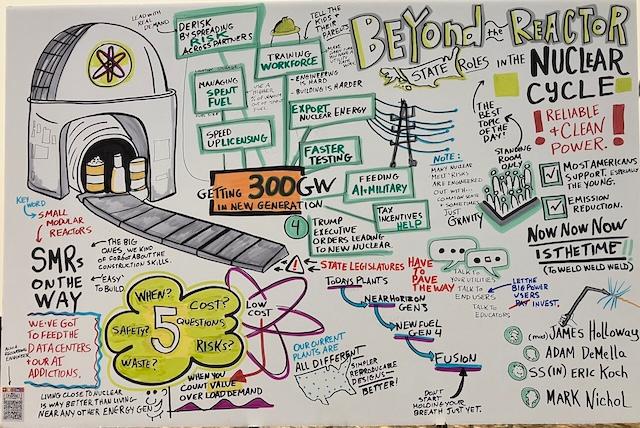
To meet the president’s goal of adding 10 new reactors to the 94 in 54 nuclear power plants now operating in 28 states by 2030, legislatures must foster a “conducive regulatory environment” and “incentivize” venture interest, the panel, moderated by Dominion Energy Vice President for Nuclear Engineering and Fleet Support James Holloway, said.
That includes streamlining permitting, revising siting requirements, expanding workforce programs, and “de-risking” up-front investment by aggressively orchestrating collaborative partnerships, panelists said.

Some lawmakers see the unfolding “nuclear renaissance” as a competition between states to “dominate nuclear energy,” a provincial insularity incongruous with how the nation’s integrated interstate electricity grid works, he said.
Indiana Initiatives
DeMella, a self-professed “recovering engineer,” said workforce development is a critical component that states must spearhead to grow nuclear power capacity.“This is where states have a key role. States can work with universities, two-year colleges. They can work with certificate programs, training schools,” he said.
The nation’s nuclear energy industry is in dire need of nuclear engineers, DeMella said.
“And not just nuclear engineers, mechanical and electrical [engineers]. We also need program managers. I'd argue we need them even more,” he said.
“Even more than that, we need welders. We need electricians. We need all the folks who put on hard hats to go to work.”
“We’re doing a lot of things” to “advocate workforce development in skilled trades, particularly welding,” he said. “The building trades in Indiana have been a strong ally. For that reason, we want to attract SMR [small modular reactor] manufacturers to Indiana.”
“It’s getting lots of attention, and we’re getting lots of calls,” Koch said.
HB 1007 is among a series of related bills that legislators approved in 2025, but it took a multiyear effort to define and encode the state’s aspiration “to position Indiana to become a leader in ... the manufacturing of SMRs,” he said.
“Three years or so ago, we began a very aggressive legislative effort to incentivize SMRs, beginning with tasking Purdue University, which has a world-class engineering school, to prepare a report and recommendation from that report,” Koch said.
SB 424 establishes “energy production zones” that stipulate if there is a site now or in the past being used to produce energy—such as a coal mine—“then that land should be allowed to produce energy from whatever source in the future,” Koch said.
He noted there are now “about 40 [energy production zones] around our state, including eight identified by the Purdue study as the most suitable for nuclear.”
The bill seeks to “de-risk investment in SMRs and encourage partnerships between a utility and what we call ‘eligible partners,’” sharing costs with third parties such as tech companies, universities, other utilities, and the military, Koch said.
Any state with research institutions, trade schools, and a commitment to developing an industry that provides clean, affordable power and good-paying jobs can replicate Indiana’s approach, he said.
With the federal government promoting nuclear energy and states clearing away regulatory obstacles while boosting workforce programs to build and sustain reactors, the onus will be on the nuclear industry to meet the moment, DeMella said.
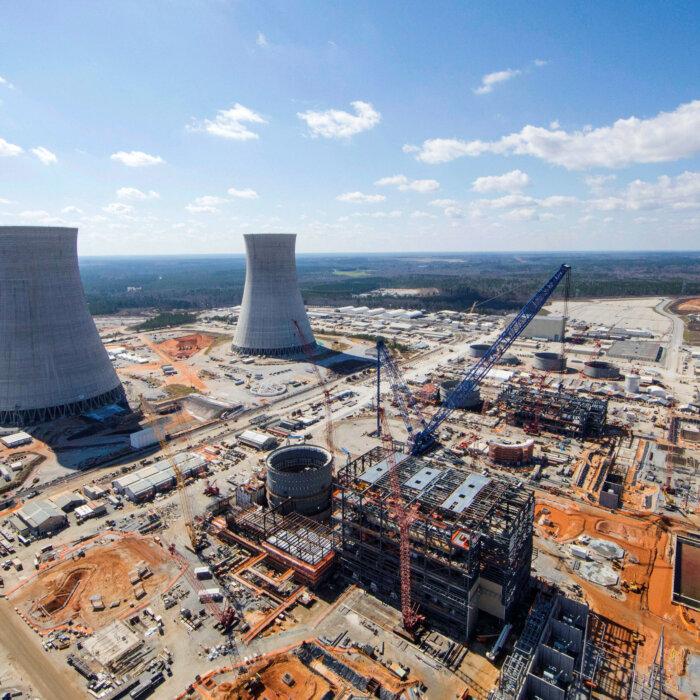
That’s not a bad place to be, considering the last new nuclear reactor to go online in the United States was in 2016, he said.
“We have to deliver—that’s the next step,” DeMella said. “We have to do it on time. We have to do it on budget.”