Firearms manufacturer Sig Sauer has been criticized over its reaction to safety concerns about the company’s flagship P320 pistol after the death of a U.S. serviceman.
U.S. Air Force Airman Brayden Lovan, 21, died from a gunshot wound to his chest at 1:30 a.m. on July 20.
The shot came from his holstered M18 pistol, which allegedly discharged as he placed it on a desk. The M18 is the military variant of the P320.
The Air Force is investigating Lovan’s death, and the Air Force Global Strike Command, at Barksdale Air Force Base, Louisiana, pulled the pistol from service.
Phil Strader, the executive vice president for consumer affairs for Sig Sauer, said the company has offered to assist the Air Force in its investigation.
The airman’s death has fueled outrage in Second Amendment circles, in light of Sig Sauer’s statement this spring responding to critics.

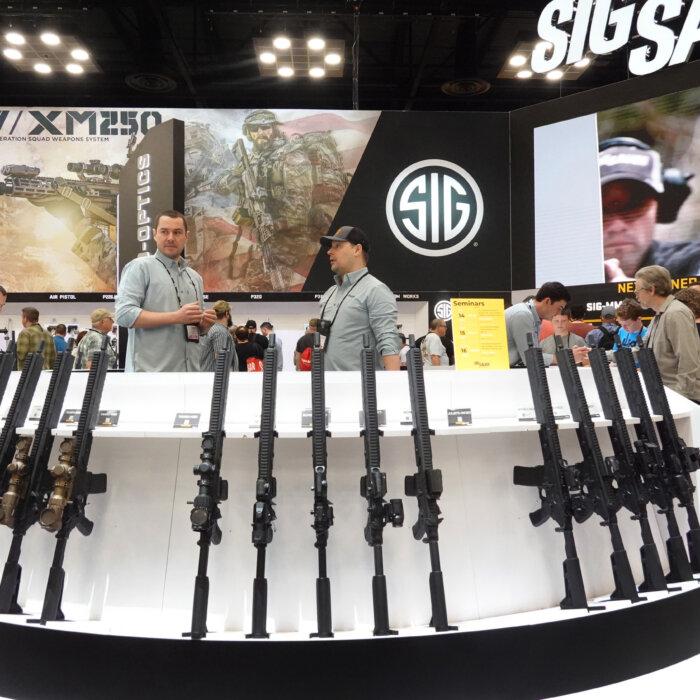
Many of the public comments have taken Sig Sauer to task for taking a “blame-the-victim” approach to the safety concerns that have been raised.
The statement reiterates the company’s claim that the pistol is reliable and safe, and ends with a warning to other gunmakers.
“Industry, take notice; what’s happening today to Sig Sauer with the anti-gun mob and their lawfare tactics will happen tomorrow at another firearms manufacturer, and then another. Today, for Sig Sauer—it ends.”
Brandon Herrera, a popular YouTuber and Second Amendment activist, criticized the company in an online video for accusing its critics of being “anti-gun.”
“I don’t think this detective who shattered her (expletive) femur is ‘anti-gun,’” Herrera said in the online video. “She might be anti-Sig now.”
Richard Hy, host of another YouTube channel focused on military and law enforcement issues, said Sig Sauer’s reaction is questionable at best.
One online response may have caught regular consumers of Second Amendment content by surprise.
John Correia runs a company called “Active Self Protection.”
In his online videos, Correia reviews shootings and other self-defense situations to glean lessons to be learned.
He focuses almost exclusively on self-defense issues.
In addition to his online content, Correia teaches self-defense classes and is an expert witness in court proceedings.
He also criticized the company’s handling of the matter.
“It’s like a master class in how to ruin your reputation in an industry,” he said.
Herrera told The Epoch Times the controversy was a warning for the company.
“Instead of fixing the issue, Sig has attacked those who point out safety concerns. This, hopefully, will be the wake-up call needed, and one that can’t be swept under the rug,” Herrera said in a direct message to The Epoch Times.
Matthew Wilde, a self-described firearms enthusiast, collector, and YouTube content creator, also takes issue with the company’s response.
He denies having an anti-gun agenda or ill feelings toward Sig Sauer. He said he just wants to help find a solution.
“I have never seen a company attack their customer base or do something their customers would see as an attack,” Wilde told The Epoch Times.
Watching the Sig Sauer debate from his home in Wyoming, Wilde decided to investigate. While he is not a gunsmith, the U.S. Army veteran has several years of experience in maintaining and shooting the P320.
He read an FBI report done for the Michigan State Police after an unintentional discharge.
Wilde decided to devise a test to determine if the pistol would fire on its own. He used a screw to put slight pressure on the trigger to simulate conditions outlined in the FBI report.
He then began tapping and wiggling the slide on the P320 but avoided touching the trigger.
He was able to get the pistol to fire five times in a row without pulling the trigger completely. Wilde said he could not replicate the results on his other, newer P320s.
Wilde said it’s important to keep his experiment in perspective. He said he is not claiming to have found the answer to what happened to Lovan. But he does believe it shows the possibility that some P320s could fire on their own.
Sig Sauer’s Strader dismissed Wilde’s test.
He said Wilde could only get the gun to fire by putting pressure on the trigger, essentially pulling it. Sig Sauer engineers have replicated Wilde’s test with Glock and Smith & Wesson pistols, he said.
“[Wilde’s] video simply proves the P320 trigger must move to the rear to fire the pistol,” Strader said.
Still, dozens of injuries have been reported over the years, including that of a police officer shot in the leg when her P320 allegedly discharged from her holster as she loaded items in her patrol vehicle last June.
Many who claim to have been injured by the P320 have sued the company.
The U.S. District Court for Eastern Pennsylvania rejected a claim by an Immigration and Customs Enforcement agent that his P320 wounded him while it was holstered.
The court rejected an expert witness and said the plaintiff failed to prove the pistol was flawed. He has appealed that decision.
In 2020, Sig Sauer paid almost $900,000 to settle a class action claim in the U.S. District Court for the Western District of Missouri.
In that case, owners of P320s manufactured before August 2017 claimed the guns would fire when the pistol’s action was unlocked and open.
This would allow gases to vent from the gun’s ejection port, possibly injuring the shooter’s hand.
In a letter to customers, Sig Sauer stipulated that its agreement was not an admission of responsibility.
The P320, first introduced in 2014, has been dogged by claims of “uncommanded discharges”—firing without the trigger being pulled—even while holstered.
The first complaints came shortly after the pistol won the Army’s Modular Handgun System competition to replace the Beretta M9 as the military’s issued sidearm in 2017.
At around the same time, reports began to surface that the gun would fire if dropped and it hit the ground at a certain angle.
That August—while maintaining that the pistol was safe—the company instituted a Voluntary Upgrade Program. P320 owners could return their guns to the company to have modified trigger assemblies installed.
“As a result of input from law enforcement, government, and military customers, Sig has developed enhancements in function, reliability, and overall safety, including drop performance,” a Sig Sauer press release said.
But the voluntary upgrade program didn’t quell the complaints.
From 2017 to the present, police, federal agents, and civilians have said that the gun is prone to firing if handled or bumped, with no trigger contact.
The company contends that it has tested the pistol and reviewed the claims.
According to Sig Sauer, the incidents were the result of operator errors.
In the months leading up to the death of the U.S. airman, Sig Sauer had mounted a public relations campaign that included interviews with prominent influencers on social media.
In cases where unintentional discharges are suspected, Sig Sauer is ready to investigate to solve any problems that may be found, Strader said.
That’s why Sig Sauer personnel met with the FBI and Michigan State Police to discuss the FBI report and to formulate testing protocols, Strader wrote in an email to The Epoch Times.
“Sig Sauer ... identified a consistent, measurable, and repeatable methodology for subsequent testing. After hundreds of tests using this methodology, no failures of the pistol’s safety systems were induced by FBI personnel,” Strader stated in the email.
“[The] Michigan State Police adopted a different light holster combination and has completely fielded the Sig Sauer pistol.”
While the company has been the object of lawsuits, it has taken legal action of its own.
On June 11, Sig Sauer sued the Washington State Criminal Justice Training Center and its executive director, Monica Alexander, over her Feb. 24 decision to ban the P320 from its training facilities, including firing ranges.
Sig Sauer claims Alexander overstepped her authority in banning the firearm and has denied the company due process by dragging her feet on its request for an administrative hearing.
William Kirk, a Second Amendment lawyer in the state of Washington, said he’s perplexed by Sig Sauer’s response.
He predicts that the company’s lawsuit against the Washington State Criminal Justice Training Center will fail.
Kirk said Alexander has the authority to limit access to the ranges, especially for safety concerns. He said it will be nearly impossible to find a judge or jury friendly to the gunmaker.
“They picked the bluest county in the bluest state [to file a lawsuit],” Kirk told The Epoch Times. “They might as well go outside and throw rocks at the moon. This state has no problem saying ‘no’ to gun owners.”
And, while he understands the need to defend a product, Kirk said the sheer number of complaints indicates there’s a problem.
“There’s just too much smoke for there not to be some kind of fire there,” Kirk said.
Strader said Sig Sauer stands by the P320 and its response to the criticism it is receiving.
He said much of the criticism is simply content creators generating “views, likes, and subscribers,” while ignoring evidence that the pistol will only fire if the trigger is pulled.
“Regardless of the accusations, Sig Sauer doesn’t place blame but only maintains that the P320 is the most tested pistol in our company’s history and can only fire when the trigger is pulled,” Strader said in an email to The Epoch Times.
Kirk said the debate has grown to the point that the ending will set a major precedent for Second Amendment media and the firearms industry.
“This is going to end spectacularly, one way or the other,” Kirk said.