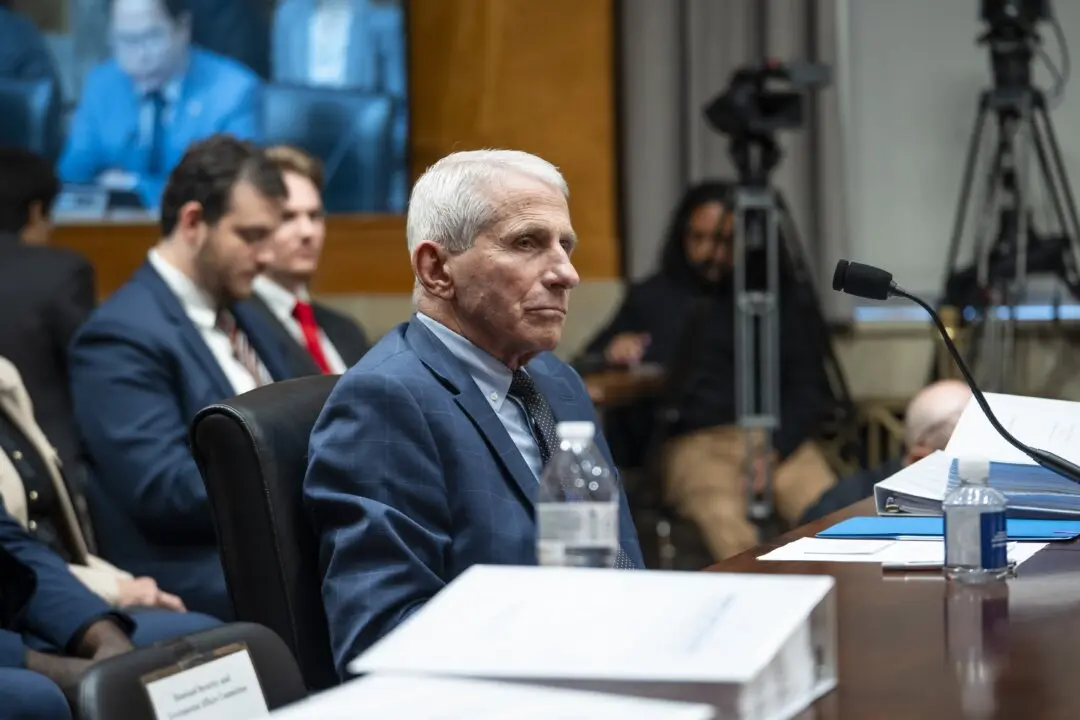
A Senate committee on Aug. 6 voted to hold Dr. Anthony Fauci, the former head of the National Institute of Allergy and Infectious Diseases (NIAID), in contempt of Congress.
The Senate Committee on Homeland Security and Governmental Affairs voted 8–5 along party lines. All Republicans voted to hold Fauci in contempt, and all Democrats, including two by proxy for the record only, voted not to hold him in contempt.
“When voluntary cooperation ends, Congress must be able to compel compliance with its lawful demands. That is Congress’s compulsory instrument,“ Sen. Rand Paul (R-Ky.), chairman of the panel, said before the vote. ”A subpoena is not an invitation. A subpoena with no consequence is not a subpoena; it’s a suggestion.”
Sen. Gary Peters (D-Mich.), the top Democrat on the committee, said before the vote that Republicans were offering the resolution “without making the case that there is a legal basis for holding Dr. Fauci in contempt.”
The committee hand-delivered the contempt resolution to the Department of Justice, Paul told reporters on Thursday.
The U.S. Attorney’s Office for the District of Columbia and an attorney representing Fauci did not immediately respond to requests for comment.


The full Senate could have considered the matter prior to making a referral to prosecutors, but Paul has said that might result in a negative vote.
Peters said referral without a vote from the Senate “would be even more dangerous, and a widely unprecedented move.”
Contempt of Congress is when a person who was subpoenaed by Congress “willfully makes default, or who, having appeared, refuses to answer any question pertinent to the question under inquiry.” Each count carries up to 12 months in prison.
Fauci, during that appearance, read a prepared opening statement noting that he had previously testified before congressional panels, before criticizing Paul and stating that he would not be answering any questions. For the rest of the hearing, Fauci said he was invoking his Fifth Amendment right against self-incrimination.
“The fact that he wouldn’t answer questions about the tie he was wearing, or the color of the carpet, the day of the week … betrays the fact that his invocation of the Fifth Amendment wasn’t tailored to anything,” Sen. Josh Hawley (R-Mo.) said on Thursday. “It was a predetermined, premeditated design to evade this committee’s questions on any subject.”
The Senate panel turned down a number of motions from Democrats to table the resolution, including one from Sen. Richard Blumenthal (D-Conn.) that would have requested federal prosecutors provide Fauci with immunity in exchange for testimony about matters related to COVID-19. Blumenthal said Fauci had a reasonable fear, based in part on Paul saying publicly that he wanted Fauci prosecuted.
Fauci’s lawyer, David Schertler, has said that Paul’s calls to prosecute Fauci trigger “what the Supreme Court has called a ‘basic function’ of the Fifth Amendment—‘to protect innocent men … who otherwise might be ensnared by ambiguous circumstances.’”
Several individuals who advised President Donald Trump during his first term were convicted of contempt of Congress after declining to cooperate with a congressional committee. They each served several months in prison.