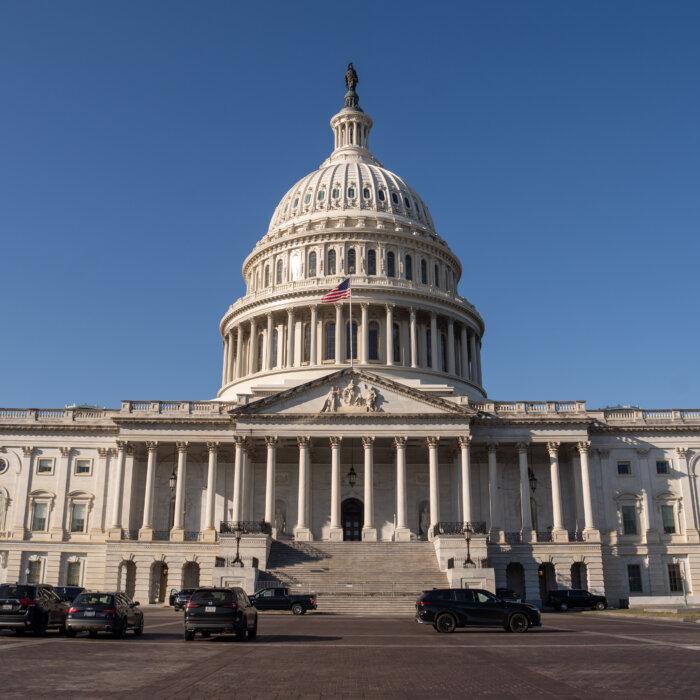
The U.S. Senate on Thursday evening approved a tranche of 97 of President Donald Trump’s nominees for the executive branch as hundreds more await confirmation.
In a 53–43 vote, the Senate gave the green light to the resolution authorizing the confirmation of these nominees together as a group, marking the third slate of nominees approved through such a measure.
The vote was party line, with Sens. Cory Booker (D-N.J.), Dick Durbin (D-Ill.), and Elizabeth Warren (D-Mass.) not voting.
Many nominees included in the resolution are lower profile.
Those on the list include Department of Homeland Security General Counsel nominee James Percival, who is expected to play a role in defending the administration in disputes over mass deportation, and Treasury Department anti-terrorism nominee Jonathan Burke, who would help combat funding for groups designated as terrorist organizations by the administration, including trans-national drug cartels.
The list also includes Yehuda Kaploun, who has been nominated as special envoy to monitor and combat anti-Semitism, which is described as an ambassador-equivalent position.
It would also give Tammy Bruce, who has served as the top spokesperson for the State Department during Trump’s second term, a promotion to deputy to UN Ambassador Mike Waltz. The post is equivalent to an ambassadorship, and Bruce would serve as Waltz’s No. 2 for all U.S. activity at the United Nations.
Dispute on Nominees
The vote fits into a broader power dispute between Senate Democrats and the White House over nominees.Historically, the president’s picks for lower executive branch positions have been confirmed by the upper chamber through unanimous voice votes, allowing dozens or hundreds of nominees to be quickly confirmed in minimal time.
Since Trump reclaimed the White House, however, Democrats have broken from this precedent, using a variety of Senate parliamentary measures and traditions to slow the confirmation of lower level appointees to a crawl.
Primarily, lawmakers have withheld their support for unanimous consent confirmations, instead using the full amount of time for debate allowed under the Senate’s rules for every nominee. This means that nominations previously confirmed by the dozens can take an entire legislative day to work through.
These procedural delays have prompted frustration from the White House, with Trump telling reporters in August, “If George Washington or Abraham Lincoln were up for approval, the Dems would delay as long as possible, then vote them out.”
Under the tradition, senators from the state in which a judicial nominee has been selected to serve can unilaterally block the nomination.
This has been particularly applied to U.S. attorney nominations under the current administration.
In states like New Jersey, New York, Virginia, Washington, and elsewhere, Trump’s nominees for the top prosecutor job have been blocked by the states’ Democratic senators.
This month, Trump reiterated his long-running calls for the Senate to ditch the practice.
“They should get rid of blue slips. If you have one Democrat in a state, it is not possible to appoint because of blue slips,” Trump said on Dec. 16.
These calls have faced difficulties, with Senate President pro tempore Chuck Grassley (R-Iowa) leading GOP opposition to abandoning the tradition.