
The April update pertains to both the criteria for members of the Advisory Committee on Immunization Practices (ACIP) and the scope of the committee. Charters for federal advisory committees such as ACIP must be refiled every two years, according to federal law.
Key Changes
One major update is the loosening of membership requirements.The only exception to those requirements was for at least one person who had knowledge regarding “consumer perspectives and/or social and community aspects of immunization programs.” That usually applied to one person in the past.


Retsef Levi, a professor of operations management at the Massachusetts Institute of Technology, and one of the people selected by Kennedy, told The Epoch Times in an email that “the new charter reflects a very positive change towards [a] more comprehensive assessment of benefits and risks of vaccines that leverages and integrates [a] broader set of relevant knowledge domains and expertise.”
The updated charter also adds language on immunization safety. It now says that in addition to providing advice to the director of the Centers for Disease Control and Prevention on effectively controlling vaccine-preventable diseases, ACIP will advise the CDC on “decreased symptomatology” for the diseases and “gaps in vaccine safety research including adverse effects following vaccination.” Additionally, ACIP shall also be responsible moving forward for “reviewing vaccination schedules by other countries and international organizations.”
Barbara Loe Fisher, co-founder and president of the National Vaccine Information Center, told The Epoch Times in an email, “From a consumer perspective, the new ACIP charter is encouraging in that it contains language about the duty of the federal vaccine policymaking committee to review data on vaccine safety and adverse events, fill in knowledge gaps about vaccine risks, and make recommendations about vaccination schedules that take into account cumulative exposures to vaccines and vaccine components, among other factors.”
New Liaisons
Organizations, including the American Academy of Pediatrics, have long served as liaisons to ACIP, often working with committee subgroups behind the scenes and speaking during public meetings in favor of expanding vaccine schedules.Kennedy added four such groups, including Physicians for Informed Consent, a nonprofit that often provides a view that is alternative to the CDC’s regarding vaccines.
“We have been educating the public about this (and more) for years, so we are honored and grateful to now have a seat at the ACIP table ... where our points can be better heard,” Dr. Shira Miller, founder and president of Physicians for Informed Consent, told The Epoch Times in an email.
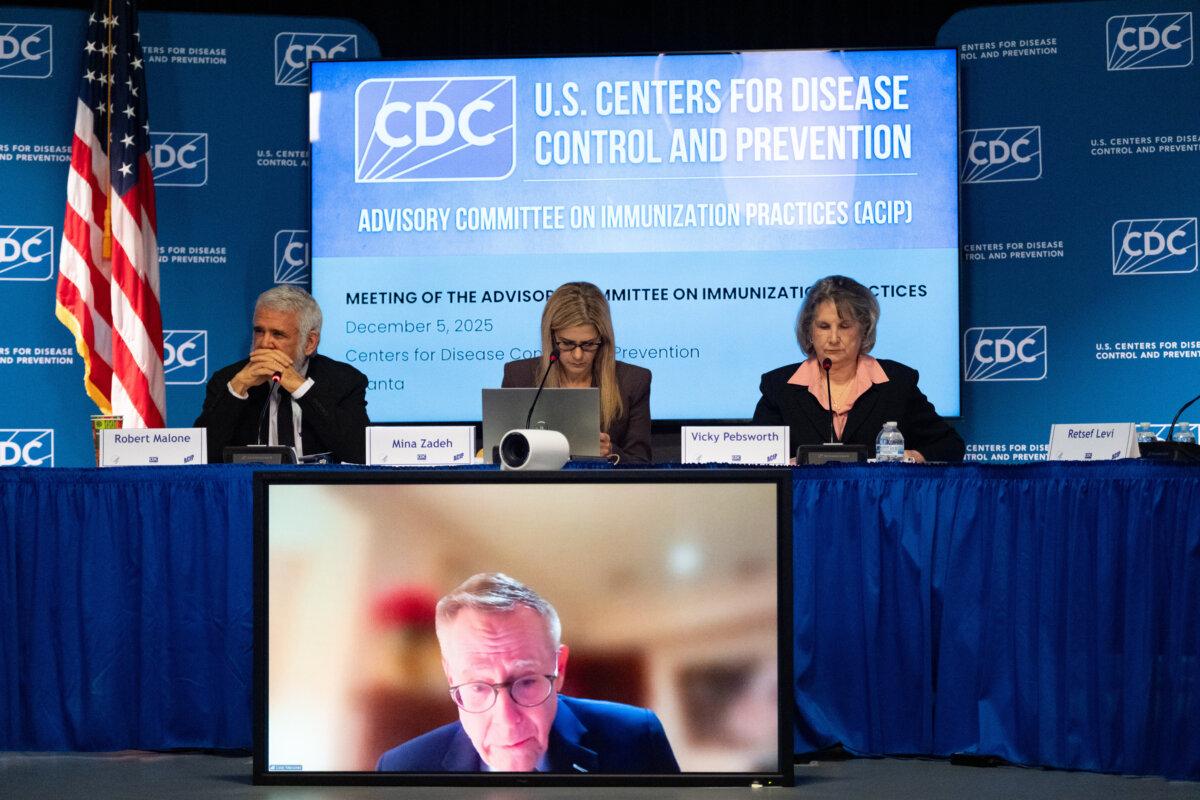
Some of the other liaisons have ties to or represent pharmaceutical interests.
The American Academy of Pediatrics, a liaison and one of the plaintiffs in the case that resulted in the recent judicial ruling, accepts money from pharmaceutical companies. The Pharmaceutical Research and Manufacturers of America, another liaison, is composed of drug and vaccine manufacturers.
Recent ACIP meetings have featured liaisons’ criticisms of the proceedings, prompting pushback from panel members who said the liaisons were biased.
“It is very important for the ACIP to receive input from groups not compromised by funding from enterprises the government is supposed to regulate,” Dr. Jane Orient, executive director of the Association of American Physicians and Surgeons, another new liaison, told The Epoch Times in an email.
Reactions, Next Steps
“This is a good step toward having a committee that considers vaccine safety as well as efficacy,“ Aaron Siri, a lawyer who has represented Kennedy and who sent the recent letter on behalf of the Informed Consent Action Network, told The Epoch Times in an email. ”Children harmed by vaccines deserve the same protection as those potentially harmed by infectious disease.”
“These are the changes we have been fighting for,” he said. “This is what it looks like when it starts to work.”
Kennedy has not commented on the changes. The Department of Health and Human Services declined to answer specific questions about certain updates.
“The ACIP charter renewal and its publication are routine statutory requirements and do not signal any broader policy shift,” a spokesperson told The Epoch Times in an email.
Dr. Ronald Nahass, president of the Infectious Diseases Society of America, one of the old liaisons that has been retained, said in an April 9 statement that the changes “appear to skew ACIP’s work toward vaccine safety and adverse events, rather than maintaining the committee’s balanced and thorough approach that traditionally has considered the full scope of vaccine data, including the benefits of reducing disease burden.”
Nahass said that the next steps for ACIP remain unclear.
Administration officials said in March, shortly after the judge blocked changes to ACIP and vaccine guidance, that they were confident the administration would prevail in an appeal.