Under the 1980 Equal Access to Justice Act (EAJA), attorneys representing nonprofits, individuals with a net worth of less than $2 million, and businesses with a net worth of less than $7 million can file a claim for the government to pay their fees if a judge determines that an agency’s action was “not substantially justified” or a case is adjudicated to avoid legal proceedings.
The law was designed to ensure that those with limited resources—Social Security recipients, veterans, mom-and-pop businesses—can have their day in court in taking on the federal government.
But House Republicans say provisions that exempt nonprofit “serial litigants” from EAJA eligibility caps are fostering a cottage-to-penthouse “sue-and-settle” industry, especially when challenging actions under the 1969 National Environmental Policy Act (NEPA) and the 1973 Endangered Species Act (ESA).
“While well-intentioned, EAJA has enabled well-funded radical environmental nonprofits to engage in ‘lawfare’ campaigns,” said Rep. Paul Gosar (R-Ariz.), chairman of the House Natural Resources Committee’s Subcommittee on Oversight and Investigations.


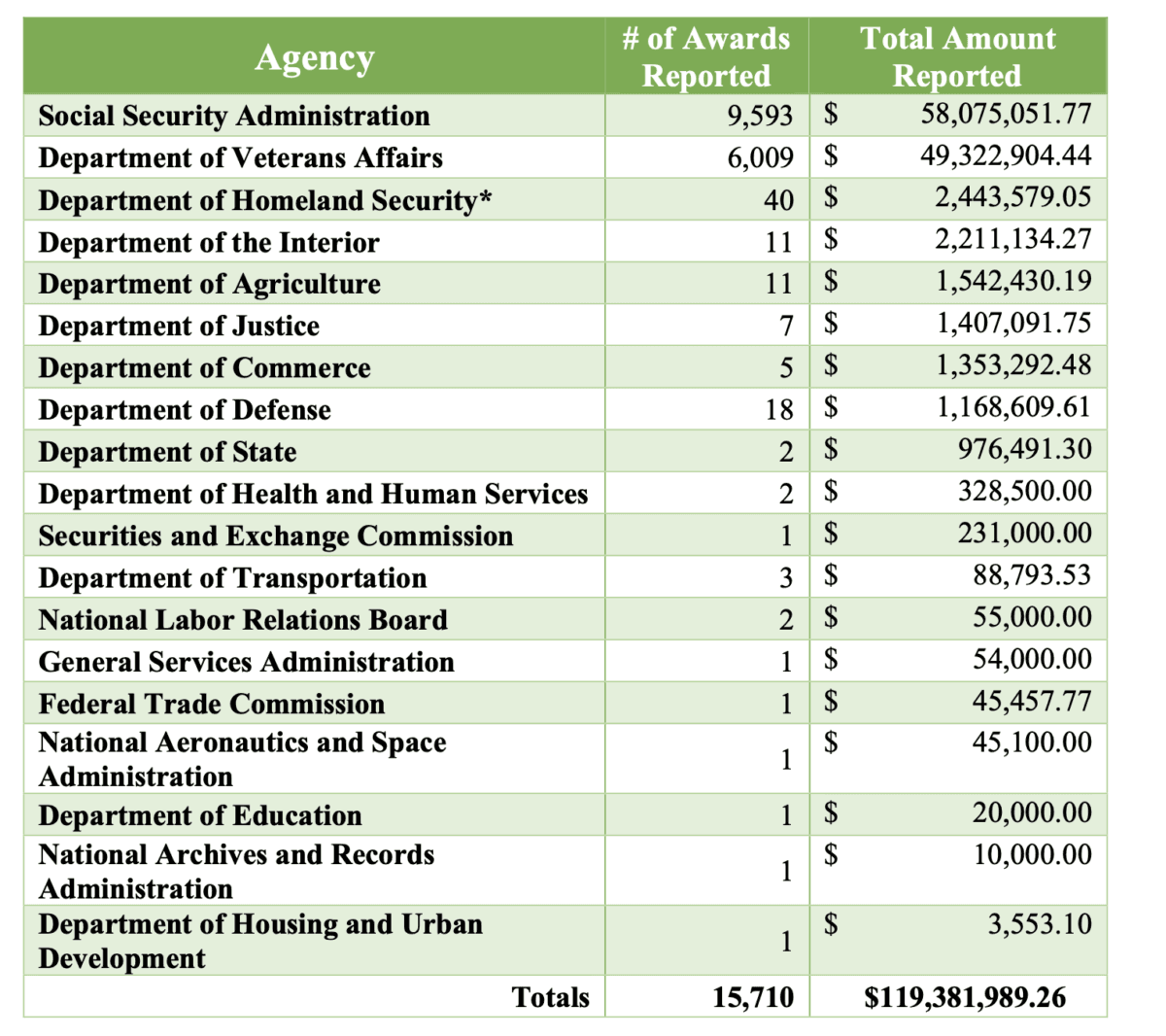
Gosar said that between 2019 and 2024, federal agencies paid $24.8 million in fees related to NEPA, ESA, and other environmental laws. In 2024, according to the Administrative Conference of the United States, the Department of the Interior paid $2.2 million in 11 awards and the Department of Agriculture paid $1.54 million in 11 awards in EAJA fees.
House Democrats claimed that the EAJA awards granted to attorneys representing environmental nonprofits—$3.7 million in 2024—do not justify diluting EAJA, linking the reform effort to GOP efforts to revise environmental, safety, health, and civil rights laws.
“Reducing EAJA eligibility would be a giveaway to large firms and industries,” Rep. Maxine Dexter (R-Ore.) said. “If ‘abuse’ of the judicial system is of interest to [Republicans], they could focus on frivolous [strategic lawsuits against public participation] lawsuits brought by people or companies with a lot of money to silence opposition.”
Although “good-faith efforts to improve transparency” are worthy of discussion, she said, “changes to EAJA that would make it harder for rural or low-income communities, individuals, small businesses, or organizations to access justice [are] a non-starter.”

Reform Recommendations
Regina Lennox, senior counsel for the Texas-based Safari Club International, said EAJA “allows for fees on fees, meaning if government objects to a fee claim and loses it, it owes additional fees.”“This disincentivizes government attorneys from challenging fee claims and incentivizes them to settle cases,” she said.
She said her nonprofit, which has more than 100,000 members across the world, has “five targeted amendments” to reform EAJA.
“First, the same net worth cap should be applied to nonprofits as to every other entity,“ Lennox said. ”Nonprofit is a tax status ... not a license to have government fund an organization’s litigation.”
EAJA-eligible nonprofits often contract large law firms such as Earthjustice, which she said has a $240 million net worth, and pay them with fee awards.
“Government should not subsidize wealthy special interest groups to sue itself,” she said.
“[Congress should limit] the number or amount of EAJA awards per organization per year,” Lennox said. “Limit recovery of EAJA awards when there are multiple suits challenging the same action, and disallow awards for merely procedural relief.”
The “‘attorney expertise’ loophole” that allows fees of up to $600 per hour should be rescinded, she said, although increasing the $125-per-hour rate set in 1996 is justified.
EAJA reform should also require courts to distinguish between awards paid by the Treasury Department and those paid from agency budgets, Lennox said, contending that money spent by the Department of Justice in defending agencies should be included.
South Dakota rancher and attorney Todd Wilkinson, a former National Cattlemen’s Beef Association president and 2026 South Dakota Senate candidate, said lawsuits that challenge grazing leases on public lands and sue the cattle industry represent a cash cow for what he said are “adversarial radical environmental groups.”
What is galling, he said, is the fact that “environmental NGOs gin up their credibility based on fee awards and their repetitive lawsuits.”
“[Litigation] isn’t to raise revenue?” he asked. “That’s the very definition of it.”
Fee awards totaling $24 million to environmental groups from 2019 to 2024 are “just the tip of the spear” in calculating costs, Wilkinson said.
“The issue isn’t the amount awarded,“ he said. ”It’s all the money spent fighting these lawsuits.”
“[When ranchers cannot operate] because a federal agency can’t make a decision because they’re tied up in court, that affects their livelihood,” Wilkinson said. “If you’re not able to get permits, delay is death.”
Travis Joseph, president of the Oregon-based American Forest Resource Council, said: “[What is] really frustrating in the forest management space [is] winning a lawsuit isn’t leading to better conservation outcomes. It’s leading to more process and cost to the agency and the taxpayer.”
His trade association, which represents lumber companies, sawmill operators, landowners, and the forest products industry in six states, is beset by what he called “ideological” litigation that prevents agencies from implementing programs to improve forest health and mitigate wildfire risk.
“EAJA allows litigation,“ Joseph said. ”Litigation leads to delay. Delay leads to loss of infrastructure and business. You don’t even need to win the lawsuit to have an impact. In fact, most of these challenges are not successful.”
Reform ‘Myths’
Lewis and Clark Law School professor Daniel Rohlf, director of Earthrise Law Center in Portland, Oregon, a self-described “environmental legal clinic” funded through fee awards, grants, and donations, said EAJA critics invent “myths.”“Myth number one does double duty,” he said, referring to the House subcommittee hearing’s title, “Abuse of the Equal Access to Justice Act by Environmental NGOs,” and contending that winning lawsuits “by definition” refutes claims of abuse.
“Attacks on EAJA have little to do with ‘abuse,’” Rohlf said. “Rather, they target environmental groups’ success in forcing federal agencies to comply with their legal responsibilities. This service to the public is ... exactly what Congress intended [in adopting the EAJA].”
“Myth number two is [that] many environmental cases leading to EAJA awards involve trivial or technical issues, such as procedural errors or missed deadlines,” he said. “My students would love this one. They'd be delighted to skip deadlines for turning in papers.”
“[ESA deadlines for listing endangered species] in a timely manner ... may make the difference between a species’ survival and extinction,” Rohlf said. “Yet, the same people who howl with protest if federal range managers delay the turnout date of their cattle by even a day, [call] lawsuits about deadlines much ado about nothing.”
The third myth, according to him, is that “settlements are bad.”
“On the contrary, in many cases settling a dispute without protracted court proceedings benefits both sides, as well as the public,” he said.
Moreover, restricting larger organizations from seeking attorney fees will tilt the playing field in favor of the wealthy and corporations, according to Rohlf.
“Large NGOs can take action ... that may otherwise go unaddressed without an organization that has resources and tools to recognize, publicize, and resolve those problems,” he said.
Dexter said permitting reform “is absolutely“ something legislators are talking about, and recognized such reform as ”a bipartisan desire.” However, she said, the EAJA reforms offered by Republicans have wider implications.
“I am concerned that attacks on one smaller group could open the door to attacks on the ability of veterans to get their due from the government,” she said, noting that VetLex, a law firm funded by EAJA fees to represent veterans, and the National Organization of Social Security Claimants call the reforms “a direct attack on the ability of vulnerable Americans to seek redress in [U.S.] courts.”
“I’m not sure we’re talking about the same law here,“ Dexter said. ”I’m stunned my Republican colleagues want to limit people’s ability [to access justice]. If government is ... failing to implement and enforce laws passed by Congress, then it’s our job to make sure ... people have access to that justice.”