A pending pact between South Carolina’s state-owned utility and a Canadian American corporation to complete nuclear reactors mothballed since 2017 could relieve Palmetto State taxpayers of billions of dollars in debt and be a precursor to similar public-private partnerships that will not leave utility customers on the hook for project cost overruns and failures.
Santee Cooper’s 14-member board agreed on Oct. 24 to negotiate with Brookfield Asset Management to resume development of two partially built Westinghouse AP1000 nuclear reactors at the V.C. Summer Nuclear Station it shares with Dominion Energy near Jenkinsville, South Carolina.
Details are to be negotiated before the board’s Dec. 8 meeting, he said, but one thing is certain: “There are no additional financial risks for our customers at all.”
Brookfield will assume responsibility for the project, supplying Santee Cooper with an undetermined amount of electricity and selling the rest to developments that the new power source will draw to the region.
“We’ve protected the ratepayers of South Carolina and, quite frankly, I think we’ve shifted the paradigm of how nuclear energy gets built here in the United States,” Staton said. “Instead of risk being absorbed by customers, [risk] will be absorbed by private entities seeking to build these assets.”

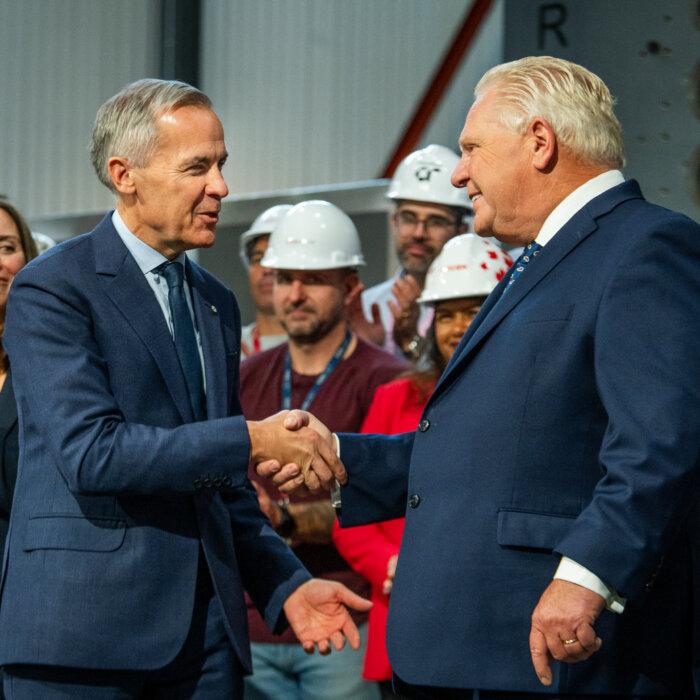
Brookfield Asset Management is a component of Brookfield Corp., a Toronto-based global investment firm with 250,000 employees in 50 countries and $1 trillion in assets. Brookfield Corp. moved its main headquarters to New York City in December 2024.
Santee Cooper sealed a 2007 deal with Westinghouse Electric to build two nuclear reactors at V.C. Summer, where South Carolina Electric & Gas had been operating a reactor since 1984. Dominion Energy purchased the company in 2019.
Construction began on the 1,117-megawatt (MW) reactors, cumulatively capable of powering more than 1 million homes, in 2013. They needed to be operating within seven years to garner state and federal tax credits to offset Westinghouse’s investment.
Delays drove up costs. Combined with similar issues in concurrent construction of two Westinghouse AP1000 reactors at the Alvin W. Vogtle Electric Generating Plant in Georgia—completed in 2023, seven years late and for $20 billion more than the original cost—the project spiraled into insolvency.
With costs topping $10 billion for an originally tabbed $9.8 billion venture, the project had no prospect of meeting 2020 tax credit deadlines. Westinghouse pulled the plug in 2017 and declared bankruptcy, leaving customers with a $9 billion bill for what was already expended.
Brookfield purchased Westinghouse in 2018. In October 2022, it formed a partnership with Cameco Corp., based in Saskatchewan, Canada, and among the world’s largest publicly traded uranium companies, to galvanize Westinghouse, which owns patented technologies inherent in half the world’s nuclear reactors.
Brookfield now owns 51 percent of Westinghouse and Cameco owns 49 percent. Westinghouse will assume control of the site to complete what it started more than 12 years ago.
“[The agreement] will help unlock the potential that Westinghouse and nuclear energy can play to accelerate the growth of artificial intelligence in the United States, while meeting growing electricity demand and energy security needs at scale,” Brookfield Asset Management President Connor Teskey said, noting that Brookfield will double the $500 billion it invested in the United States “within the next decade.”
‘Great Day’ for South Carolina
Brookfield’s pending pact with Santee Cooper preceded its Oct. 28 Energy Department agreement, but Staton signaled that the corporation, vertically integrated for extracting uranium with Cameco and building reactors with Westinghouse, is a favored federal vendor.“A changing market in the face of dramatically increasing demand [and Trump’s policies] have provided an impetus to construct large-scale nuclear,” he said.
This prompted Santee Cooper to solicit bids to revive the project.
The proposal drew interest from 70 companies and received 15 bids in “a competitive process” reviewed by New York City-based Centerview Partners and J.P. Morgan, according to Staton, but Brookfield stood out.
“They have an incredible balance sheet and tremendous capital availability,” he said, noting that Brookfield owns more than 46,000 MW of generation, enough to power Los Angeles, with plans to build 227,000 MW.
“They have a track record—and that’s very important here.”
Brookfield is no stranger to South Carolina, he said, with $3 billion in investments and 2,000 employees in the state.
“Our goals included completing these reactors with private money and no ratepayer or taxpayer expense, delivering financial relief to our customers and gaining significant additional power capacity for South Carolina,” Santee Cooper Board Chair Peter McCoy said.
“Brookfield’s proposal would do just that. And the company has the financial capability to stand behind its proposal.”
Both praised South Carolina Gov. Henry McMaster and state lawmakers for committing resources to allow Santee Cooper to maintain the site, making it look “more like something that had been suspended only over a few months, not over seven years,” Staton said.
Among issues to negotiate is how much electricity will be committed to Santee Cooper and if $2.7 billion of $3.6 billion already paid from the $9 billion bill customers inherited can be absorbed by Brookfield or the Energy Department.
“President Trump’s executive order encouraged the completion of partially started nuclear resources,” Staton said. “I feel very comfortable that [the executive orders were] directed directly at Santee Cooper.
“We’re going to have thousands of folks working out at this site for five or six years. It’s going to spawn tremendous opportunity for other businesses to service the nuclear facilities, to locate here in South Carolina. The people of South Carolina will see significant benefit having clean energy brought to us by folks with great access to capital at no risk—no risk—to consumers.”
U.S. Nuclear Industry Council President Todd Abrajano said the project’s revival and interest in developing others is a win-win for the country.
“Efforts to bring reactors back online reflect the resurgence of America’s nuclear industry and underscore the value of nuclear energy as a reliable, carbon-free power source,” he said in an email to The Epoch Times.
Staton said: “It’s a great day for Santee Cooper. It’s a great day for the board, for our customers, and it’s a great day for the state of South Carolina.”