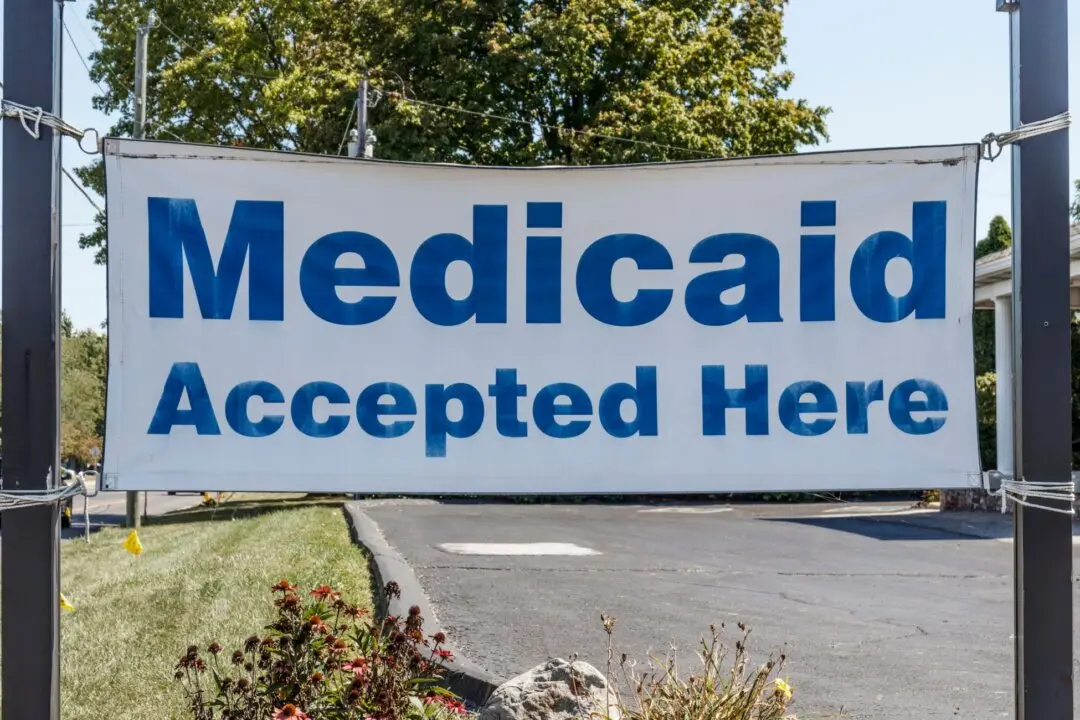
Under a new law that took effect July 1, New Jersey has imposed taxes on companies whose employees and employees’ dependents receive Medicaid.
New Jersey’s employer healthcare assistance tax, signed by Gov. Mikie Sherrill last week, aims to ensure that large companies do not rely on the government to provide health coverage to lower-wage employees rather than offering them affordable coverage as required by federal law.
New Jersey estimates that it spends $1,700 per person on Medicaid.
“Instead of asking taxpayers to foot that bill, this budget looks to large employers,” Sherrill said. “It asks any company with 50 or more employees on Medicaid—companies like Amazon and Walmart—to cover their workers, which they should do anyway; or pay a fine.”
The tax will raise state revenues by an estimated $145 million annually, the governor’s 2027 budget plan projected.
Nationally, more than 27.2 million able-bodied adults are working full-time and receiving Medicaid benefits, according to White House data. Employers with 50 or more employees are required to offer health coverage by federal law.

The New Jersey fees will start at $325 per person for companies with at least 50 recipients and top out at $750 for those with more than 500 Medicaid beneficiaries. Temporary, part-time, or seasonal employees are excluded from the requirements.
Medicaid is a joint state-federal insurance program for low-income or disabled Americans. The program costs taxpayers more than $960 billion in 2024, according to federal data. Federal taxpayers are responsible for 64 percent of that amount, and the rest is paid by the states.
Nearly 750 private companies and 80 government agencies are subject to the payment, according to a 2024 report from the New Jersey Department of Human Services.
These companies employed more than 141,000 Medicaid beneficiaries, who had more than 266,000 dependents covered by NJ FamilyCare—New Jersey’s Medicaid program.
That’s nearly one quarter of Medicaid beneficiaries in New Jersey.
By assessing employers based on the number of workers enrolled in NJ FamilyCare, the legislation created “incentives that could harm the very residents the Medicaid program is intended to help,” said Jennifer Spiegel, policy analyst at New Jersey Policy Perspective, a nonpartisan think tank whose website says it aims to “advance economic, social, and racial justice.”
A fee tied to recipients could discourage employers from hiring workers in Medicaid, causing more barriers for low-income workers and families in seeking jobs, according to Spiegel.
Other States’ Attempts
Some other states have taken actions similar to New Jersey’s employer tax, with mixed results.
Massachusetts enacted an assessment on companies having six or more workers when their non-disabled workers received MassHealth benefits, the state’s equivalent of Medicaid. That law was in effect from 2018 to 2019 before it was allowed to expire.
Colorado lawmakers this year proposed a fee on employers with more than 500 employees that had workers enrolled in Medicaid. The bill did not pass.
Lawmakers in Washington proposed a similar measure this year, which also failed to advance.
California lawmakers proposed developing employer responsibility measures for employees who are not offered employer health coverage. That bill has not yet received a vote.
Oregon’s House of Representatives passed a bill to require large employers to report on workers who receive medical assistance, but the bill didn’t pass the Senate before the legislature adjourned.
Fair Responsibility or Undue Burden?
Proponents of these measures have presented them as an attempt to get large companies to shoulder their responsibility as employers.
Former Health and Human Services Secretary Xavier Becerra, who is now running for governor in California, promised action on the issue.
“I will pursue a fee on large employers who do not offer health coverage to their low-wage workers who qualify for Medi-Cal, so that corporations who shift their healthcare costs onto taxpayers pay their fair share,” Becerra states on his campaign website.
New Jersey business associations criticized the move as detrimental to business.
“We’re putting this onus on employers who are already dealing with sky high increases in health care costs annually, while neglecting the many reasons their employees choose purposely to stay on Medicaid,” Michele Siekerka, president of the New Jersey Business and Industry Association, said in a March statement.
Siekerka said that the move was unlikely to have the desired policy outcome.
Commenting on a similar New Jersey proposal in 2020, conservative think tank the Center for Budget and Policy Priorities wrote, “This proposal almost certainly would lead to discrimination in hiring and layoffs against people of color, single mothers, and possibly young workers, and cause other unintended harm to workers.”
Employer payments assessed under New Jersey’s healthcare assistance plan will be due April 15, 2027.