This copy is for your personal, non-commercial use only. Distribution and use of this material are governed by our Subscriber Agreement and by copyright law. For non-personal use or to order multiple copies, please contact The Epoch Times Reprints.
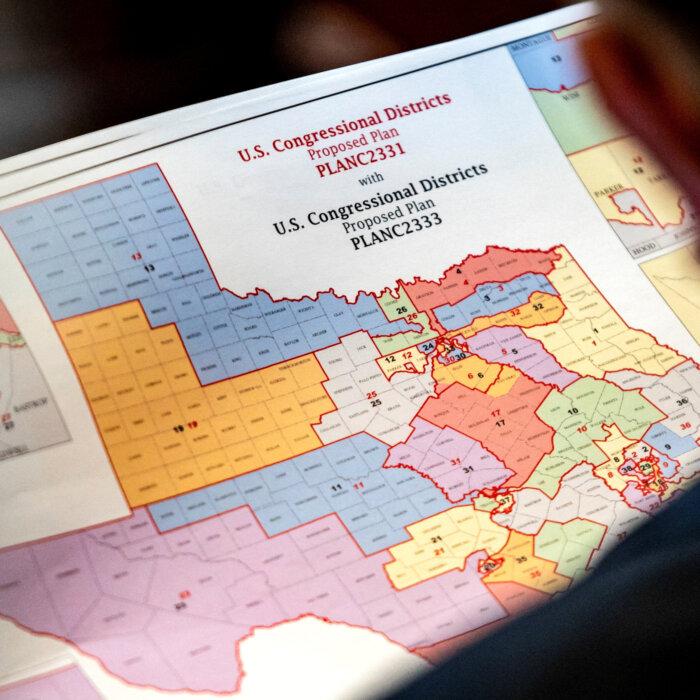
The National Association for the Advancement of Colored People (NAACP) on Aug. 26 filed a motion seeking to block Texas’s newly enacted congressional map, arguing it “intentionally discriminates based on race.”
The NAACP filed the motion for a preliminary injunction in the U.S. District Court for the Western District of Texas in El Paso, as part of a lawsuit that names the Texas governor and the Texas secretary of state as defendants.
The motion is an amendment to a lawsuit against Texas that the NAACP filed in 2021 to challenge congressional maps drawn after the 2020 census. The original complaint had said that redistricting plans were drawn by legislators and adopted “for the express purpose of permissibly discriminating against voters of color” in violation of the U.S. Constitution and Voting Rights Act.
The Republican-majority Texas Senate passed the new congressional map into law in a party-line vote in the early morning of Aug. 23. Texas’s Republican-majority House of Representatives had approved the redrawn map in an Aug. 20 vote.
Republicans currently control 25 of the state’s 38 U.S. House seats. Republicans could increase their presence in the state’s U.S. House delegation by as many as five seats.
The NAACP’s CEO and president, Derrick Johnson, said in a statement that the state of Texas is 40 percent white but that “white voters control over 73 percent of the state’s congressional seats.”
“It’s quite obvious that Texas’s effort to redistrict mid-decade, before next year’s midterm elections, is racially motivated,” Johnson said. “The state’s intent here is to reduce the members of Congress who represent Black communities, and that, in and of itself, is unconstitutional.”
Texas lawmakers have said the new map was not drawn to target minorities’ voting power.
State Sen. Phil King, a Republican, said on Aug. 25 that he only considered political performance when crafting the map.
“I have not reviewed any racial data,” King said.
Lawyers’ Committee for Civil Rights Under Law, which is representing the NAACP, said the new maps “bulldoze important majority-minority districts” and dilute the political power of those minority groups.
Damon T. Hewitt, president and executive director of the Lawyers’ Committee, said in a statement: “This is an intentionally harmful and discriminatory effort, and we must call it out as such. Black and Brown voters in Texas deserve better. They are legally and constitutionally entitled to fair representation. These maps do the opposite, and they must not stand.”
The Epoch Times contacted the offices of Texas Gov. Greg Abbott and Secretary of State Jane Nelson for comment, but neither responded by publication time.
Passage of the new map was delayed for two weeks after more than 50 state Texas House members, all Democrats, staged a walkout over the congressional redistricting and headed to blue states, holding up the quorum needed to pass the measures.
Abbott said in an Aug. 23 statement: “I promised we would get this done, and delivered on that promise. I thank Lieutenant Governor Dan Patrick for leading the passage in the Senate of a bill that ensures our maps reflect Texans’ voting preferences.”
California’s Potential Redistricting
On Aug. 26, the NAACP urged other states, including California and New York, to “act immediately” by redistricting and passing new electoral maps.
Republican-led states such as Ohio are weighing similar moves, while some Democratic-controlled states are considering their own map changes in response.
Reacting to the Texas redistricting push, California Gov. Gavin Newsom has pressed for his state to redraw its own congressional map.
On Aug. 21, Newsom signed a legislative package to authorize a Nov. 4 referendum to redraw California’s congressional maps in favor of Democrats.
The map could see voters increase Democrats’ hold on California’s U.S. House delegation by as many as five seats, potentially counteracting the Texas redistricting push.
In response, California Republicans have filed two legal challenges against the redistricting plan.
The battle over congressional maps could prove decisive in the 2026 midterm elections, as Republicans currently hold a three-seat majority in the U.S. House of Representatives.
Reuters and Ryan Morgan contributed to this report.
Victoria Friedman is a UK-based journalist covering a wide range of international stories, with a particular interest in technology, eastern Europe, and defense.