
In the past seven years, almost 80 percent of murder suspects in Baltimore have prior arrest records, according to Sean Kennedy, visiting fellow at Maryland Public Policy Institute.
Baltimore, the largest city of Maryland, has one of the highest murder rates in the country and is often ranked No.2 behind only St. Louis.
Almost half of the murder suspects were previously arrested for violent crime. Three in 10 were on parole or probation when the killings took place.
Kennedy based his analysis on internal reports prepared by the Homicide Administrative Unit at Baltimore Police Department. He obtained the reports through public record requests.
The suspects’ rap sheets were also fairly long. In 2019, murder suspects had an average of eight prior arrests, according to a police analysis shared with The Epoch Times.
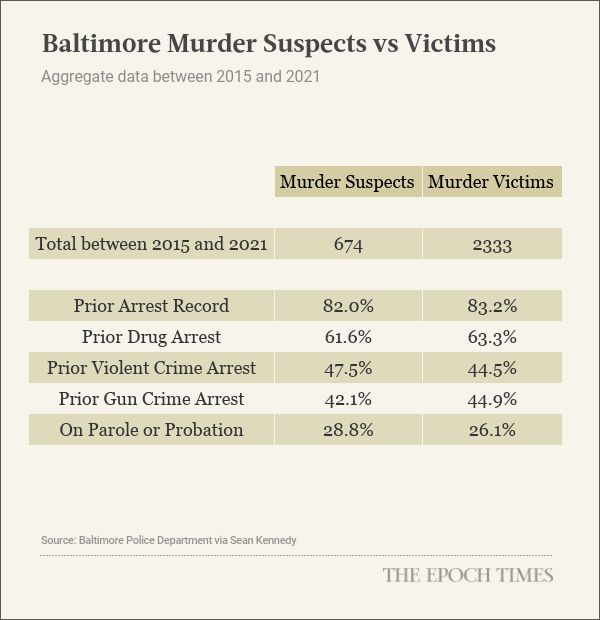
To get the seven-year total, Kennedy added up murder suspects identified by the police in a given year for murders committed in the same year.
Since annual numbers were prepared in aggregate, the sum could include a few duplicates, but even so, it would not affect the percentages of prior arrests much, Kennedy said.
Duplicates could happen when a suspect was identified in one year for a murder, and then identified again in another year for another murder.
It is not clear how many of these murder suspects were arrested, prosecuted, or convicted.
“What we see from the suspect analysis is that these are repeat offenders, some being repeat violent offenders, who were likely escalating their behaviors and one day killed someone,” Kennedy said.
He said heavier consequences for repeat offenders, such as longer sentences, would have prevented some of these killings.
The same went for murder victims, who bear very similar criminal backgrounds, he said.
“Because many are in a dangerous occupation already—being drug dealers, shooters, or robbers—eventually for these people things caught up with them and they got killed,” he said.
In 2019, 16 percent of murder victims had been shot or shot at in prior years, according to the analysis shared with The Epoch Times.
Sending these people back onto the street is almost like giving them a death sentence, he said. “I think they deserve prison time, not death sentences.”
It adds to the tragedy when innocent people got caught up in the crossfire and killed, he said.

Baltimore’s homicides jumped significantly in 2015. It went to 344 from 211 in 2014. Since then the city’s homicides have hovered above 300, averaging 333 a year.
In 2021, Maryland’s Gov. Lawrence Hogan, a Republican, introduced two bills that he said would make a dent in violent crime. One required courts to disclose judges’ sentencing decisions for violent crime and the other asked for longer sentences for gun-related crimes.
Both bills were stalled in the Democratic party-controlled state House.
Hogan reintroduced the two bills in 2022. One of them, the Violent Firearms Offender Act of 2022, is currently under consideration in the Senate Judiciary Committee.
Kennedy recently submitted his murder suspect and victim analysis as an expert testimony to the committee.
Maryland Senate Democrats propose a different approach to curb crime than that of Hogan, one that focuses on prevention, intervention, and rehabilitation.
They also want to go harder after so-called ghost guns, with one bill proposing to ban the sale, receipt, and transfer of such gun parts in January 2023.