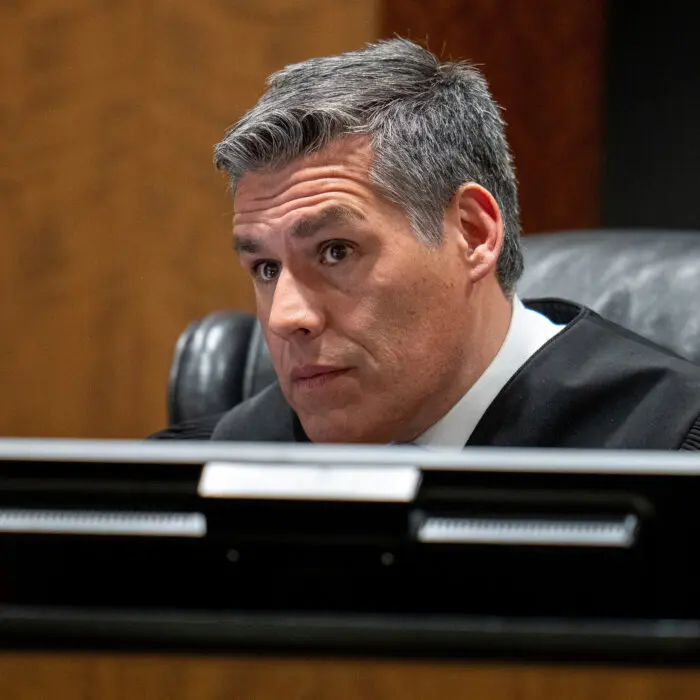
Judge Tony Graf Jr. ruled on June 26 that a deputy county attorney violated a gag order when he publicly commented about bullet testing in the case against alleged Charlie Kirk assassin Tyler James Robinson.
Speaking from the Fourth District Court in Provo, Utah, Graf stated that Deputy Utah County Attorney Christopher Ballard violated a gag order when he went beyond “merely correcting the ballistics record.” Ballard’s comments went too far when he told the media that prosecutors believed they could overcome the presumption of innocence that all defendants, including Robinson, are afforded in U.S. criminal court cases.
The judge, however, rejected defense lawyers’ request to block prosecutors’ use of the death penalty against Robinson.
Striking the death penalty would be too harsh and also would be inappropriate for a “civil contempt” violation rather than a criminal one, the judge said.
Instead, citing remedies used in other civil-contempt cases, Graf agreed to “encourage future compliance” and issue “a meaningful remedy.”
Graf said he would consider additional jury-selection procedures and other measures after consulting with the prosecution and defense. In addition, “the court shall compensate the defendant for the reasonable attorney’s fees and costs incurred” while pressing the contempt allegation.
The judge’s ruling precedes the next big step in the case: a preliminary hearing set to begin July 6. At that hearing, prosecutors are required to present some of the evidence they have against Robinson. At that hearing, prosecutors must show they have sufficient proof to proceed to trial.
Graf spent more than 20 minutes reading his ruling aloud.
The controversy leading to the hearing began after the defense filed a March 27 motion asserting that a ballistics-test report suggested evidence against Robinson was insufficient.
Defense lawyers were “technically correct” in their wording of that filing. But it was “highly prone to misinterpretation,” the judge said, because the defense omitted a key finding. While the bullet fragment analysis was “inconclusive,” the ballistics report also found that “the bullet could not be excluded.”
“The media seized on this omission, generating headlines that materially overstated the forensic conclusions, stating the bullet did not match the rifle,” the judge said.
An exception to a court-conduct rule allows attorneys to correct inaccurate publicity that neither they nor their client generated, Graf said. But Ballard’s “additional statements concerning the strength of the state’s evidence and anticipated ability to overcome the presumption of innocence exceeded the scope of that exception and violated the court’s publicity order,” the judge said.
Graf issued that order shortly after Robinson was arrested days after the fatal shooting of Kirk at a Utah Valley University program on Sept. 10, 2025 and charged with Kirk’s killing
His decision to tightly restrict pretrial statements from both sides was needed to preserve the parties’ rights to a fair trial amid “immense national and international media attention,” the judge said.
“Courts depend upon public confidence that criminal prosecutions will be decided upon evidence presented in open court,” he said, “rather than public advocacy outside of it.”