Immigration and Customs Enforcement’s (ICE’s) Homeland Security Investigations carried out a nationwide operation between June 22 and July 10 that dismantled “SIM farms” run by transnational criminal organizations.
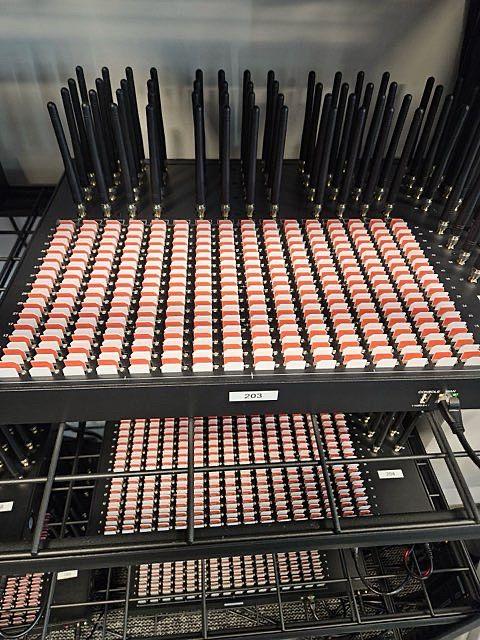
SIM (subscriber identity module) farms are systems containing large numbers of SIM cards from different wireless carriers, often housed in banks of cellphones, modems, or specialized devices known as SIM boxes.
These can be used to send and receive bulk messages or calls and often exploit voice over internet protocol (VoIP) technology to do so. Initially developed for legitimate purposes, the technology has become prominent among organized fraudsters targeting mass audiences through phishing texts, scam calls, and fraudulent online accounts.
The recent nationwide operation, dubbed Operation Signal Break, “dismantled critical command-and-control infrastructure used to perpetrate large-scale telecommunications fraud across the United States,” ICE said in a July 24 statement.
Authorities will now analyze the seized SIM data to identify victims and assess losses caused by such fraud. The illicit proceeds from the fraud, which are suspected to be linked to Chinese transnational criminal organizations and distribution networks, will be traced.
This is expected to support criminal indictments, sanctions targeting national and international infrastructure used in criminal activity, and asset seizures. SIM box operations are estimated to result in losses worth $15 million annually to Americans, according to ICE.

SIM box fraud, “also known as interconnect bypass fraud, is a scheme in which fraudsters reroute international calls to appear as local ones,” a Nov. 8, 2025, post from IT services provider Synaptique said.
For instance, when a foreign national calls someone in the United States, the call is diverted through VOIP to a SIM box in America instead of passing through a legitimate international call gateway. The SIM box then uses one of the local SIM cards to place a new local call to the recipient.
SIM boxes can be used by criminals to communicate in a clandestine manner. Foreign rival states and intelligence agencies can also use SIM boxes in their operations.
In its statement, ICE said that Operation Signal Break mobilized specialized SIM Box Surge Teams composed of criminal analysts, special agents, and computer forensic analysts, surging them to California, Florida, Texas, Massachusetts, New York, and New Jersey to tackle SIM farm operations.
“I commend our special agents for their outstanding dedication and teamwork in dismantling illicit telecommunications infrastructure,” Homeland Security Investigations (HSI) Acting Executive Associate Director John Condon said in the statement.
“Their relentless pursuit of justice and commitment to protecting the integrity of our communications networks have made our communities safer and sends a clear message to those seeking to exploit our systems to defraud Americans.”
Since 2024, the HSI has seized more than 1,900 SIM boxes, more than 500,000 SIM cards, and in excess of $700,000 in illicit proceeds. It has executed more than 116 federal criminal search warrants. In total, 68 SIM farms used to facilitate fraudulent texts and calls have been disrupted across 15 states. The probes have led to one criminal arrest and 11 administrative arrests.
In September 2025, the U.S. Secret Service (USSS) announced the dismantling of an “imminent telecommunications threat” in the New York tristate area that involved the use of thousands of SIM cards.
A network of electronic devices located throughout the region was used to conduct telecommunications-related threats against senior government officials. In total, more than 300 co-located SIM servers and 100,000 SIM cards were found across multiple sites.
In addition to enabling anonymous telephonic threats, the infrastructure could facilitate other crimes, such as enabling encrypted communications between criminal enterprises and threat actors, and disabling cell phone towers, according to the U.S. Secret Service.
“The potential for disruption to our country’s telecommunications posed by this network of devices cannot be overstated,” Secret Service Director Sean Curran said in the statement.
In an international case of SIM box criminal operations, Europol announced in October 2025 that it had taken down a cybercrime-as-a-service criminal network that provided SIM box services to criminals worldwide.
The online service offered telephone numbers to people from across 80 nations. In total, authorities seized 1,200 SIM box devices and around 40,000 active SIM cards.