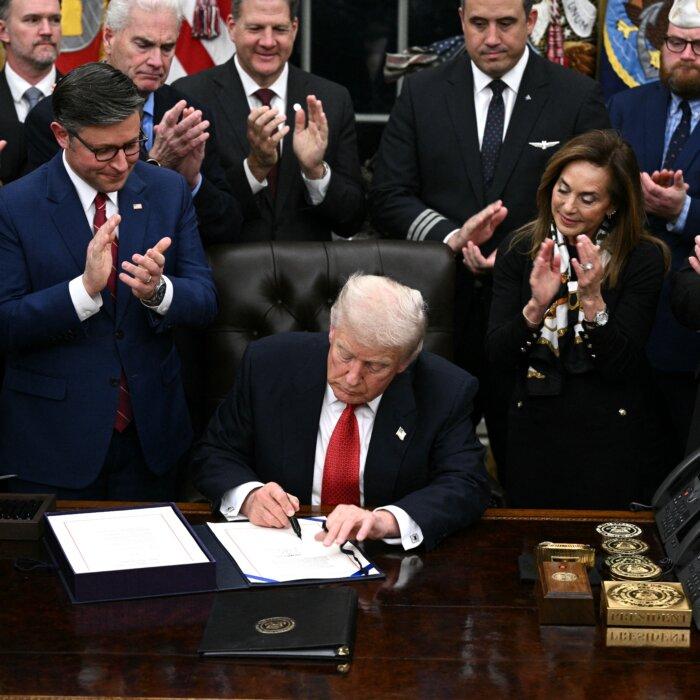
House Speaker Mike Johnson (R-La.) announced on Nov. 12 that the House will soon vote on legislation to repeal a provision of a deal to end the shutdown that allows senators to sue if the government illegally obtains their electronic records.
Congress passed the measure on Wednesday as part of a legislative package to reopen the government.
The provision was inserted into the government funding bill at the behest of several Republican senators whose phone data was accessed by the Department of Justice under the Biden administration during Special Counsel Jack Smith’s “Arctic Frost” probe and criminal investigation of President Donald Trump’s efforts to overturn the results of the 2020 election.
The senators whose data was accessed include Sens. Marsha Blackburn (R-Tenn.), Lindsey Graham (R-S.C.), and Cynthia Lummis (R-Wyo.).
Normally, the United States government cannot be sued for any tort or other civil cause of action under the constitutional doctrine of “sovereign immunity,” which can only be waived by an Act of Congress. In the past, Congress has enacted several laws—such as the Tucker Act, the Federal Tort Claims Act, and the Freedom of Information Act—which waive sovereign immunity and allow lawsuits against the government. This provision would do the same for senators for their data privacy claims.
The provision does not allow senators to sue if they were the subject of a criminal investigation and the data was accessed for that purpose.
House Republicans who have commented on the issue have broadly opposed the provision. There is no equivalent provision granting a right of action to members of the House if their data is accessed.
“I’ve struggled with what the right course of action here is because what they did is wrong. This should not be in this piece of legislation,” Rep. Austin Scott (R-Ga.) said during a House Rules Committee meeting on the temporary funding bill.