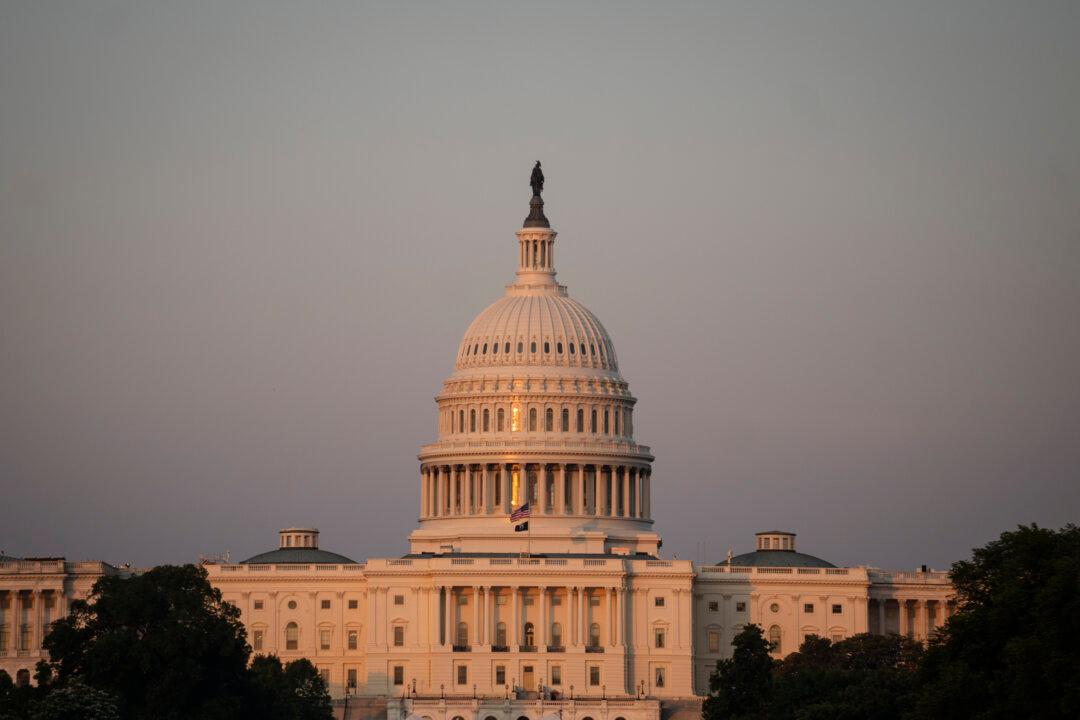
The U.S. House on Jan. 14 passed a package of appropriations bills to fund the government, as Congress works to rapidly pass full-year appropriations bills ahead of the pending Jan. 30 government funding deadline.
The bills provide funding through the end of the fiscal year, which ends on Sept. 30, 2026, for the Department of State and Department of the Treasury, along with the IRS, the federal judiciary, and the Federal Trade Commission.
It brings the House up to eight of 12 must-pass spending bills, at least in an initial draft. But only three of these bills have been passed by both the House and Senate and signed into law by President Donald Trump.
The other five still need to be worked out between the House and Senate before the two chambers can pass an identical bill into law.
All 12 will need to be passed by Jan. 30, or Congress will need to pass a stopgap funding bill to prevent a government shutdown.


Leaders in both chambers have expressed disinterest in a repeat of the 43-day government shutdown that came after the previous government funding deadline passed.
Instead, Democratic leaders in both chambers, including House Minority Leader Hakeem Jeffries (D-N.Y.) and Senate Minority Leader Chuck Schumer (D-N.Y.), have expressed a desire to work with Republicans to avoid such an outcome.
During the vote series on Jan. 14, the House also rejected two proposals by some of the lower chamber’s most conservative members.
One of these, proposed by Reps. Eli Crane (R-Ariz.) and Andy Biggs (R-Ariz.), called for the State Department to slash $315 million for anti-communist nonprofit foundation National Endowment for Democracy. The proposal would have zeroed out the Reagan-era program, which has offered grants to pro-democracy and civil groups for more than four decades.
The proposal was overwhelmingly rejected by the House in a 127–291 vote. Rep. John Moolenaar (R-Mich.), who sits on the board of the group, was among those who voted against the amendment.
Lawmakers also rejected a proposal from Rep. Chip Roy (R-Texas) calling for a 20 percent cut to the funding for the federal district and appeals courts in Washington. It would have eliminated salaries and funding for Judge James Boasberg and Judge Deborah Boardman entirely.
The House also rejected Roy’s amendment in a 163–257 vote.
The two votes indicate that most Republicans in the House are also looking to evade a government funding fight with House Democrats.
Although the House has now completed its initial work on eight of the 12 annual funding bills, the broad majority of federal spending for the upcoming fiscal year has yet to be finalized, including for some of the most expensive departments: the Pentagon, for which Trump has requested $1.5 trillion, the Department of Health and Human Services, the Department of Transportation, the Department of Housing and Urban Development, and the Department of Homeland Security.
The massive spending increase for the Pentagon—roughly $500 billion more than the previous record—is likely to face opposition from Democrats, as well as certain GOP lawmakers such as Rep. Thomas Massie (R-Ky.) and Sen. Rand Paul (R-Ky.).
Measures related to the Department of Homeland Security are also likely to face opposition from Democrats, who have called for the administration to pull back on its mass deployment of Immigration and Customs Enforcement (ICE) agents to cities across the United States.
Lawmakers such as Rep. Alexandria Ocasio-Cortez (D-N.Y.) have specifically called for Democrats to use the appropriations process to reduce funding for ICE. She recently tied ongoing ICE expansions to the $1 trillion in spending cuts included in the One Big Beautiful Bill Act.