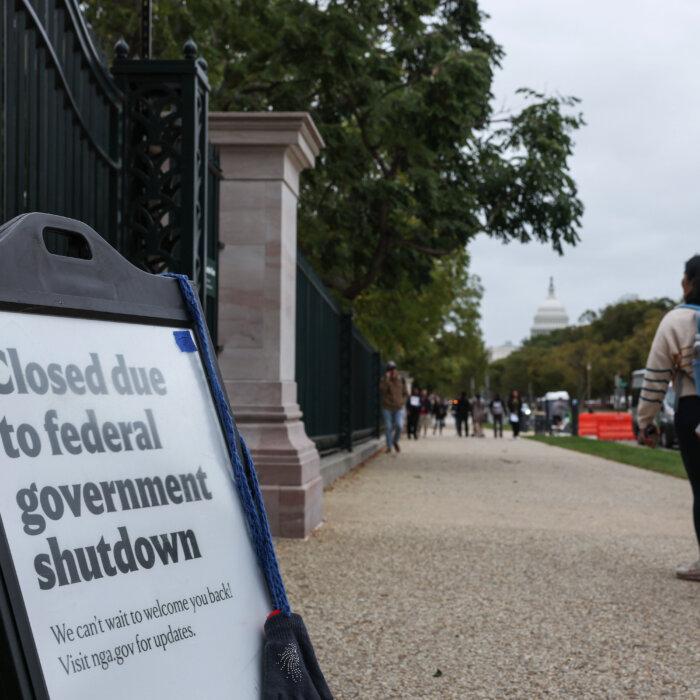
The federal government remains shut down as the Senate again rejected a stop-gap funding measure on Oct. 20.
The 50–43 vote was the 11th time a Republican-backed continuing resolution to extend current funding through Nov. 21 fell short of the 60 votes needed to end debate in the Senate and bring the matter to an up-or-down vote.
The 20-day shutdown is now the third-longest in history, leaving hundreds of thousands of federal workers furloughed without pay and others, including TSA and border patrol officers, working without pay.
Republicans have blamed Democrats for the shutdown, calling it a political stunt.
“This has always been about the spectacle,” House Speaker Mike Johnson (R-La.) told reporters on Oct. 20.

Democrats accused Republicans of causing the shutdown by refusing to negotiate over their proposal to make changes in health care funding as part of the continuing funding resolution.
Democrats cited insurance premium rate increases, which will be announced Nov. 1, in their call for Republicans to negotiate on health care subsidy extension in exchange for reopening the government.
“We’re also getting close to the notification of all the people that their insurance premiums are doubling, and that’s going to have an effect, I hope, particularly in the red states,” Sen. Jack Reed (D-R.I.) told reporters on Oct. 20. “That’s where most of the people will be affected, and [Republicans will] understand that they have to let people still keep their health care.”
Republicans have said that Democrats’ health care demands should be negotiated after the government reopens and should not become a prerequisite for ending the shutdown.
Sen. Mike Rounds (R-S.D.) expressed frustration that the shutdown interrupted negotiations on health care that had begun in the Senate in July.
“We were working together, I thought very well. I thought things were kind of coming together.” Rounds said. “But when you have a shutdown, that just kind of kills the discussions.”
Health insurance subsidies for certain users of the Affordable Care Act (ACA) Marketplace have been a key demand for Democrats.
These subsidies, called enhanced premium tax credits, were created as a temporary measure during COVID-19 to allow people making more than 400 percent of the federal poverty level to gain temporary help in affording health insurance. That equates to an annual income of $128,000 for a family of four in 2025.
These subsidies are set to expire in December 2025. Democrats propose making them permanent.
Rep. Chip Roy (R-Texas) said Republicans will not extend these subsidies to those with higher-than-average incomes. He maintains that ACA Marketplace plans are not affordable in part due to rampant fraud and abuse of the system.
The congressman told reporters on Oct. 20 that he is willing to negotiate a path forward for the ACA Marketplace. “But it has to be with the phase out or elimination of subsidies generally, in favor of empowerment of patients and doctors and not insurance companies,” he said.