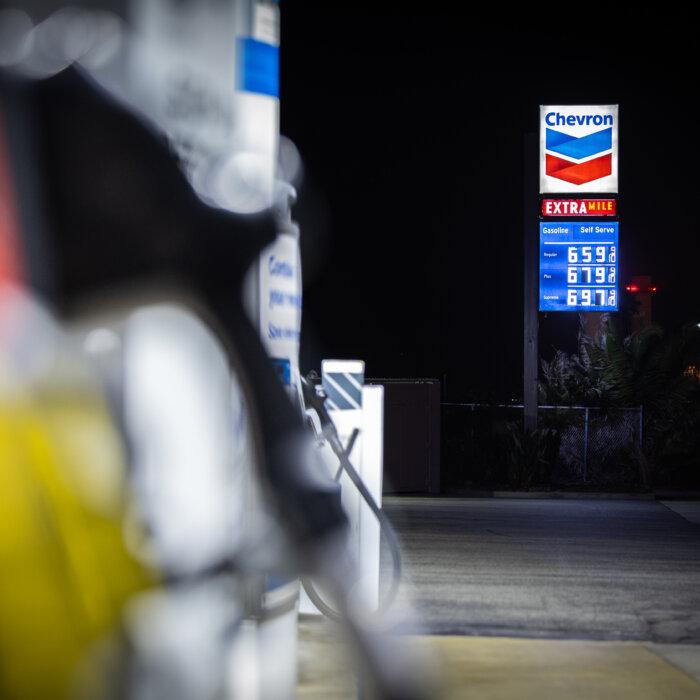
The nationwide average price of regular gasoline marginally increased on Thursday, after five straight days of decline, the American Automobile Association (AAA) said in a May 14 statement.
The national average price is “at the same range as it was in 2022, the year gas prices hit record highs. Travelers are preparing to hit the road in record numbers next week, and drivers will be facing the highest Memorial Day gas prices in four years,” AAA said.
On Friday, prices declined less than a cent to $4.52 per gallon from Thursday’s $4.53. In six states, average gas prices exceeded $5: Illinois, Nevada, Alaska, Oregon, Hawaii, and Washington. Prices exceeded $6 in California. Texas had the lowest price at $3.99 per gallon.
While Thursday’s average gas price was lower than last week’s, prices at the pump continue to remain elevated as crude oil hovers around the $100 per barrel price level.
“Deliveries will begin immediately as the Department continues to move swiftly to address short-term supply disruptions and strengthen U.S. energy security,” the DOE said.

On Feb. 27, a day before the conflict began, Brent crude oil futures closed the day at around $72 per barrel. On May 15, oil was trading at around $108 as at 9:10 a.m. ET.
Tight Oil Market
Since the start of the war, crude oil output from OPEC has fallen by more than 30 percent, the group said in a May 13 report.Current OPEC output is at 18.89 million barrels per day, down from 28.65 million barrels before the conflict broke out. The organization cut its outlook for the year, predicting global crude oil demand would grow by less than 1.2 million barrels per day, down from its previous forecast of 1.4 million barrels per day.
However, “global economic growth continues to show resilience for this year despite geopolitical tensions,” the report said.
In a May 14 post, ING Bank said that the oil market is “eagerly awaiting” the outcome of the meeting between President Donald Trump and Chinese leader Xi Jinping. Trump’s summit in China ended on May 15.
“The market could be pinning too much hope on the US–China talks yielding some positive results on Iran,” ING said.
“Some hope that China could exert pressure on Iran to reach a deal with the US, to end the war and lead to a resumption of energy flows through the Strait of Hormuz.”
Morgan Stanley said in a May 12 report that the risk of prolonged oil supply disruption, especially around the Strait of Hormuz, has now increased.
Prior to the conflict, around 32 ships used to traverse the strait daily between January and March, a number that crashed to roughly two during March–April. There is now a 12 million-barrel-per-day shortage in global oil production.
“While a 12 million barrel-per-day difference may not appear large in a global context, it represents the largest supply shock since the 1970s OPEC oil embargo,” Morgan Stanley said.
“Further, its persistence amplifies the risk of broader economic impacts. Moreover, the timing of this disruption further compounds the issue, with the gasoline-heavy summer driving season (May through August) quickly approaching.”