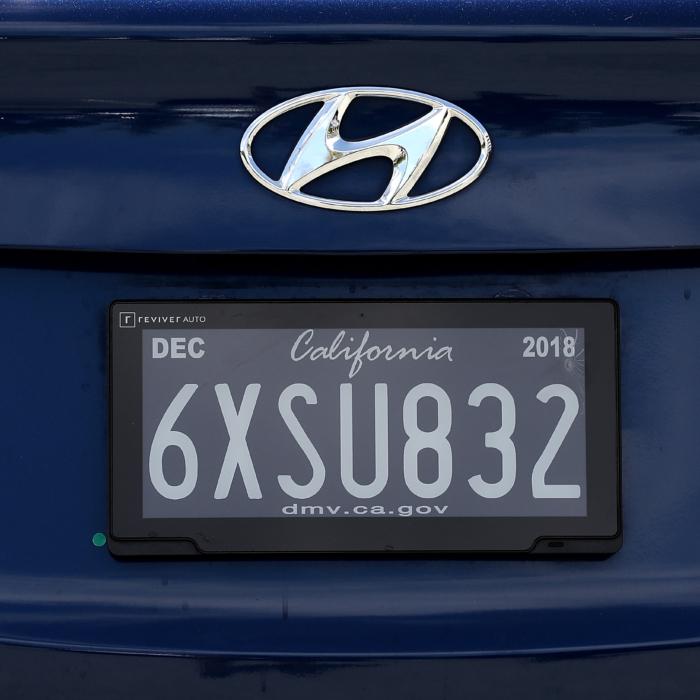
A federal appeals court ruled unanimously on July 31 that driver-selected messages on personalized “vanity” license plates are private speech protected by the First Amendment, not government speech that a state may control.
The decision by a three-judge panel of the U.S. Court of Appeals for the Fourth Circuit appears to be the first by a federal appeals court to resolve the question of whether the alphanumeric messages on vanity plates are private speech or government speech since a 2015 Supreme Court ruling on specialty license plate designs.
The nation’s highest court held 11 years ago in Walker v. Texas Division, Sons of Confederate Veterans, that Texas could reject a specialty license plate displaying the Confederate battle flag without running afoul of the First Amendment.
In that case, the justices found 5–4 that the graphics and slogans on specialty plates offered to the public are government speech. The high court left open the separate question of personalized alphanumeric messages selected by drivers—the issue decided in this case.
In Virginia, drivers are allowed to personalize their license plates for a fee, subject to some restrictions such as for vulgarity, the opinion said.
The Department of Motor Vehicles’ policy is to deny a combination of characters that a reasonable person would consider “profane, obscene, or vulgar in nature,” “sexually explicit or graphic,” “excretory-related,” “used to describe intimate body parts or genitals,” “used to condone or encourage violence,” or “used to describe illegal activities or illegal substances.”
In addition, state law prohibits issuance of a vanity plate to a registered sex offender if the requested character combination could be interpreted as referring to children.
The DMV retains the right to recall and cancel any vanity plate if the department later finds that it did not comply with the official guidelines when it was issued.
The personalization program is very popular: More than 930,000 Virginia vehicles have vanity plates, representing around 11 percent of all Virginia vehicles, which is one of the highest rates among states in the country, the opinion said.
In this case, the plaintiff, Curtis Whateley, applied for a vanity plate bearing the characters “FTP&ATF,” which he took to mean “[Expletive] the Police & [the U.S. Bureau of] Alcohol, Tobacco, and Firearms.”
Virginia originally issued the plate but later revoked it, saying it was vulgar and promoted violence. Whateley sued, arguing the state government had violated the First Amendment by canceling his plate because of its message, according to the opinion.
The federal district court threw out Whateley’s suit, finding that the message on his plate constituted government speech, so ordinary First Amendment protections did not apply.
Virginia argued in the case that all state-issued plates, which always remain the property of the state, contain government speech even when the character combinations on personalized plates reflect the views of the person who requested them.
The appeals court noted that there is scant evidence that “state governments have traditionally used the character combinations on license plates to communicate their own messages.”
Harris said it was the appeals court’s task to determine if the character combinations constituted state speech, in which case it would be entitled to express the views of its own choice, or whether those combinations convey drivers’ private speech, in which the state’s speech restrictions must conform to the First Amendment.
The difference between government and private speech is easy to ascertain when the government speaks itself, such as when an official gives a speech or an agency releases a report, but when the government claims to be speaking through a party, the analysis is more difficult, the opinion said.
“The government’s ability to discriminate among messages and viewpoints when it speaks for itself is ‘essential’ for government to function, but the government-speech doctrine is ‘susceptible to dangerous misuse’ if deployed to ‘silence or muffle’ a private citizen’s ‘expression of disfavored viewpoints.’”
Because Virginia’s personalized plate messages “have greater indicia of private speech than Texas’s specialty plate designs” dealt with in the Walker precedent, and because they most closely resemble the kinds of speech the Supreme Court has ruled as private, “we conclude that the messages here are private speech protected by the First Amendment,” the opinion said.
If, as the state argued, the “message conveyed” by every Virginia license plate, regardless of the character combination, were “‘this vehicle is registered with the state,’ then there would be no need for guidelines—and no need to recall an ‘FTP&ATF’ plate because it communicated a vulgarity or encouraged violence.”
The Fourth Circuit vacated the district court’s dismissal of the lawsuit, returning it to that court for further proceedings on the issue of whether Virginia’s restrictions survive constitutional scrutiny once the personalized messages are treated as private speech.