A federal judge on Aug. 14 refused to block the Trump administration from building a border wall spanning 62 miles of a Native American tribe’s reservation lands in southern Arizona.
Leon said the Roosevelt Reservation—which designates all public lands within 60 feet of the international boundary as a public reservation—allows the government to construct the wall on those lands.
According to the ruling, the tribe had argued that it held aboriginal title to the reservation lands before the Roosevelt Reservation was created. But the judge said historical evidence showed otherwise, noting that President Theodore Roosevelt established the Roosevelt Reservation in 1907, before the tribe’s reservation was created.
“Even if the Roosevelt Reservation does not exist on the Nation’s reservation, plaintiff has not shown how construction of a wall on the existing international border will change the boundaries of the Nation’s reservation,” Leon said.
The judge continued: “As a legal matter, it is well-established that Congress has exclusive authority to diminish reservation boundaries, and that Congress must make its intent to do so clear and unambiguous.
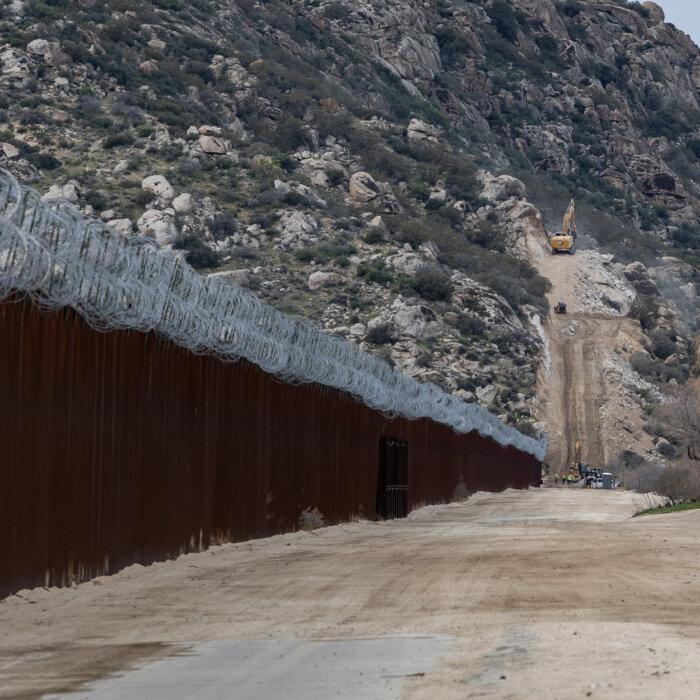

“But I am not aware of any case holding that construction of a border wall adjacent to a reservation—with the possibility of activities that may interfere with the Nation’s use and occupancy rights—necessarily diminishes the reservation’s boundaries.”
The judge also rejected the tribe’s argument that the border wall’s construction would constitute a trespass on its reservation, citing the federal government’s sovereign immunity.
Leon said he expects the government to follow through on its guarantees to consult and cooperate with the Tohono O’odham Nation to address concerns over the border wall’s construction.
James Percival, general counsel for the Department of Homeland Security, hailed the ruling in a social media post, saying the border wall was intended to increase border security.
In a statement, the Tohono O’odham Nation said it strongly disagrees with the ruling and would consider “all possible options” to continue its legal challenge.
“The primary concern is that the court did not adequately address many critical issues that the construction of a border wall will have on our nation, our people, our land, and our culture.
“It is imperative that these concerns be addressed before any construction or pre-construction activities are done by the federal government on our land,” the tribe said.
President Donald Trump revived efforts to complete the southern border barrier on July 4, 2025, when he signed the One Big Beautiful Bill Act into law.
The legislation set aside $46.6 billion for border infrastructure, including wall expansion, surveillance systems, and additional funding for Border Patrol operations.
As part of that initiative, the Department of Homeland Security and CBP awarded $4.5 billion in contracts for what officials describe as a “smart wall” system designed to enhance monitoring and detection along the border.