LOS ANGELES—A jury in a bellwether social media addiction trial in Los Angeles Superior Court on March 9 heard from a former therapist who testified, via recorded deposition, that it was not social media use alone, but rather a volatile mix of circumstances and triggers that led to a young plaintiff’s mental health challenges.
The plaintiff, a 20-year-old California woman identified in court documents as “Kaley G.M.” or “K.G.M.” says she suffered depression, anxiety, body dysmorphia and other harms after becoming addicted to YouTube and Instagram while in elementary school.
“First of all, she’s a teenage girl, which comes with a lot of stress and self-image and self-esteem challenges,” said Alison Pratt, a licensed family therapist who treated the patient beginning in 2020, when she was 14, for a period of five years. An edited video of Pratt’s deposition testimony, recorded in April 2025, was played for the jury.
“You could add COVID into the mix, which had a significant impact, having to be home all the time, having to learn in front of a screen, and missing out on milestones,” she said.
Toxic family relationships, academic and social struggles, cyberbullying, and social media use were also contributing factors, according to Pratt.
Over the preceding four weeks, K.G.M.’s lawyers constructed a powerful narrative of a happy, outgoing child who became crippled with social anxiety and feelings of low self-worth after developing an addiction so powerful it reached 16 hours in a single day at its peak and kept her coming back despite obvious, compounding harms and incessant bullying.

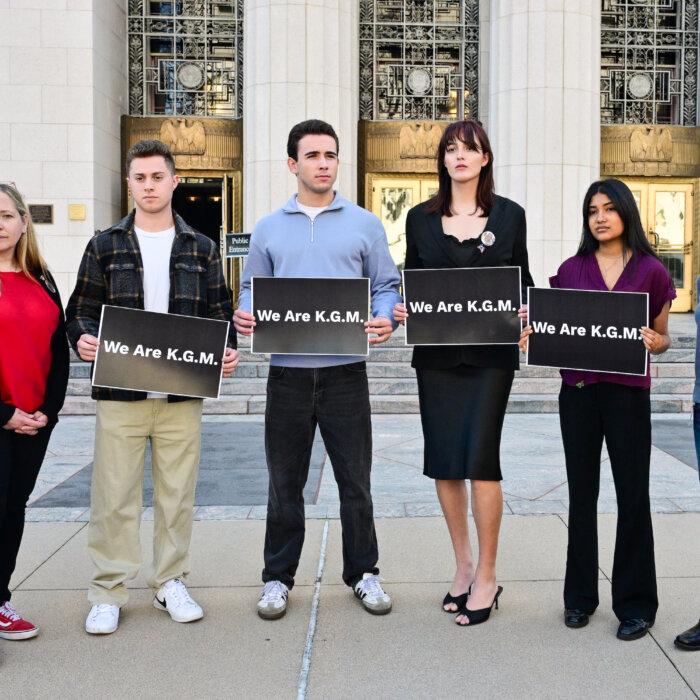
Her case is one of a handful of high-stakes trials that will set the stage for thousands of civil injury suits brought by children, parents, school districts, and attorneys general across the country.
The jury is being asked to determine whether social media companies can be held liable for alleged harms caused by platform design features—rather than by content posted by third parties, which is broadly protected by the First Amendment and Section 230 of the 1996 Communications Decency Act.
Expert witnesses for the plaintiff have described how defendants’ apps are designed to target primal reward pathways in the brain, to which adolescents are especially vulnerable.
Features such as “infinite scroll,” short vertical video feeds, notifications, and proprietary algorithms that have become highly adaptive and customized, they said, snare young people and keep them stuck in a cycle of withdrawal, addiction, and regret that is virtually indistinguishable from substance addiction.
Expert witnesses for the plaintiff, themselves national leaders addiction sciences, have previously pointed to a robust body of literature, as well as their own clinical experience and emerging research to support their claims.
“There is a wealth of peer-reviewed literature and other publications from authoritative bodies validating that people can get addicted to social media,” Lembke said.
Attorneys for the defendants have pointed out that Bagot was the only professional in K.G.M.’s lengthy medical history to diagnose her with social media addiction.
Meta and Google, parent companies of Instagram and YouTube, respectively, are named in the lawsuit.
While Pratt said she believed social and emotional development could be delayed as a result of an over-reliance on social media, she didn’t have an opinion whether or not that was true for K.G.M.
“At times she’d use social media as a coping mechanism. She’d spend large amounts of time on social media,” Pratt said.
In a January, 2021 therapy session with Pratt, K.G.M. reported a number of stressors—school, having “no friends,” family dynamics, and COVID—contributing to feelings of sadness and low motivation.
There was no mention of social media, Pratt acknowledged under cross-examination.
In an April 2021 session, the plaintiff reported having panic attacks and identified social media and family dynamics as contributing factors, according to Pratt’s deposition testimony.
K.G.M.’s fights with her mother, she told her therapist, would often center around her use of the phone, and a fear that it might be taken away.
SnapChat (parent company Snap, Inc.) and TikTok (parent company ByteDance) were co-defendants in the original lawsuit, but settled privately with the plaintiff days before trial. They remain named in related, consolidated actions.