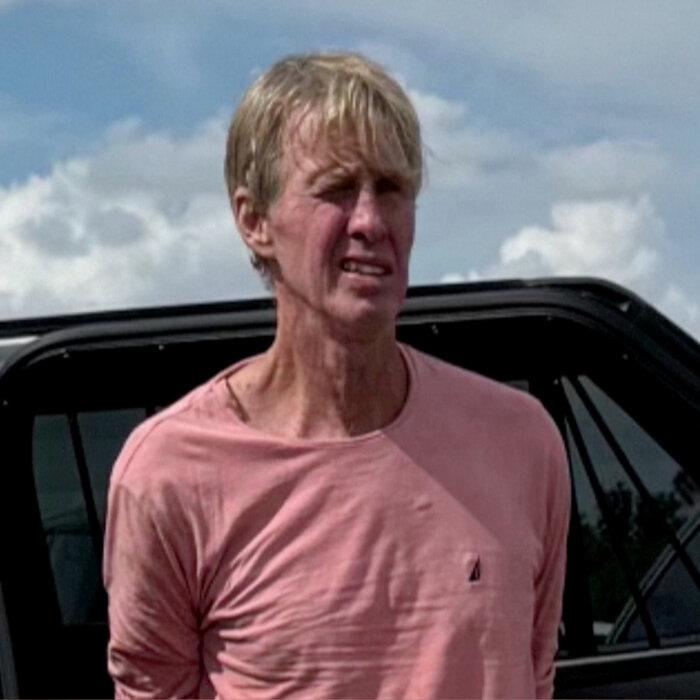
FORT PIERCE, Fla.—The defense rested its case on Sept. 22 in the trial of Ryan Wesley Routh, the man charged with attempting to assassinate President Donald Trump at his golf club in West Palm Beach, Florida, in 2024.
Routh, who is representing himself as the defendant in the case, called three witnesses on Sept. 22. He questioned a firearms expert about the SKS-style rifle found at the crime scene in September 2024, as well as two character witnesses who have known Routh for years. They testified that he has a history of community engagement and helping his friends and associates.
“Under stress, you’ve always been a jolly person,” said Atwill Milsun, who was described as a mentee and longtime associate of the defendant who attended school with Routh’s son more than 10 years ago.
Routh chose not to testify in the case.
Routh questioned military veteran and gun expert Michael McClay Jr. as to whether the SKS-style rifle could have been operable when found at the crime scene by law enforcement in 2024. McClay testified that when he test-fired the gun in February, it successfully fired a bullet.
However, the gun misfed the next bullet from the magazine instead of automatically chambering it like a properly operating semi-automatic weapon, he said. McClay said this malfunction could be a result of poor maintenance of the magazine.
Upon cross-examination, prosecutors pointed out that authorities had used multiple kinds of acid on the SKS-style rifle in an attempt to restore the serial numbers that Routh allegedly attempted to destroy after he purchased it last year.
The gun was then stored for seven months before McClay test-fired it, further exposing the gun’s magazine to fumes from the acid residue that was still present on its exterior, prosecutors said. When prompted, McClay confirmed that pouring any kind of acid on a gun will lead to metal corrosion.
Prosecutors also asked McClay if a single round from the gun would be enough to hurt a potential target.
“It would cause bodily harm, yes,” McClay said.
Routh then probed Milsun and Marshall Hinshaw, his other character witness and longtime friend and employee, to establish his “reputation of nonviolence.”
Hinshaw testified that he has known Routh for “20-plus years,” that the defendant was “very well-liked” in the community in Greensboro, North Carolina, and that he would not expect Routh to harm anyone.
During cross-examination, prosecutors determined that Hinshaw has seen little of Routh since the latter moved to Hawaii in 2017. They also asked Hinshaw if Routh’s alleged purchase of the SKS-style rifle, his alleged attempt to purchase a rocket launcher-style weapon, or his alleged visit to Trump’s golf course to try to assassinate him would change the man’s view that Routh is nonviolent.
“Pretty fair to say,” Hinshaw said.
District Judge Aileen Cannon of the U.S. District Court for the Southern District of Florida reminded Routh repeatedly to keep his questioning within the scope of each witness’s expertise and the bounds of federal rules for witness testimony and cross-examinations, informing him that he had “crossed the line” multiple times with his queries.
Prosecutors objected to several lines of inquiry from Routh on Sept. 22, including when he asked McClay if, in his training, it takes “a special kind of person to take another life.”
Prosecutors called it an “offensive” question and said it was beyond the scope of the case. Cannon told the defendant that psychological state of mind is outside the bounds of McClay’s expertise, prompting Routh to withdraw the question.
Cannon said closing arguments will begin on the morning of Sept. 23, followed by jury deliberation. The judge gave jurors their extended jury instructions in court on the afternoon of Sept. 22.