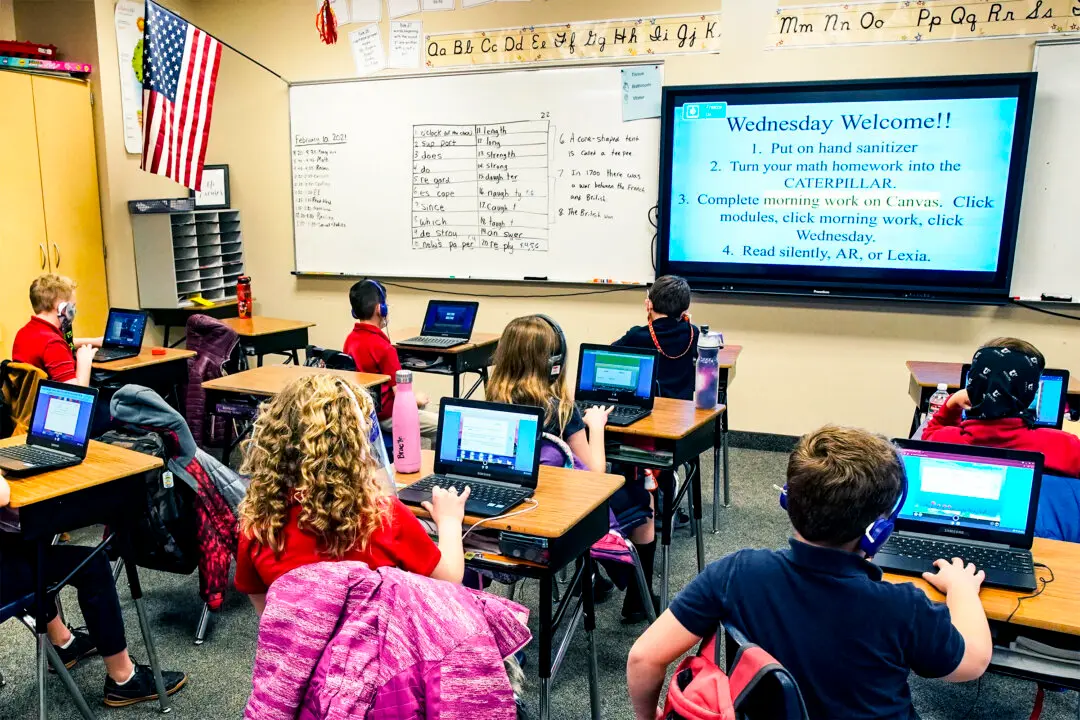
In the months and years ahead, public school communities across the nation might be buzzing about the “five C’s.”
Those C’s are not letter grades in a handful of core subject areas, although critics of this growing initiative say that less academic rigor would reflect such mediocrity. The concept—also referred to as the new North Star for academic achievement—prioritizes critical thinking, communication, collaboration, creativity, and citizenship.
An increasing number of states are phasing in these “Portrait of a Graduate” frameworks that advocates say will better prepare young people for future careers and adult life, especially considering rapid technological and societal changes brought on by artificial intelligence. In many cases, testing and assessments are deprioritized, raising questions about suitable metrics and rubrics for measuring academic achievement at a time when reading and math scores are declining or remaining stagnant across K–12.
“Both very blue and very red states have undertaken the effort,” Harry Feder, executive director of FairTest, a nonprofit organization that advocates fair and open testing, said in a 2025 report.
He estimated that at least 20 states and hundreds of school districts have adopted a Portrait of a Graduate framework.
Where, Why, and How
FairTest’s list of 20 states with a plan implemented or in progress includes states in every region of the country, plus Hawaii. Florida and Texas are not on the list. California is not listed as a state participant yet, but several of its districts have adopted Portrait of a Graduate guidelines.

The first states to adopt these policies were South Carolina, Utah, Washington, and Virginia, according to the National Association of State Boards of Education (NASBE). These changes took place before the COVID-19 pandemic and the loss of learning that followed.
In South Carolina, business leaders provided the state with descriptions of employable skills. In Utah, the Department of Education designed a “Talent Map” that recognizes academic mastery in subject areas while also encouraging students to develop and demonstrate character traits such as integrity and resilience. Washington state’s Portrait of a Graduate framework is centered on diversity and “cultural competency.” Virginia’s, which codified the five C’s into a state law, promotes project-based learning, according to the NASBE.
Instead, diploma candidates must demonstrate a strong foundation in the state learning standards as well as “the knowledge and skills necessary to achieve success in college, careers, civic engagement, service, and life,” the Department of Education website says. It also says that Regents exam scores, presentations, projects, and portfolios are the options candidates can include in their “portraits” for graduation.
The department hasn’t yet announced what changes, if any, will be made to core subject completion requirements and elective courses.
The California Department of Education announced on March 2 that it’s planning workshops to develop statewide Portrait of a Graduate guidelines focused on deeper learning for 21st-century skills and innovative uses of technology.
Hezekiah Herrera, a San Diego K–12 education consultant who has worked on this initiative with districts in several states, including New York and California, said Portrait of a Graduate is a conceptualization of what schools should be producing, as opposed to measuring student success based on standardized tests and content mastery. So far, schools have struggled to develop a subjective system for evaluating student portfolios.
Support
The NASBE, in a 2022 report, said a key benefit of this framework is “giving students a clear picture of the purpose of their schooling and the steps they can take toward proficiency.” The report cited examples of elementary school children starting community gardens, high school kids helping military veterans, and students from low-performing schools taking pride in their work and going on to college.Andrew Tucker, executive director of the Collaborative for Academic, Social, and Emotional Learning, said the framework is critical for two reasons: to prepare students who aren’t interested in pursuing a four-year college degree and to provide young people with durable skills that cannot be replaced by artificial intelligence.
Criticisms
Herrera said he doesn’t think these changes will work. He said he’s been unable to find any proof of improved literacy rates, increased math proficiency, or enhanced college preparation resulting from Portrait of a Graduate frameworks. Moreover, he said, they stifle opportunities for high-achieving students.“When a student who is reading at a 12th-grade level and performing pre-algebra concepts is placed in a collaborative setting to collaborate on a community issue, the ceiling for potential growth is limited,” he said. “I have personally watched gifted students become bored and disengage with the educational process due to the framework providing little to no outlet for their abilities.
“Would a California school district be expected to give high marks to a student praying outside of Planned Parenthood, or would only the students who marched for Gaza be graduation-ready?” he wrote.
David Goodwin, president of the Association of Classical Christian Schools, said Portrait of a Graduate frameworks in their current form indicate even further erosions to K–12 academic standards. He cited the diminishment of regional accreditors in the 20th century, the end of verbal and quantitative reasoning assessments, the move to make SAT scores test optional for college admissions, affirmative action in higher education, and grade inflation in public schools.
What’s Next
It may be too soon to say whether these initiatives are effective, especially if measures of success are tied only to state test scores, graduation rates, and the percentage of high school graduates going on to college.The nation will be watching closely as New York and presumably California implement frameworks. They spend far more money on public education than most other states and have traditionally enjoyed a reputation for having strong public schools. But they are also experiencing declining enrollments and budget gaps in many of their districts.
Universal school choice, which is experiencing strong growth in at least 17 states, also hangs in the balance. Goodwin said Portrait of a Graduate standards will drive more families to charter schools and private institutions, but the demand will quickly exceed the supply.
The National Council on Teacher Quality is watching for any changes to teacher training programs regarding this new framework, but it doesn’t expect to see any drastic changes, said Heather Peske, council president.
“Teachers will still need to understand the foundations of teaching reading and math, classroom management, and have strong [student teaching] experiences,” she told The Epoch Times.