Former FBI Director James Comey formally asked a federal district court in North Carolina on July 27 to dismiss the indictment charging him with threatening President Donald Trump.
Comey said he found the seashells arranged on a beach and took a photograph of them. He said he assumed the shells were intended as a political message. Comey subsequently deleted the post, saying he did not know at the time that the “86” phrase was associated with violence.
To “86” is a slang expression that can mean remove or get rid of someone, and has been used in some contexts as a euphemism for killing someone. The number 47 has been interpreted to refer to Trump, who is the 47th president.
A true threat is a serious statement indicating someone intends to commit violence against a specific person.

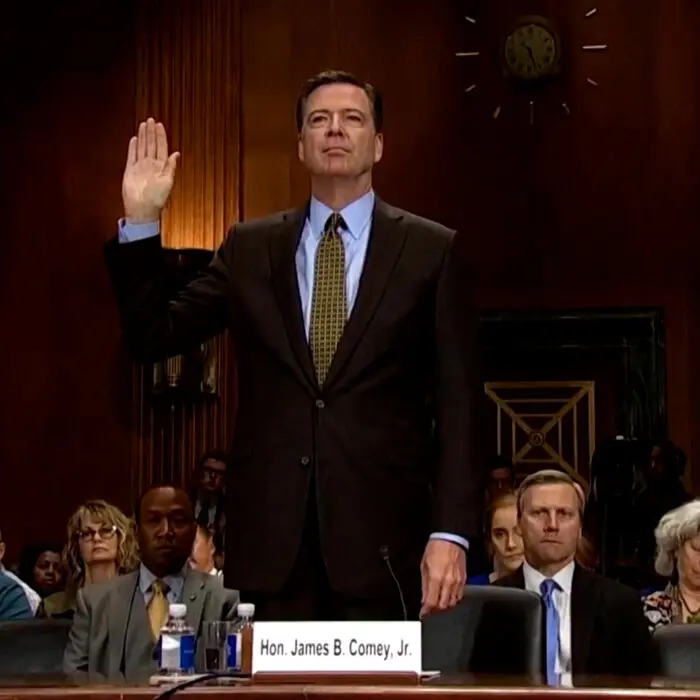
“Both Counts of the indictment seek to punish Mr. Comey for a social media post expressing a political viewpoint,” Comey attorneys write in the motion.
“As a matter of law, that post was protected by the First Amendment and falls outside the scope of 18 U.S.C. [Section] 871(a) and 18 U.S.C. [Section] 875(c). Both Counts must therefore be dismissed.”
The federal government alleges in the Section 871 charge that Comey deliberately made a threat to take the life of or inflict bodily harm upon the president of the United States. The maximum penalty is five years of imprisonment.
The government alleges in the Section 875 charge that Comey threatened criminal conduct across state lines through online or other interstate communications. The maximum penalty is also five years of imprisonment.
“Over the past year, this department has charged dozens of cases involving threats against all sorts of individuals. We take these seriously, every single one of them.”
Comey said at the time that he looked forward to clearing his name in court.
“Nothing has changed with me,” the former law enforcement official said. “I’m still innocent. I’m still not afraid. And I still believe in the independent federal judiciary. So let’s go.”
The court asked the federal government to respond to Comey’s new motion by Aug. 18.
Last year, Comey was indicted in federal court in Virginia for allegedly making a false statement to Congress and obstructing a congressional proceeding. In November of that year, a federal district judge dismissed that indictment, finding that the appointment of interim U.S. Attorney Lindsey Halligan, who oversaw the prosecution, was unlawful.
In December 2025, the government appealed. The appeal is pending before the U.S. Court of Appeals for the Fourth Circuit.