“Several triatomine species are common in the southern United States, where they transmit T. cruzi and invade human dwellings,” the researchers wrote. “Wildlife, captive animals, and companion animals, especially dogs, are commonly infected with T. cruzi parasites in this region and serve as reservoirs.”
Signs and Symptoms
Chagas disease can cause health issues in people decades after they are infected with the parasite, health officials said.Symptoms of acute Chagas disease can include fever, body aches, fatigue, headache, vomiting, diarrhea, a redness or rash around the bug bite area that may develop into an ulcer, and a swollen eyelid, the clinic said. However, some people do not develop any symptoms.


About 30 percent to 40 percent of people infected with the parasite can develop a chronic infection, Mayo Clinic said.
Symptoms of a long-term infection can include heart palpitations, shortness of breath, fainting, dizziness, chest pain, constipation, heartburn, bloating, and issues with swallowing.
“Chronic Chagas disease may cause serious complications that affect your heart, brain, and digestive tract,” the Mayo Clinic said. “These can be life-threatening and may be something you may have to manage for the rest of your life.”
The clinic notes that chronic symptoms can also include cardiac arrest, enlarged heart, heart failure, arrhythmia, enlarged esophagus, or enlarged colon. Acute versions of the infection can cause myocarditis—inflammation of the heart muscle—or brain inflammation.

Kissing bugs, which are sometimes called vampire bugs, include dozens of different species that feed on the blood of certain animals. The CDC report states that Triatoma sanguisuga, T. gerstaeckeri, T. protracta, and T. rubida are the ones of most concern because they are most commonly found in human dwellings.
“Classification of Chagas disease as endemic, in particular as hypoendemic, to the United States could improve surveillance, research, and public health responses,” CDC officials wrote. “Acknowledging the endemicity of Chagas disease in the United States is crucial for achieving global health goals.”
States Where Chagas Has Been Reported
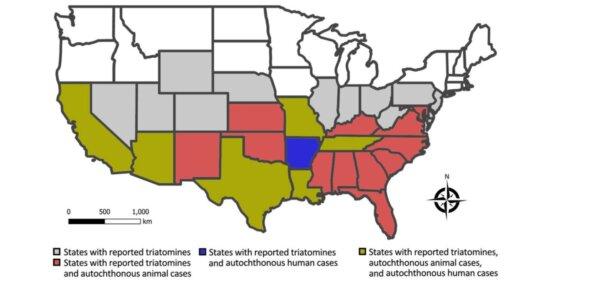
A map released by the CDC, cited in the September paper, shows that the insects have been found—without any reports of Chagas disease cases in animals or people—in Nevada, Utah, Wyoming, Colorado, Nebraska, Illinois, Indiana, Ohio, West Virginia, Pennsylvania, New Jersey, and Delaware.States that have been found to have local transmission of animal and human cases of Chagas disease and kissing bugs include California, Arizona, Texas, Louisiana, Missouri, and Tennessee, according to the map.
The map shows that states with cases of local transmission of Chagas in animals—not in people—as well as reports of kissing bugs include New Mexico, Oklahoma, Nebraska, Kentucky, Mississippi, Alabama, Georgia, Florida, South Carolina, North Carolina, Virginia, and Maryland.
Arkansas was the only state that had a report of a locally transmitted human Chagas case and kissing bugs, the CDC map shows. It means that so far, no local animal transmission of Chagas disease has been reported in Arkansas.
UCLA Says Disease ‘Can Be Deadly’
The World Health Organization estimates that about 7 million people worldwide, primarily in Latin America, have the parasite infection that causes the disease.According to the U.N. health body, Chagas disease can be “curable if antiparasitic treatment is initiated early, in the acute phase.” In its chronic stage, “treatment and follow up can potentially prevent or curb disease progression and prevent transmission, for instance, during pregnancy, and birth.”
Treatment Options
The CDC says Chagas disease can be treated with some antiparasitic medications, although that treatment tends to work best when started early.The medications include benznidazole, which the Food and Drug Administration has approved to specifically treat the disease, as well as nifurtimox, according to the agency.
But Joanna Schaenman, an infectious diseases physician and researcher who works with transplant patients, said in the UCLA statement that Chagas patients sometimes require a heart transplant, although some can also manage the condition with heart medication.
“Patients with Chagas disease as [the] cause of end-stage heart failure generally do very well after heart transplantation,” Schaenman said.
“And they can live a full and high-functioning life after the transplant.”