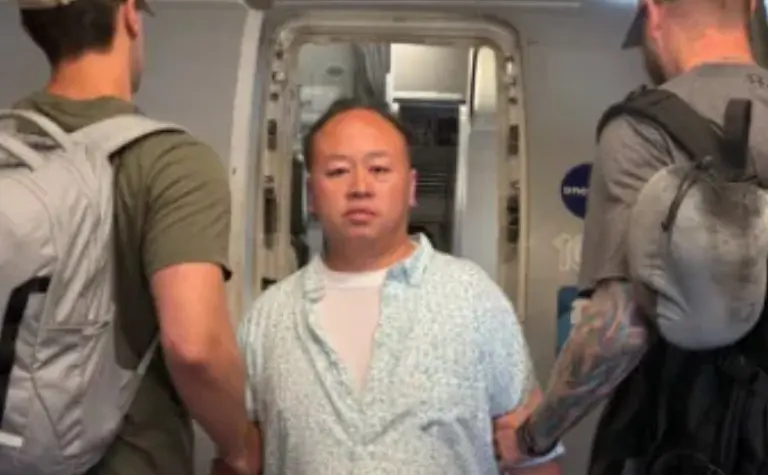
Border agents in Brownsville, Texas, apprehended a U.S. citizen with an outstanding warrant on suspicion of sexual assault on a child, U.S. Customs and Border Protection (CBP) exclusively told The Epoch Times on Monday.
The man, Bryan Eduardo Alcala, 20, was attempting to enter the country from Mexico on July 6 when he was caught and turned over to local authorities in Harlingen, Texas, where his warrant originated.
Port Director Tater Ortiz for the Brownsville Port of Entry credited border agents’ attention to detail not only for stopping human smuggling and drug trafficking attempts but also for arresting individuals suspected of violent crimes.
“Our CBP officers perform their duties with strict vigilance,” Ortiz said.
Alcala tried to enter the United States at the Brownsville and Matamoros International Bridge, where officers referred him for a secondary inspection.
During that additional screening, CBP said his identity was run against law enforcement databases, which revealed him to be the man wanted by the Harlingen Police Department in connection with sexual assault on a child.
The agency credited the National Crime and Information Center, a centralized and automated hub designed to share information among law enforcement agencies from all levels, for its success in identifying and arresting wanted individuals.
Information from this database has led to arrests for alleged crimes such as homicide, prison escape, money laundering, robbery, drug trafficking, child sex, fraud, theft, and even military desertion.

Early this year, CBP agents in Brownsville used the National Crime and Information Center for the arrest of a Mexican citizen. On Jan. 30, officers at the Gateway Bridge referred Luis Alberto Zarate Pegueros, 41, for a secondary inspection as he attempted to cross into the country through a pedestrian entry.
The National Crime and Information Center revealed he had an outstanding warrant for a sex-related offense involving a child in Hidalgo County, Texas.
CBP took him into custody and turned him over to U.S. Marshals and Hidalgo County sheriff’s deputies.
Sophisticated technology and the increased presence of agents on the ground focusing on enforcement, which stemmed from policy changes with the Trump administration, have led to the most secure border in U.S. history, CBP officials said.
Aside from the personnel and technology resources at ports of entry, what’s referred to by CBP as an “interview” is another layer of security.
“It could be a driver that nine times we saw him in a Versa, and then we see him in a Fiat,” San Ysidro Port Director Mariza Marin said. “‘Where’d you get this car?’ So the officers are trying to build that picture, and that’s part of the interview.”
By the time a traveler reaches an officer for the interview, agents already have a wealth of information on hand about the person’s history.
Asking simple questions that might appear as small talk is actually agents trying “to poke holes” in a story, San Diego Director of Field Operations Sidney Aki said, such as, “Why did you go to Mexico? Why are you coming to the United States? Whose car is this? Why are you bringing that?”