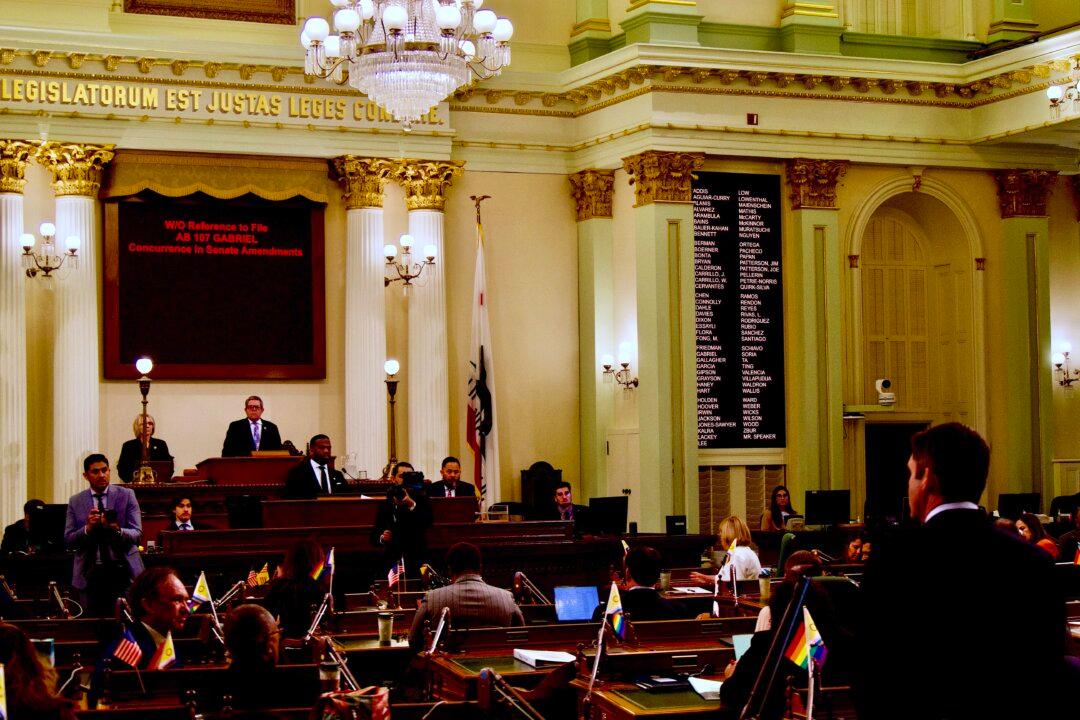
The California State Legislature has approved its $325 billion budget proposal, which is expected to be signed by Gov. Gavin Newsom by June 27, after additional potential negotiations between the governor and legislative leaders.
Funding for Medi-Cal, wildfire protection, and Proposition 36 were among some of the most highly debated items during the legislature’s budget discussion.
The budget proposal passed in both the state Senate and Assembly largely along party lines on June 13, reflecting differences in values and priorities, according to lawmakers. Both chambers are about 75 percent Democrat and 25 percent Republican.
“We teach our undergraduate students in budgeting that budgets are, at their core, a statement of our values and what we believe in and how,” state Sen. Christopher Cabaldon, a Democrat who represents Yolo, said before the Senate floor vote.
Assemblyman Jesse Gabriel, a Democrat who represents Encino and is chair of the Assembly Budget Committee, said ahead of the Assembly floor vote that the challenging budget negotiations were “guided by ... twin goals of compassion and fiscal responsibility.”
Medi-Cal for Illegal Immigrants
The Legislature’s version of the budget, or Senate Bill 101, seeks to tackle the $12 billion deficit in the governor’s proposal by scaling back spending cuts while increasing borrowing, with the spending cut reduced to $3.5 billion from the $5 billion proposed by Newsom in his May revision.SB 101, passed by the Legislature on June 13, includes the enrollment freeze but would reduce the monthly premiums to $30, and adults who are 60 years old or older would not need to pay the premium.
Democratic legislators said they were focused on showing compassion to the most vulnerable communities, such as illegal immigrants who they said contribute to California’s economy. At least one member said the current budget proposal would not be enough.
“Health care is a human right for all, regardless of immigration status,” Assemblyman Joaquin Arambula, a Democrat representing Fresno, said before the floor vote. He said he opposed the “two-tiered” system in Medi-Cal created by the budget proposals of both the governor and the Legislature.
Arambula said that, as a doctor, he had seen many illegal immigrants in emergency rooms “seeking care in the last moments” because they lacked regular and preventive medical care.
“It was providers like me who oftentimes had to have those hard conversations with family members,” he said.
Republican legislators said the current Medi-Cal system is not sustainable. The estimated cost of expansion in enrolling adult illegal immigrants in Medi-Cal jumped from a few billion dollars to more than $10 billion, they said.
“We simply cannot afford it,” Assembly Republican Leader James Gallagher said. “It is clearly not sustainable and not feasible.
Prop. 36 and Wildfire Protection
California voters passed Proposition 36 with more than 68 percent support in the November 2024 general election. The proposition increased penalties for certain drug and retail theft crimes and allowed “treatment-mandated felony” charges for certain individuals with two or more previous drug convictions.Republican legislators and some Democrat colleagues said the voters’ will should be honored and that more money is needed.
“It is a priority of Californians,” state Sen. Tony Strickland, a Republican who represents Huntington Beach, said during discussions.
He noted that Prop. 36 was a rare win in all the state’s 58 counties.
“[It] should have been the first thing funded, fully funded, [with ongoing funding],” he said.
Republican legislators presented amendment proposals to the budget, which included funding Prop. 36 with $400 million, allocating $500 million instead of $200 million for wildfire prevention, defunding California high-speed rail, and prioritizing low-income and senior California residents in Medi-Cal programs.
The amendments were voted down by the Legislature.
The California budget is expected to go into effect on July 1 if it is signed by the governor.