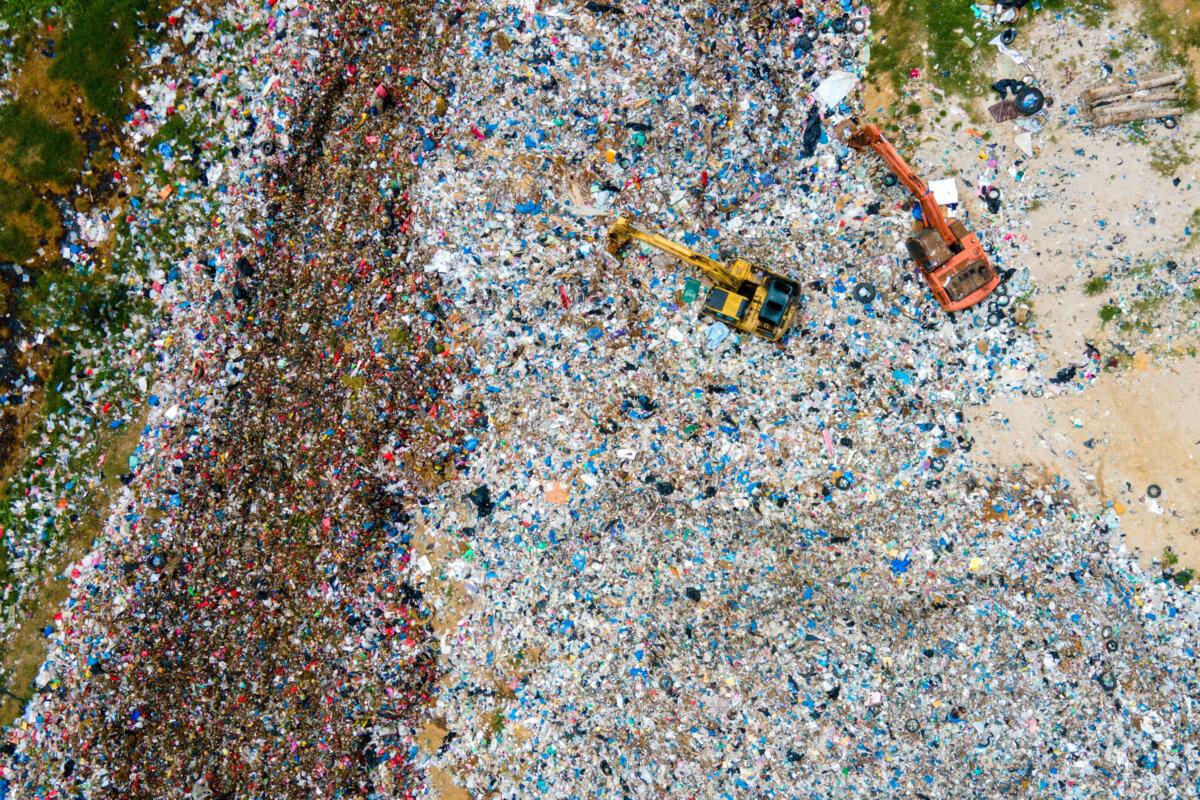
As tech firms continue rolling out their latest artificial intelligence (AI) systems, a mountain of old electronics is piling up behind the scenes. According to experts, the technology, with its frequent hardware upgrades and difficult-to-recycle components, is accelerating the world’s garbage crisis.
Researchers expect that number to rise by 32 percent and reach 82 million metric tons by 2030.
Generative AI, the technology that leverages large language models (LLMs) such as Claude and ChatGPT, is now adding to the growing volume of junked electronics.


And less-conservative projections suggest that the amount of AI-related e-waste will likely be even higher, given the rapid growth rate of LLMs.
Industry insiders said the scope of AI’s e-waste goes beyond the problem of proliferating garbage. It is a mountain of garbage chock-full of dangerous components such as toxic chemicals and industrial solvents.
“AI’s contribution to the e-waste crisis isn’t merely about hardware churn, but also about systemic design inefficiencies that need to be addressed,” Gaurav Shah, managing partner at Trident Renewables, told The Epoch Times.
Shah has worked with renewable energy, waste management, and circular economy investments across the United States. From his perspective, AI has a long way to go in terms of environmental sustainability.
“The rapid obsolescence of [graphics processing units] and [tensor processing units] reflects a deeper flaw in how the AI ecosystem measures progress,” Shah said.
“Performance per watt has replaced performance per life cycle as the optimization metric.
Rapid Turnover
Taras Demkovych, cofounder of Forbytes, said rapid hardware turnover is “a direct contributor” to the e-waste problem, especially for data centers running large AI models.“Hardware lifecycle management is often overlooked, exacerbating the e-waste problem,” he told The Epoch Times.
In his work with AI systems integration, Demkovych said frequent upgrades create surplus equipment that is rarely reused efficiently. Because of the intricacy of AI hardware components, breaking them down for reuse is a serious challenge.
“Advanced AI hardware is complex to dismantle due to multi-layer boards,” Demkovych said. “Many devices are designed for compactness, not recycling. Complexity leads to higher disposal costs and lower recycling rates.”
“These components become obsolete within 18 [months] to 24 months as models grow more demanding and vendors release more efficient hardware, which leads data centers and enterprises to retire devices en masse,” AI expert Darshan Mehta told The Epoch Times.
Mehta currently works as a product manager in applied AI at AT&T, and has also worked with digital infrastructure at Meta.
“It’s not just hardware obsolescence,” he said. “Other factors, including the proliferation of specialized cooling systems, power delivery modules, and proprietary firmware, further complicate recycling.”
Toxic Footprint
The challenge of recycling e-waste is about more than just tiny, difficult-to-break-down components. It is also about the amount of potentially hazardous materials that can be released in the dismantling process.Then there are the industrial solvents such as xylenes and Methyl Ethyl Ketone that are used to clean components within the sprawling network of specialized hardware, storage, and networking components—each one a maze of minuscule pieces—that supports the technology.
“Ultimately, both industry and government will need to prioritize circular design in the race for AI efficiency,” Mehta said. “Otherwise, gains in computing power will keep being overshadowed by environmental cost.”
Complicating the E-Waste Industry
Management of e-waste is already a fast-growing industry. With a market value of more than $76 billion in 2024, e-waste management is forecast to surpass $282 billion by 2033, according to global business intelligence firm Market Data Forecast.However, dismantling old AI components is more complicated than a lot of other e-waste, according to Mehta.
“Industry-grade AI hardware is far more complex than consumer electronics,” he said. “Systems often consist of densely packed circuit boards, diverse rare-earth materials, and soldered multi-layer components, making disassembly labor-intensive and costly.”
Mehta said proprietary designs and tightly integrated cooling contribute to low recycling yields.
Part of the Problem, Part of the Solution
Traditional recycling has been plagued with inefficiency and the danger of contamination, a potentially dangerous problem when dealing with e-waste components.Now AI itself is enhancing sorting accuracy and speed and optimizing logistics while advancing material recovery techniques.
“In e-waste processing, AI systems pinpoint valuable components for recovery, such as precious metals and rare earth elements in electronic devices,” Okon Recycling said. “This ability maximizes resource recovery from increasingly complex waste streams.”

Nonetheless, the volume of e-waste is rising five times faster than recycling efforts, according to the Global E-Waste Monitor. Demkovych said he believes that the growing demand for AI hardware is part of this problem.
“AI improves sorting efficiency and predictive maintenance, but the influx of new devices still outpaces recycling capabilities,” he said. “Technology alone cannot offset e-waste growth; policies and design changes are needed.”
Mehta concurred.
“AI has made real progress in recycling efficiency, with robotic systems now capable of sorting and separating e-waste faster and more accurately than manual approaches, while predictive maintenance extends equipment lifespans at some facilities,” he said.
However, Mehta noted that these gains still struggle to match the sheer volume and pace of AI-driven hardware turnover.
Shah said he believes that AI could revolutionize more than just recycling.
“I firmly believe if AI can optimize recycling logistics and predictive disassembly, why not use it to re-engineer its own supply chain?” he asked.
Throwing Away Money
Woven into AI’s expanding stream of e-waste are billions of dollars in metals.Valuable metals worth an estimated $91 billion were embedded in the world’s e-waste supply in 2022, according to the Global E-Waste Monitor. Within that number are roughly $19 billion in copper, $15 billion in gold, and $16 billion in iron.
Although cost is traditionally cited as a barrier to higher rates of e-waste recycling, the payout from mineral recovery might offset the initial upfront investment.
Traditional mining can source 5 grams to 10 grams of gold per metric ton; e-waste recycling can recover 1,000 grams to 3,000 grams of gold per metric ton.
The study’s authors stated that metal recovery using more advanced e-waste recycling technologies could save money in the long run. The cost of recovery per kilogram of gold ranges from $10,000 to $20,000, or from about $4,500 per pound to about $9,000 per pound.
That is a much lower price tag than the cost of $30,000 to $50,000 per kilogram—about $14,000 to $23,000 per pound—for the same ore using traditional mining methods.