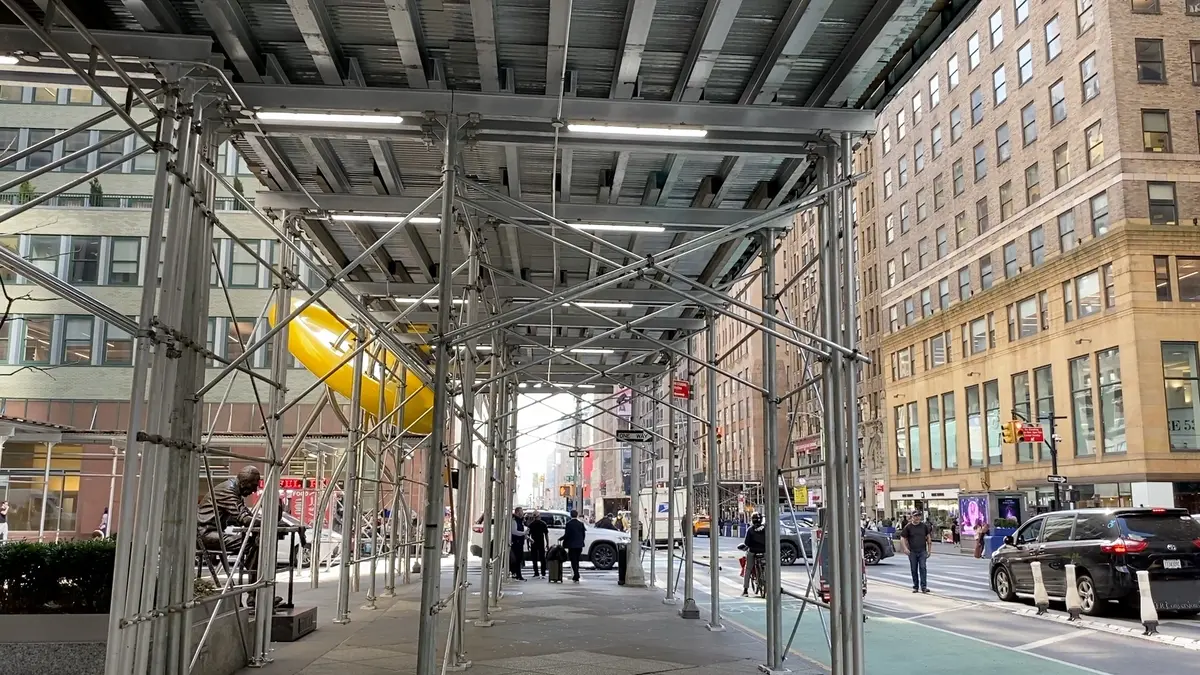
If you walk around New York City, you won’t be able to miss the structural support poles and painted plywood covering so many sidewalks. These structures, known as sidewalk sheds, are in place for renovation projects and to protect pedestrians from debris falling off buildings.
Now the city wants to shorten the time these sheds stay up, and new penalties officially go into effect Aug. 13.
“We should not accept darkened sidewalks and covered walkways as a fact of life,” said Mayor Zohran Mamdani as he announced the removal of sidewalk sheds at public housing development Highbridge Gardens on March 6.
There are currently more than 7,000 such sheds installed around New York City, with more than 600 that have been up for four years or more.
Securing financing to tackle these facade repair projects has been a major source of delay.
New York’s Aging Building Stock

During the city’s construction boom from 1910 to 1940, New York built more than 4,000 buildings six stories or taller. With so many buildings more than 80 years old, New York’s building stock requires upkeep. Many buildings were built with terracotta tiles, and when those tiles deteriorate and fall off, they can be deadly.
In May 1979, Barnard College freshman Grace Gold died when she was struck by a piece of terracotta that fell from a building on the Upper West side. The incident spurred the city to require property owners to inspect their exterior walls every five years and certify the facade is safe. Buildings six stories and taller are subject to the city’s Facade Inspection and Safety Program; across the five boroughs, that’s 17,000 buildings.
In May 2015, toddler Greta Greene died after she was struck in the head by a brick that fell from an eighth-floor window ledge. That case resulted in criminal charges against the engineer who filed an inspection report without having inspected the building.
Then on Dec. 17, 2019, architect Erica Tishman, 60, died when a piece of facade fell from a building in Midtown and struck her head.
After each death, the city’s Department of Buildings stepped up enforcement, erecting the sidewalk sheds on behalf of owners if city inspectors deemed conditions unsafe. Rules were updated in 2019, and any facades considered a potential hazard in the upcoming year would be tagged “unsafe,” requiring the sidewalk shed to be erected.
But the facade renovation projects haven’t been completed as fast as city officials would like.
Stricter permitting rules for the sheds passed in April 2025 under former Mayor Eric Adams’ “Get Sheds Down” initiative, shortening permits from 12 months to just 90 days. To renew the permit and keep the structure up, the owner must file a progress report. If repairs stall for six months, owners could face $6,000 a month in fines.
Building facades in New York have to be inspected every five years. If chunks of a building might fall, the sheds must be installed to protect the public. Even when there’s no danger, but repair is needed, owners must put up the sheds to protect the public.
Getting the Sheds Down
The new process will allow the city to police facade repair projects and perhaps speed them up since applicants to renew a shed must send in a progress report every 90 days.
For building owners, if a project gets stalled for lack of funding, fines and fees for progress reports to handle the quarterly renewal process could accumulate to thousands of dollars. Add on city citations for not making progress and fines could quickly exceed tens of thousands of dollars.
When repair is needed, projects often require one to two years to complete. Depending on the scope of the work, costs can be in the millions of dollars.
Many factors, such as weather and landmark permits, are beyond an owner’s control, said Gene Ferrara of JMA consultants. “It still takes you almost a year to get a job off the ground from the time you figure out you’ve got to do it. And that’s contracts, negotiations, specifications, bidding,” he told The Epoch Times.
Ferrara’s father founded JMA Project Management Consultants, an engineering firm serving the area since 1980. Building owners don’t want the sidewalk sheds in front of their buildings either, said Ferrara. “He doesn’t want it. It costs him money, costs him rental, costs him liability. It’s not that they want it up. There’s a reason why it’s up.”
Yet some sidewalk sheds have been up for more than a decade.
Costs to Business
Before the new law took effect in February, the owner of a building could install the shed, pay the $130 renewal fee once a year, and keep the shed up indefinitely. For some owners, that was the more affordable solution, Mike Lopez, a qualified exterior wall inspector and technical director at Rimkus, told The Epoch Times.
“If I pay a few thousand in penalties versus paying a few hundred thousand dollars in repairs, some may take the penalty,” said Lopez, a building inspector in New York for 15 years.
Under Mayor Adams the city filed criminal lawsuits against several owners to get them to repair their buildings and take the sheds down. In the past, no penalties would be imposed for taking up a public sidewalk with a shed.
According to Andrew Rudansky, spokesman for the Department of Buildings, the new fines are an important enforcement tool and the new rules allow “discretion to hold off on issuing penalties if the property owners can demonstrate that they are taking steps to make repairs, or they provide a valid reason for why they have not made progress.”
Ferrara said getting financing for such repairs can be difficult, and it’s the biggest cause of delays. “They don’t have the money,” he said. “If you’re clearing a profit of—or no profit as a landlord every year, and all of a sudden a $500,000 facade restoration project comes up, it ain’t going to be easy for him—banks are not going to loan him a lot of money on that real estate investment now in New York City.”
Charles Zsebedics, operations manager at Amalgamated Housing Cooperative in the Bronx, told The Epoch Times he sees the sidewalk sheds as a symptom of a larger problem: that maintaining a building facade requires a lot of money and financing options are limited.
Amalgamated has 13 buildings, four of which currently have sidewalk sheds. One building has had the sheds up for more than 10 years. Zsebedics said the annual cost to keep the shed up for a building is $100,000.
In 2014 a brick fell off one of his buildings, 80 Van Courtland Park South. Fortunately, the brick fell onto the grass and no one was hurt. Zsebedics said management immediately put up sidewalk sheds and contacted their architect. The sheds went up and stayed up as Amalgamated raised enough money for the facade renovation, which cost nearly $3 million.
He said repairs were completed in 2021 and they filed a report with the Department of Buildings saying that the facade was now safe. But during its inspection of the building the department found hairline cracks in brick or mortar. Zsebedics said they were not hazardous. After negotiating with the department for seven months, Amalgamated was not permitted to file their facade as safe and the sidewalk sheds had to remain in place. More than 10 years later, the sheds are still up.
What makes Amalgamated unique is that it is one of the oldest affordable housing cooperatives in the state, approaching its 100-year anniversary. The buildings have decades of deferred maintenance, said Zsebedics.
Do Other Cities Have Sheds ?
Philadelphia, Boston, Chicago, San Francisco, and other U.S. cities also inspect building exteriors to protect the public. But in other cities, a reported repair project won’t automatically trigger installing protective structures.
In New York, when an inspector finds a building facade needs repair within the next year, if that is not repaired by the next reporting cycle (five years later) the condition is automatically classified as “unsafe” and a sidewalk shed must be installed.
Other cities such as Chicago and San Francisco give more discretion to inspectors to evaluate if the facade is a danger to the public.