The Democratic Party has spent the past year winning elections without settling a basic question: what it wants to be.
Its voters keep giving split answers. In some places, they choose Democratic Socialists who vow to upend the system; in others, moderates who promise to steady it. Both keep winning.
And because the two tend to win in different kinds of districts—the left in safe, deep-blue seats, moderates in the purple and red places that decide majorities—the party has not had to choose between them. The factions rarely share a ballot, so the disagreement can stay theoretical.
That, strategists and elected officials across the party’s wings suggest, is much of why a reckoning over its direction has not yet arrived. It is coming. For now, geography is holding it off.
The contradiction was on display on a single night last fall. On Nov. 4, 2025, Zohran Mamdani, a Democratic Socialist, was elected mayor of New York City, months after defeating former Gov. Andrew Cuomo in the Democratic primary and again in the general election after Cuomo ran as an independent.
His rise in the country’s largest city—after years of gains by progressives and Democratic Socialists such as Sen. Bernie Sanders (I-Vt.) and Rep. Alexandria Ocasio-Cortez (D-N.Y.)—was read by many as proof the party was moving left.

The same night offered a more complicated picture. In Virginia and New Jersey, two Democrats who ran as moderates—Abigail Spanberger and Mikie Sherrill—won governorships, Spanberger flipping Virginia from Republican control and Sherrill keeping New Jersey in Democratic hands. Both campaigned on the cost of living. Two kinds of Democrats won at once, from opposite ends of the party, and neither had to answer for the other.
That tension has sat near the center of Democratic politics since. Primaries in Maine and New York in recent weeks sharpened it. On June 23, it broke fully into the open.
The morning after three insurgents tore through New York City’s Democratic primaries, the party’s third-ranking House leader stood at a podium in Washington and tried to wave the whole thing away.
“Nothing that the mayor did helps or hurts us,” Rep. Pete Aguilar (D-Calif.) said of Mamdani, whose endorsed candidates had just unseated two sitting members of Congress. The races that decide the House majority, Aguilar said, are somewhere else. It was the geographic argument in miniature: the left’s wins came in places that do not determine control, so leadership could set them aside.
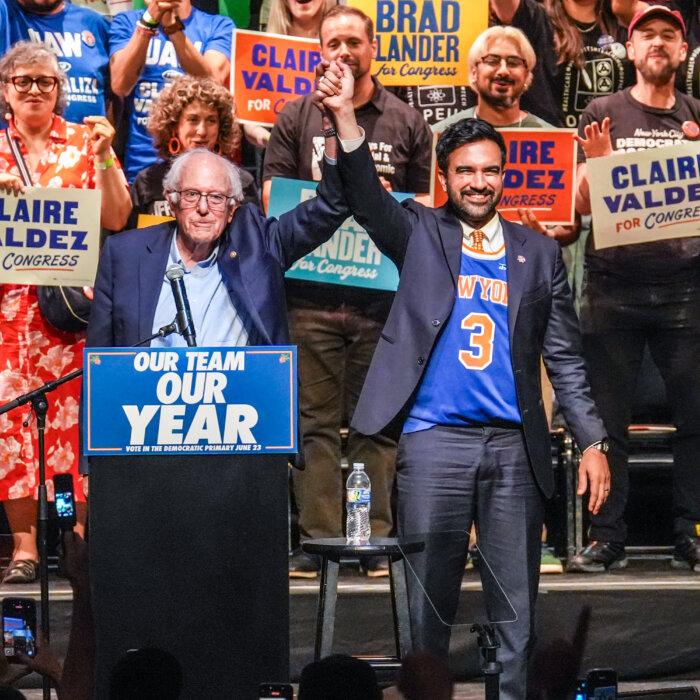
His party did not set them aside. On June 23, Brad Lander defeated Rep. Dan Goldman (D-N.Y.) in Manhattan, first-time candidate Darializa Avila Chevalier edged Rep. Adriano Espaillat (D-N.Y.) by about 2,000 votes in a district spanning upper Manhattan and the Bronx, and Claire Valdez claimed an open seat in Queens.
All three had Mamdani’s backing, and all three ran to the left of the Democrats they beat. Two identify as Democratic Socialists; Lander has aligned with the movement. The race in Espaillat’s district turned partly on Israel, with Avila Chevalier attacking the incumbent for accepting donations from the pro-Israel group AIPAC. Lander has also been critical of Israel while being Jewish himself.
Within hours, the results set off an unusually public argument among Democrats—not only over what they mean, but over whether the people who won belong in the party at all. Some strategists argued the night revealed something other than a simple leftward turn.
Not What It Looks Like?
To some who study the party, the leftward reading misses the point.Alyssa Batchelor-Causey, a Democratic strategist who has taught American politics, said the night belonged to “the more progressive wing,” driven by voters who want “conviction” and “lived experience.” But the idea that the party is marching left gets the direction backward, she argued: The party has barely moved, while the political conversation has slid rightward.
Adin Lenchner, a Democratic strategist and partner at the firm Carroll Street Campaigns, said anyone seeking one clean lesson “is also going to be at a bit of a loss,” noting that New York Democrats nominated candidates of sharply different stripes on the same night.
What ties the winners together, he and Batchelor-Causey argued, is not ideology but authenticity—whether voters believe a candidate means what they say. “Authenticity is enormous,” Lenchner said, especially for younger voters raised online. The same anti-establishment energy, he said, runs beneath figures as different as Mamdani, Maine Senate candidate Graham Platner, and Sen. Jon Ossoff (D-Ga.).
‘The Dirtbag Left’
Other Democrats heard the same results and sounded an alarm.James Carville, the veteran strategist, went further, raising on his “Politics War Room” podcast what he called “the S word, schism.”
Reading a New York Times report that Avila Chevalier had criticized interracial relationships and the American flag aloud, Carville said, “Lady, I ain’t the same party as you.”
Chevalier has apologized for some prior remarks, including a disparaging comment about former Vice President Kamala Harris, saying she does not talk about things in the same way as she once did.
Some on the left, Carville argued, “do not like Democrats ... they wish Democrats poorly,” and he suggested the party negotiate “terms of a schism.” He said he was “done.” But he drew a careful line on Israel: He is “enthusiastic,” he said, about a party that questions the Israeli government’s policies, while adding, “I don’t want to be in a political party that denies the right of the State of Israel to exist.”
Jaime Harrison, who chaired the Democratic National Committee until 2025, framed his objection as loyalty, not ideology.
The electoral case came most sharply from Matt Bennett of the moderate Democratic think tank Third Way.
The districts Democrats need to flip averaged Trump+8, he said, “44 points to starboard of those DSA strongholds.” The wins, Bennett argued, “were a big gift to the Republicans,” and the left’s positions could be “weaponized” against swing-district Democrats the way “defund the police” once was. “Democrats will win the majority in November,” he wrote, “but they will win in tough red and purple places DESPITE—not because of—the DSA.”
‘Our Candidates Run as Democrats’
The candidates and their allies rejected the charge that they are interlopers.Gustavo Gordillo, a co-chair of the New York City Democratic Socialists of America, said on NY1 that the group’s candidates “run as Democrats,” appear “on the Democratic Party ballot line,” and join the Democratic caucus once elected.
The disagreement, he said, is with how the establishment “organizes or runs its party apparatus.” He cast the divide in economic terms: The party is “funded by billionaire donors” while claiming to “represent the working class,” and “you have to choose between the billionaire class and the working class.”
Mamdani said on election night: “It’s not just a question of electing more Democrats,” he said. “It’s a question of electing better Democrats.”
A Reckoning Deferred
Party leaders kept their focus on November. Aguilar, the California congressman, pointed to competitive districts, not the safe seats the left won, as the battleground for control. Rep. Suzan DelBene (D-Wash.), who runs House Democrats’ campaign arm, referenced a recent Washington Post analysis of turnout, saying Democratic primary voters had outnumbered Republican turnout so far in the midterm cycle.The fight is unfolding as the party’s old guard leaves the stage. Reps. Nancy Pelosi (D-Calif.), Steny Hoyer (D-Md.), and Jerry Nadler (D-N.Y.), along with Senate Democratic Whip Dick Durbin (D-Ill.), are among the senior members not seeking reelection—part of one of the largest waves of congressional retirements in decades.
Batchelor-Causey doubts they are simply bowing out gracefully; she suspects internal pressure, while noting the reasons are personal and that many older members are “really hanging on.”
How the argument resolves will not be clear for years. The party’s factions can hold their separate ground through a midterm—the left winning safe city seats, moderates winning swing districts—without ever sharing a ballot.
Two things would force the question: governing together, if Democrats retake the House, and the 2028 presidential primary, when the party must choose a single national standard-bearer.
Bennett has already pledged the centrist case for that fight. Carville wants to negotiate terms before it. Batchelor-Causey, who calls coalition disagreement “a feature, not a bug” of democracy, said only that “a moment is coming.”
The same tension that surfaced the night Mamdani and two moderate governors won together has not eased in the months since. Whether the party holds its factions together—or whether Carville’s schism arrives—will come into focus if Democrats gain a governing majority in this year’s midterms or the debate stretches to 2028.
Third Way, the Democratic National Committee, and Chevalier’s campaign did not respond to multiple requests for comment.