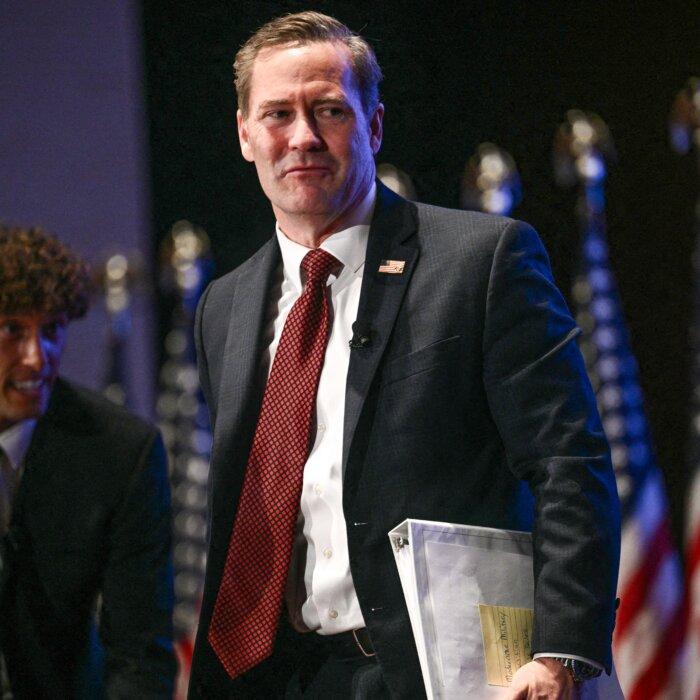
Mike Waltz, former national security adviser to President Donald Trump, faced a tough confirmation hearing before the Senate Foreign Relations Committee on July 15 for his nomination as United Nations (U.N.) ambassador.
He fielded questions about his responsibility in adding a journalist to a sensitive military phone chat group and vowed to protect American sovereignty at the U.N.
Waltz, who served three terms in Congress before Trump tapped him to be national security adviser, left that role in May after lawmakers scrutinized him for inadvertently adding a journalist from The Atlantic to a Signal chat group discussing a U.S. military strike on Houthi terrorists in Yemen.
During Waltz’s confirmation hearing on July 15, he vowed to combat the Chinese Communist Party’s (CCP) influence at the U.N. and make the international body “great again” by protecting American sovereignty if confirmed.
He also fielded tense questions about his role in the Signal controversy and reports that he is still on the White House payroll, as of July 1.
1. Vows to Make ‘UN Great Again’
In his opening statement, Waltz said he would advance Trump’s agenda at the world body and “make the U.N. great again.”This would involve advancing America’s sovereignty, which Waltz said “will always be first and foremost” among the United States’ ambitions whenever engaging with international organizations like the U.N.
He said he would weigh the “pros and cons” of which organizations the United States should engage with, and to make sure U.S. taxpayer money isn’t being inappropriately used, such as when the World Bank made concessionary loans to China.
Waltz also pointed out that the United States overwhelmingly pays more to fund the U.N. than any other nation, offering more than the combined contributions of 183 other member states.
2. Still on White House Payroll
Sen. Jacky Rosen (D-Nev.) challenged Waltz on his desire to protect taxpayer money and root out waste at the U.N., pointing to the White House’s July 1 annual report to Congress on staff salaries.According to the report, Waltz is listed as receiving an annual salary of $195,000 under the position “adviser,” despite having left his official role a month prior. Rosen asked Waltz if he’s been receiving a salary since “being let go” as national security adviser.
Waltz called the reports that he was “let go” or fired by Trump “fake news,” and confirmed being on the White House payroll as an “adviser” helping with “transitioning a number of important activities.”
Sen. Chris Murphy (D-Conn.) mentioned that Houthi terrorists, sponsored by the Iranian regime, have resumed attacks on shipping lanes in the Red Sea and offensive operations against Israel.
Murphy, who said stopping Houthi attacks was used as a pretext, asked Waltz how he views the Trump administration’s strikes on Iran’s nuclear sites.
3. Opposing CCP Influence at UN
Sen. Mike Lee (R-Utah) celebrated Waltz’s role on the House’s China Task Force, where he produced hundreds of recommendations for “managing the delicate relationship between the United States and China,” the senator said.Sen. Jeanne Shaheen (D-N.H.) emphasized the need to keep the United States “at the [U.N.’s] table” because “China will be writing the rules” if America allows the nation to be the U.N.’s largest peacekeeping and financial contributor.
“They continue making long-term investments at the United Nations and international organizations, not only through contributions, but by placing more Chinese nationals in key roles,” she said.
Waltz said it’s “absurd that the world’s second largest economy is treated as a developing nation in most U.N. agencies that give China favorable status.”
He said China pushes its personnel into all levels at the U.N. and said U.S. leadership is essential at the international body.
4. Loss of Funding Used to Oppose China
Shaheen said that while some may not like what certain U.N. institutions do, if America does not remain committed to the body, China will take advantage of U.S. “disengagement.”She pointed out that some of the programs and agencies that the Trump administration has moved to cut or dismantle, including the U.S. Agency for International Development (USAID), were working to combat CCP influence.
“Within months, China has moved into so many of those foreign assistance programs that have been shut down that had been operating for years,” she said. “We have packed up our bags and gone home, and China’s there.”
Shaheen asked Waltz what he would do to ensure the United States would still be opposing the CCP at the U.N. after the Trump administration outlined a series of cuts to the body and its sub-agencies.
5. Faces Critics From Both Sides
While it has been months since Waltz accidentally added a journalist to a sensitive Signal chat group discussing military plans on Houthis in Yemen, the topic came up on Tuesday.Sen. Chris Coons (D-Del.) criticized Waltz for using Signal, an end-to-end encryption messaging app, to discuss “sensitive information about a U.S. military operation against the Houthis” among himself and other top administration officials.
Waltz said the Biden administration approved Signal as a tool to encrypt some government communications, which was followed by a tense back-and-forth with Coons over whether what was inadvertently shared with the journalist amounted to “demonstrably sensitive information” about U.S. attack plans.
Waltz denied that any classified information was shared.
Sen. Tim Kaine (D-Va.) pointed out that the Defense Department has opened two ongoing investigations and has yet to reach “the conclusion that no classified information [was] shared.”
Democrats were not the only source of scrutiny during Waltz’s hearing.
One of his past votes in Congress became an inflection point for Sen. Rand Paul (R-Ky.).
Paul said that Waltz was serving on the Armed Services Committee when Trump announced his intention to draw down troops in Afghanistan in 2020.
At the time, Rep. Jason Crow (D-Colo.) and former Rep. Liz Cheney (R-Wyo.) introduced an amendment that “attempted to circumscribe [Trump’s] power to assign troops,” and Waltz supported it, Paul said.
The senator said he worries that Waltz comes “more from the Liz Cheney wing of the [Republican] party than the Donald Trump wing of the party” if he wants to limit the president’s powers to end a war.
Waltz said he would have to look at the amendment again, but emphasized he is “squarely with the president,” and vowed to keep the United States out of wars if confirmed as U.N. ambassador.