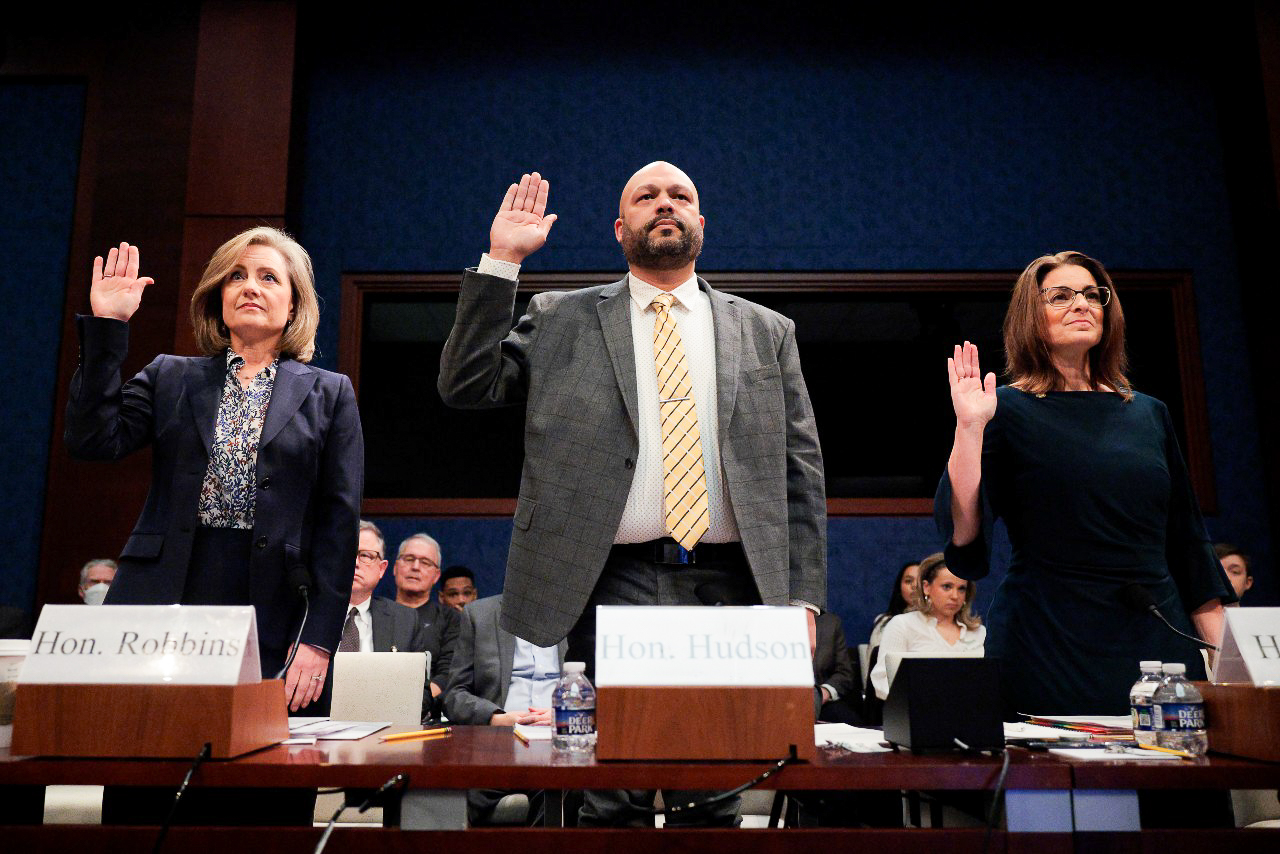

Minnesota’s multibillion-dollar fraud scandals sparked spirited exchanges before a congressional committee on Jan. 7 in the first of two hearings that the U.S. House Committee on Oversight and Government Reform has set on the topic.
During a session that spanned nearly five hours, several shouting matches erupted, sometimes involving witnesses who pushed back at lawmakers. At times, Rep. James Comer (R-Ky.), the committee chairman, called members out of order, pounded his gavel, and called for decorum.
“This isn’t just a Minnesota problem,” Comer said in his opening remarks, noting that about 35 percent of that state’s budget comes from federal grants.
“Hard-working Americans pay those taxes, and that money is being funneled to fraudsters, funding luxury homes, fancy cars, and vacations abroad,“ he said. ”Some of it is even allegedly going overseas to support terrorists.”
A trio of Republican Minnesota lawmakers who have been combating fraud for years—Reps. Kristin Robbins, Walter Hudson, and Marion Rarick—testified at the hearing, along with a fourth witness, Brendan Ballou, a former federal prosecutor and native Minnesotan.
Minnesota Gov. Tim Walz and Attorney General Keith Ellison are scheduled to testify to the committee on Feb. 10. Both elected officials have defended their actions and denounced fraudsters.

Since 2022, nearly 100 people, mostly of Somali descent, have been charged in various Minnesota fraud schemes. Programs intended to provide meals, autism therapy, and housing assistance have been defrauded, authorities have said, leading to charges. Meanwhile, a major scandal is emerging over home health care, prosecutors announced after evidence was seized in mid-December.
National Discussion Misses Key Point
Hudson said the national conversation about fraud in Minnesota “has been fraught with distractions” about personalities and partisan politics.“My role here today is to cut through all of that and provide you with a clear picture of a culture which has developed over many years,” he said.
A well-documented lack of oversight for Minnesota’s generous benefit programs made it easy for people “to turn benefits into business,” Hudson said.
“[The state developed] a culture of profiting from government programs in perpetuity—not as a safety net, but as an industry,” he said.
Robbins said there is “sort of a ‘cottage industry’”: Consultants earn a living by helping people obtain benefits.
Although some of those efforts may be legal, they appear to be designed to take advantage of the system, the witnesses said.
Another aspect of the Minnesota culture, Robbins and Hudson testified, centers around protection of Somalis.
People who raised fraud suspicions about Somalis, who are black and Muslim, were threatened with lawsuits or labels such as “racist” and “Islamophobic.” Several Democrats on the House Oversight Committee stated that they felt that Somalis were being demonized; when they asked the trio of state lawmakers whether they thought that all Somalis were committing fraud, they unanimously answered, “no.”
Hudson said that in his opinion, allowing Somalis to profit from government programs was “politically beneficial to Democrats.”
“The Somali community is a huge constituency group, and we’ve had some tight races in Minnesota,” Hudson said, noting that Somali votes could spell the difference between victory and defeat.
Rep. Brad Finstad (R-Minn.) contributed another factor: His fellow Minnesotans believe in taking care of each other.
Whistleblowers Punished, Intimidated
More than 1,000 current and former state workers have banded together to communicate with each other and with members of the Minnesota House of Representatives anti-fraud committee, according to Rarick. She and Hudson are members of that committee, which Robbins heads.Many of the whistleblowers are connected to the Minnesota Department of Human Services (DHS), the state welfare agency.
Rarick testified that she has repeatedly communicated with the whistleblowers since the anti-fraud committee’s inception a year ago. Since then, the workers’ fears of retaliation have “intensified under an avalanche of fraud,” Rarick said.
“Their collective message has been completely consistent: Instead of focusing on fraudsters, DHS leadership instead focuses its surveillance on employees,” the state lawmaker testified.
After one whistleblower raised concerns, she faced a lengthy investigation, was escorted out of the building, and was transferred involuntarily to another state agency, according to Rarick.
Other employees have reported being threatened with being fired, “being blacklisted from all state agencies,” and receiving “a veiled threat of the use of military intelligence against them,” Rarick said. In one email, a senior DHS official allegedly told other leaders about using military-intelligence resources to track down whistleblowers’ exact locations, according to a statement read at the hearing.
A couple congressmen at the hearing raised the possibility that such actions, if proven, could constitute criminal conduct.
In addition, DHS allegedly used computer programs to scour “employees’ emails and chats and other communications, looking for key words like ‘fraud,’ ‘double billing,’ ... and ‘overpayments,’” Rarick testified.
Schemes Grew for at Least 10 Years
Robbins alleged that officials allowed fraud to persist in her state for many years, “in the face of countless whistleblower and auditory reports, as well as stories by local investigative journalists and the Center of the American Experiment.”The reports date back a decade or more and involve many types of fraud, she said.
Many Americans were unaware of Minnesota’s fraud problems until publicity began building late last year. After independent media outlets’ reports and a viral video by YouTuber Nick Shirley gained attention, federal officials took action. Shirley’s video showed child care centers without children in attendance, but the biggest fraud scandal documented thus far in Minnesota involves feeding needy children, not child care.
Feeding Our Future, a nonprofit in Minnesota, falsely claimed to serve millions of meals; dozens of people have been charged and convicted since 2022. Robbins said the total fraud in that case has reached about $310 million, as prosecutions continue.
In addition, investigators are scrutinizing 14 Minnesota Medicaid programs considered vulnerable to fraud, with $9 billion or more in fraudulent payments suspected, prosecutors have said. At one point, a federal prosecutor said there was enough fraud in Minnesota to keep 1,000 prosecutors busy, according to Hudson.
Some key events happened in 2019 after one whistleblower went public with allegations of child care fraud, Robbins said, citing documents from current whistleblowers.
“[Officials told DHS’s Office of Inspector General that] they could no longer do criminal investigations,” Robbins said. That office’s investigators were then forbidden from meeting with Bureau of Criminal Apprehension agents without a supervisor’s approval.
Terminology changed, too, she said.
“They went from calling it ‘fraud’ to calling it ‘overbilling,’ and they created an ‘overbilling committee’ ... to decide if any of that overbilling would be recouped,” Robbins said.
Based on what he was hearing from witnesses at the hearing, Rep. Jim Jordan (R-Ohio) said it seemed to him that Minnesota leaders did not just “ignore” fraud.
“I think it’s worse than that,” he said. “I think they helped it along.”
The problems have been allowed to worsen for too long, Robbins said, noting, “The time for justice and accountability is now.”
Rep. Tim Burchett (R-Tenn.) agreed.
Big Fraud in Other States, Too
Rep. Robert Garcia (D-Calif.), who leads House Oversight Democrats, said: “I think everyone on both sides of the aisle can agree that fraud is a threat—at every level of government, in every private sector business, and to every single American. Fraud exists everywhere.”“When we find fraud, we should punish people, and those that are committing it against the American public, especially when it damages services that people rely on,” he said. “Now, what we should not do is use fraud as an excuse to rip away aid from innocent people who follow the rules and need help in our society.”
Garcia and other Democrats said President Donald Trump’s fraud crackdown efforts seem to be limited to Minnesota and other Democrat-controlled states, even though large-scale fraud has also been identified in Republican-dominant states such as Mississippi.
A Mississippi scandal, which broke in 2023, centers around allegations that $77 million in federal welfare funds went to rich and powerful people rather than benefiting the poor.
Several Republican lawmakers responded that they want to attack fraud in any state where it occurs, regardless of political leanings. They also noted that Republicans advanced the Department of Government Efficiency’s efforts to root out waste, fraud, and abuse of government funds, which Democrats largely opposed.
Rep. Ro Khanna (D-Calif.) called for an audit of all 50 states “to make sure government money is spent wisely.”