The Department of Energy (DOE) plans to invest up to $100 million to strengthen the United States’ critical minerals workforce and domestic supply chains.
Currently, there are “significant workforce shortages” in the country across the critical minerals and materials supply chain, the department said in an Aug. 7 statement. The DOE estimates the country will need roughly 6,000 new engineers in the next decade solely in the mining sector.
The $100 million funding will support the Providing Opportunities for Specialized Education in Critical Technologies (PROSPECT) initiative that seeks to “expand educational opportunities and develop the skilled workforce needed to support the domestic production, processing, recovery, and recycling of critical minerals,” DOE said.
Launched by the DOE’s Office of Critical Minerals and Energy Innovation, PROSPECT’s near-term goal is to double the number of U.S. graduates with degrees related to minerals, mining, and relevant supply chain technologies within a two-year period.
Over the long term, the program will support implementing new curriculum, financial programs, teaching tools, and other incentives to ensure continued workforce growth in the critical minerals sector.
Critical minerals are essential for economic stability, national security, and supply chain resilience since they are the basis of several key industries and critical infrastructure.
According to a November 2025 Federal Register notice, 60 minerals have been identified as critical, including aluminum, arsenic, boron, chromium, cobalt, copper, graphite, iridium, manganese, neodymium, nickel, rhodium, silicon, silver, tungsten, uranium, vanadium, and zirconium.
Critical minerals and materials are used for various applications, including batteries, nuclear energy, solar cells, magnets and motors, semiconductors, steel production, alloys for aerospace and defense, general electronics, and lasers.
According to the DOE, since 2015, enrollment in mining education programs in the country has crashed by roughly 45 percent. Shortfalls in mining, materials science, and recycling have enabled foreign workforces to outpace the United States in every stage of the supply chain.
In its recent statement, the DOE said PROSPECT will help train the next generation of American workers needed to secure the United States’ mineral and energy independence.
“A strong domestic mining and minerals workforce is essential to powering America’s future, strengthening our national security, and ending our dependence on foreign adversaries for the materials that underpin modern energy, manufacturing, and defense,” Secretary of Energy Chris Wright said in the statement.
More Investments
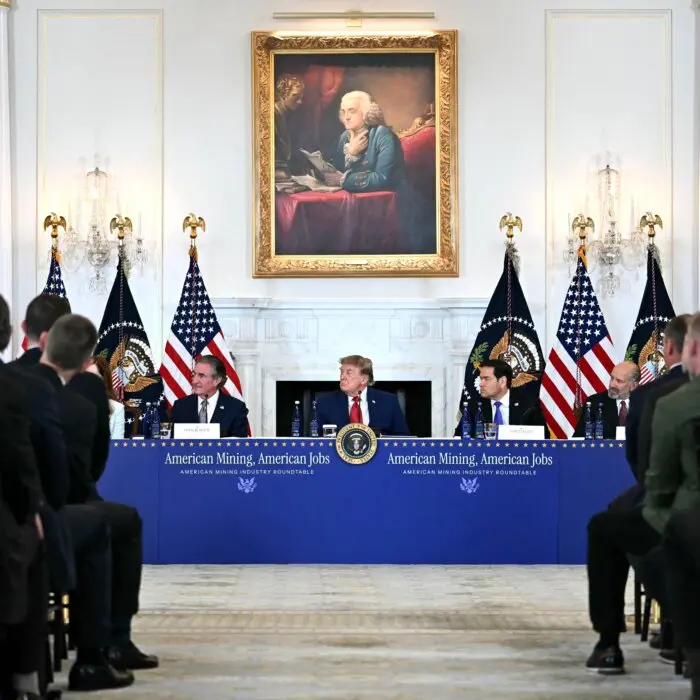
Out of the $180 million funding, $80 million will be provided by the military to three universities for workforce and technology development programs—Colorado School of Mines, the South Dakota School of Mines, and Johns Hopkins University.
Trump warned at the meeting that “half of our current mining workforce is set to retire within the next three years.”
In addition, the president also announced almost $2 billion in investments in mining. This includes a $1.4 billion loan to Sila Nanotechnologies to construct a battery facility in Washington State, a potential loan of over $1 billion to Ivanhoe Electric’s Santa Cruz Copper Project in Arizona, and a $400 million investment in Sunrise Energy Metals to manufacture high-heat aluminum alloys for spacecraft and fighter jets.
“We’re putting our miners back to work, and we’re reclaiming America’s rightful place as the minerals superpower of the world,” Trump said.
According to an Aug. 7 White House fact sheet, since January 2025, the Trump administration has approved or signed 160 minerals deals worth around $40 billion.
In addition, Trump has used Section 232 of the Trade Expansion Act of 1962 to protect domestic manufacturing, including instituting tariffs and negotiating with trading partners on a wide range of goods, such as critical minerals.
“These actions strengthen these essential U.S. industries and the U.S. industrial base, ensure domestic producers and workers can compete on a level playing field, protect American jobs, and bolster American national security,” the White House stated.