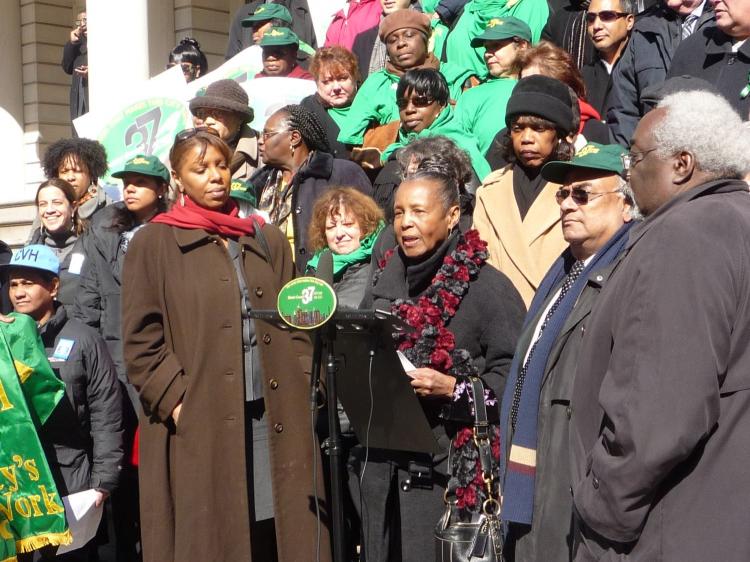
NEW YORK—Members of New York City’s largest union of public employees, District Council 37, gathered in front of City Hall Wednesday to issue a report saying the City government spends too much in private contracts.
They say that not only are private employees more expensive to hire, but they are not subject to rules and regulations that City employees must adhere to. On the job, these contract workers look no different from city employees but they are paid more.
DC37 executive director Lillian Roberts calls them the “shadow government,” which she defines as “a parallel work force of mare than 100,000 employees hired without the merit and fitness examinations and background checks that the city requires for civil service workers.”
DC37 represents 125,000 New York City public employees who serve in a variety of industries. They work in hospitals, libraries, museums, transportation, schools. Their average salary is $31,000 and most of them reside in the city, according to union statistics.
The union’s findings are detailed in the report titled “Massive Waste at a Time of Need.” Report authors say that the City could narrow its $4 billion budget gap by hiring more public employees to do the work it has been contracting out. Private contracts cost the City over $9 billion for over 18,000 contracts in fiscal year 2009, which is up 37% from 2005, according to City budget figures.
The report compared private contract costs incurred by eight different City agencies to what it would cost if those contracts were awarded to public employees. For example, the report found that the Department of Transportation could save $2.9 million by having public employees install street signs.
Aside from making the most of the taxpayer’s dollar, relying more on public employees ensure more accountability, union members say. Thomas Eppinger, president of the Uniformed Emergency Medical Services Officers Union, says certain details fall through the cracks when companies associated with private hospitals are in charge of running a percentage of the Fire Department’s ambulances.
“Sometimes they pick up a patient and send them to their (private) hospital without asking where they want to be taken,” Eppinger said. He added that when a private hospital closes, their ambulance service ends too, forcing the FDNY to spread its resources thinner to cover the areas previously served by the contractor. “It’s essentially a reduction of service, but they’re not required to tell the council,” Eppinger said.
Judith Arroyo, president of the United Federation of Nurses and Epidemiologists, has seen the increase of private nurses in public schools in recent years. “It started with Giuliani and the nursing shortage,” Arroyo said. “But no one is monitoring the quality of care of contracted nurses. We have no personnel files and no idea if they have pending charges up in Albany.” Public employees have supervisors who must report to the Office of School Health and the Department of Health and Mental Hygiene.
When demand for labor is great, the competition among workers is high. Many unionized workers have fled to higher paying jobs with private companies, which weakens the union’s bargaining power.
DC37’s full report is available at http://www.dc37.net
They say that not only are private employees more expensive to hire, but they are not subject to rules and regulations that City employees must adhere to. On the job, these contract workers look no different from city employees but they are paid more.
DC37 executive director Lillian Roberts calls them the “shadow government,” which she defines as “a parallel work force of mare than 100,000 employees hired without the merit and fitness examinations and background checks that the city requires for civil service workers.”
DC37 represents 125,000 New York City public employees who serve in a variety of industries. They work in hospitals, libraries, museums, transportation, schools. Their average salary is $31,000 and most of them reside in the city, according to union statistics.
The union’s findings are detailed in the report titled “Massive Waste at a Time of Need.” Report authors say that the City could narrow its $4 billion budget gap by hiring more public employees to do the work it has been contracting out. Private contracts cost the City over $9 billion for over 18,000 contracts in fiscal year 2009, which is up 37% from 2005, according to City budget figures.
The report compared private contract costs incurred by eight different City agencies to what it would cost if those contracts were awarded to public employees. For example, the report found that the Department of Transportation could save $2.9 million by having public employees install street signs.
Aside from making the most of the taxpayer’s dollar, relying more on public employees ensure more accountability, union members say. Thomas Eppinger, president of the Uniformed Emergency Medical Services Officers Union, says certain details fall through the cracks when companies associated with private hospitals are in charge of running a percentage of the Fire Department’s ambulances.
“Sometimes they pick up a patient and send them to their (private) hospital without asking where they want to be taken,” Eppinger said. He added that when a private hospital closes, their ambulance service ends too, forcing the FDNY to spread its resources thinner to cover the areas previously served by the contractor. “It’s essentially a reduction of service, but they’re not required to tell the council,” Eppinger said.
Judith Arroyo, president of the United Federation of Nurses and Epidemiologists, has seen the increase of private nurses in public schools in recent years. “It started with Giuliani and the nursing shortage,” Arroyo said. “But no one is monitoring the quality of care of contracted nurses. We have no personnel files and no idea if they have pending charges up in Albany.” Public employees have supervisors who must report to the Office of School Health and the Department of Health and Mental Hygiene.
When demand for labor is great, the competition among workers is high. Many unionized workers have fled to higher paying jobs with private companies, which weakens the union’s bargaining power.
DC37’s full report is available at http://www.dc37.net