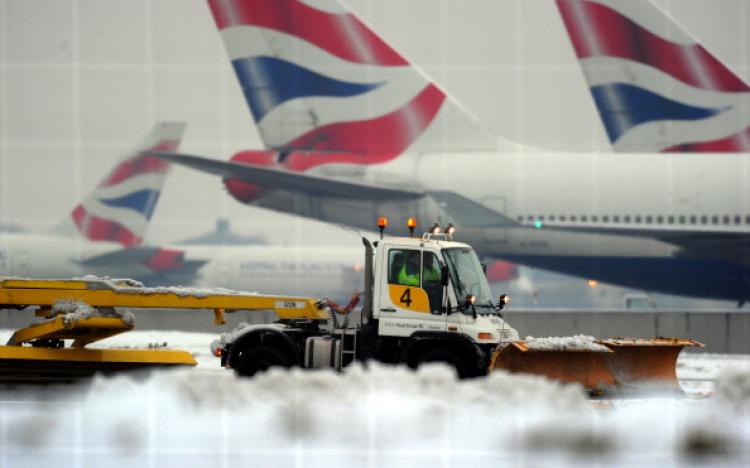
Recent heavy snow and extreme weather conditions have grounded Britain and northern Europe during one of the highest peak seasons for travel this year, prompting authorities to consider new laws to fine operators for excessive disruption and inadequate planning.
The British Transport Secretary Philip Hammond said that new parliamentary legislation would be introduced that would fine airports for “service failure.” He advocated that there would be a heavy-handed approach given that Britain experienced the heaviest snowfall since 1981 in December, which resulted in the nation’s busiest airport, Heathrow International, shutting down and abandoning 2,000 passengers in cold terminal buildings.
The key concern is about the excessive delay in reopening the airport, and he named operators like the country’s flagship airline British Airways for not having contingency plans or being more responsive regarding rescheduling flights given the heavy snowfall.
Moreover, the prediction of the poor weather conditions for travel also highlighted the poor responsiveness of the airport’s facilities and operations.
The British Aviation Minister Theresa Villiers said in a statement, “Obviously we had been in touch with the airports urging them to be properly prepared for the winter weather. Next time they need to do better.”
According to the Telegraph, Heathrow had invested US$771,000 on snow clearing equipment in 2010. It was discovered that one of the world’s busiest airports had only 10 snowplows to clear the runways, whereas Gatwick Airport, which is less than half the size of Heathrow, had 14.
The snow excavation plan expected that just 0.8 inches of snow would be equivalent to 5,300 tons of snow resulting in the definition of a blizzard scenario and thus halting flights.
Based on the present rules, the Civil Aviation Authority (CAA) is only allowed to inflict financial penalties for incompetence in terms of passenger shortages with security checks, seating, and cleanliness. The maximum annual penalty is 7 percent of airport charges, which is an estimated total of $97 million.
Hammond said, “Because airports are ultimately strategic infrastructures, we probably need to have as a very last resort some powers to intervene in a way we don’t have at the moment, except where safety and security are concerned. We have got the vehicle in the airport regulation bill to take those powers.”
The limitation of the jurisdiction of the CAA was clearly revealed when Heathrow was not operational on the weekend of Dec. 18-19, and although it could impose the closure of airports, it did not have the ability to reopen them.
British Airways, through a spokesperson said, “We will of course play a full part in the government’s discussions about this year’s weather disruption and will make public the findings of our own independent investigation. We welcome legislation designed to improve the experience for passengers at the U.K.’s airports.”
Meanwhile, severe winter weather conditions are continually affecting various parts of the United States and hundreds of flights have been canceled, with the majority of the brunt focused on the East coast.
Most airlines are prepared to waive penalties for travelers to change their tickets, which will hit revenue bottom lines considering the volume of travel around this time of year is normally the highest. Canada has also been experiencing similar weather conditions.
The British Transport Secretary Philip Hammond said that new parliamentary legislation would be introduced that would fine airports for “service failure.” He advocated that there would be a heavy-handed approach given that Britain experienced the heaviest snowfall since 1981 in December, which resulted in the nation’s busiest airport, Heathrow International, shutting down and abandoning 2,000 passengers in cold terminal buildings.
The key concern is about the excessive delay in reopening the airport, and he named operators like the country’s flagship airline British Airways for not having contingency plans or being more responsive regarding rescheduling flights given the heavy snowfall.
Moreover, the prediction of the poor weather conditions for travel also highlighted the poor responsiveness of the airport’s facilities and operations.
The British Aviation Minister Theresa Villiers said in a statement, “Obviously we had been in touch with the airports urging them to be properly prepared for the winter weather. Next time they need to do better.”
According to the Telegraph, Heathrow had invested US$771,000 on snow clearing equipment in 2010. It was discovered that one of the world’s busiest airports had only 10 snowplows to clear the runways, whereas Gatwick Airport, which is less than half the size of Heathrow, had 14.
The snow excavation plan expected that just 0.8 inches of snow would be equivalent to 5,300 tons of snow resulting in the definition of a blizzard scenario and thus halting flights.
Based on the present rules, the Civil Aviation Authority (CAA) is only allowed to inflict financial penalties for incompetence in terms of passenger shortages with security checks, seating, and cleanliness. The maximum annual penalty is 7 percent of airport charges, which is an estimated total of $97 million.
Hammond said, “Because airports are ultimately strategic infrastructures, we probably need to have as a very last resort some powers to intervene in a way we don’t have at the moment, except where safety and security are concerned. We have got the vehicle in the airport regulation bill to take those powers.”
The limitation of the jurisdiction of the CAA was clearly revealed when Heathrow was not operational on the weekend of Dec. 18-19, and although it could impose the closure of airports, it did not have the ability to reopen them.
British Airways, through a spokesperson said, “We will of course play a full part in the government’s discussions about this year’s weather disruption and will make public the findings of our own independent investigation. We welcome legislation designed to improve the experience for passengers at the U.K.’s airports.”
Meanwhile, severe winter weather conditions are continually affecting various parts of the United States and hundreds of flights have been canceled, with the majority of the brunt focused on the East coast.
Most airlines are prepared to waive penalties for travelers to change their tickets, which will hit revenue bottom lines considering the volume of travel around this time of year is normally the highest. Canada has also been experiencing similar weather conditions.